As of 2026-04-30 UTC, Baidu's one-minute post about ERNIE-5.1-Preview looks like a standard arena-victory message on first pass. It says the model is No. 1 among Chinese models and No. 13 globally on the latest LMArena Text leaderboard, with additional category placements in math, legal and government, business and financial operations, and software and IT services.[1][2] But the sharper signal sits one sentence later. Baidu says ERNIE-5.1-Preview inherits the ERNIE 5.0 pre-training base while shrinking total parameters to roughly one-third, active parameters to roughly one-half, and pre-training cost to about 6% of comparable models at its scale.[1][2]
That changes how the release should be read. The headline is not merely "Baidu climbed another leaderboard." The real message is that Baidu is trying to extract a cheaper text-first operating lane from the giant ERNIE 5.0 foundation. The ranking claim supplies public validation; the compression numbers tell you what the company actually wants buyers and developers to remember.[1][2]
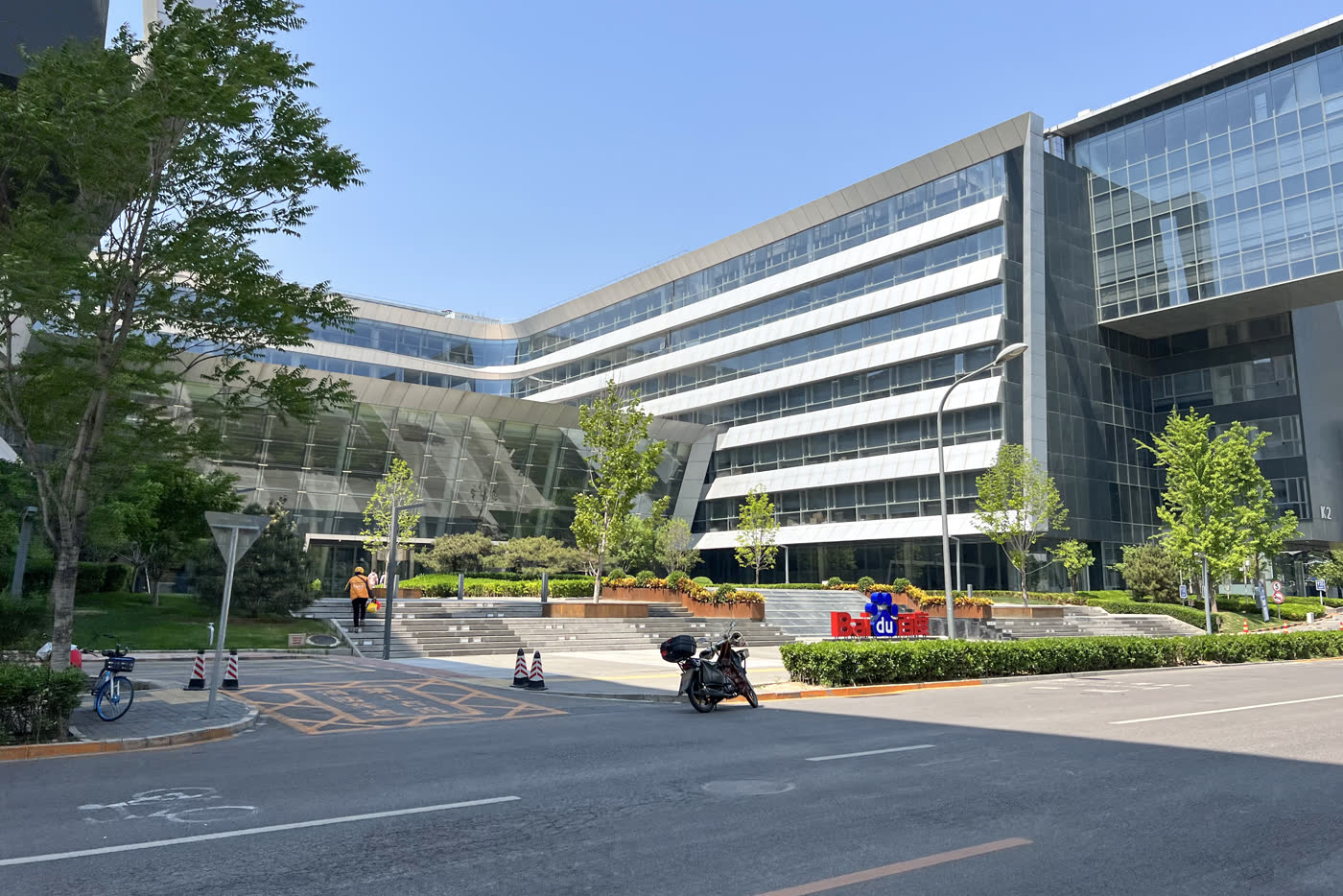
Image context: the cover uses a real Wikimedia Commons photograph of Baidu's ZPark Phase II campus in Beijing. It fits this article because the post is about product geometry and deployable shape, not a stylized AI visual. A real campus scene makes the institutional delivery story clearer.[7]
The ranking matters, but only inside the right evaluation boundary
LMArena is not meaningless, but it is also not a universal capability exam. The Arena paper describes the system as a pairwise human-preference evaluation platform rather than a controlled engineering benchmark for every production workflow.[6] That means ERNIE-5.1-Preview's text placement is useful as a signal about general response preference and category-specific writing performance, but it does not, by itself, prove superiority in long-horizon agents, tool use, coding pipelines, or multimodal tasks.[1][2][6]
This boundary is important because Baidu's announcement is extremely short. It gives the market-facing outputs first: overall text rank, category ranks, then the compression claim.[1][2] My inference is that Baidu knows a leaderboard screenshot travels faster than a systems paper, but it also knows the harder commercial problem in 2026 is not "can we demo a frontier model?" It is "can we make a model shape that people can afford to deploy repeatedly?" The rank is there to attract attention. The cost shape is there to make adoption legible.
ERNIE 5.0 is the real baseline, and that is what makes 5.1 interesting
The April 30 note only becomes meaningful when read against the February 6, 2026 ERNIE 5.0 materials. In those documents, Baidu described ERNIE 5.0 as a 2.4 trillion-parameter unified multimodal foundation model trained across text, image, video, and audio inside one autoregressive framework.[3][4][5] The company emphasized three architectural ideas in particular: a shared token space across modalities, modality-agnostic routing inside an ultra-sparse MoE design, and elastic training that allows a super-network to spawn multiple sub-configurations without retraining from scratch.[3][4][5]
That last point is the bridge to 5.1. If ERNIE 5.0 were only a giant multimodal prestige object, today's 5.1 note would sound like an awkward side release. Instead it sounds like the first public extraction of the efficiency logic Baidu had already promised. A model compressed to one-third of total parameters and half of active parameters is exactly the kind of downstream lane that an elastic, once-for-all training story was supposed to enable.[1][3][4][5]
So the useful way to read 5.1 is not "Baidu built a smaller good model." It is "Baidu is starting to monetize the deployment geometry of ERNIE 5.0." The giant multimodal base establishes capacity. The smaller preview tries to prove that the base can be cut into a text-first operating point that still holds up in public preference testing.[1][3][4][5]
The new training language shows where Baidu wants the next competition to sit
The April 30 post introduces two phrases that matter even though the company does not unpack them in detail there: decoupled fully-asynchronous reinforcement learning and scaled agentic post-training.[1][2] Those phrases are not random garnish. They signal where Baidu wants ERNIE-5.1-Preview to be understood: not only as a compressed pre-training artifact, but as a model specifically tuned for text reasoning, knowledge work, and creative or operational tasks that benefit from stronger post-training.
This also connects back to the 5.0 report. Baidu had already described a specialized RL pipeline for hard reasoning and agentic tool-use alignment, including replay-buffer and hint-based mechanisms meant to stabilize learning on sparse-reward tasks.[3][5] The 5.1 note looks like a public product-layer continuation of that work. My inference from the wording is that Baidu is shifting some of its public emphasis away from "look how unified our multimodal core is" and toward "look how efficiently we can turn that core into a usable text-and-agent model at lower cost."[1][3][5]
That is a sensible move. Multimodal ambition gave Baidu a frontier narrative in February.[3][4][5] But text reasoning, domain writing, and agentic post-training are the surfaces where enterprise usage and recurring workloads accumulate faster. A cheaper preview that still performs well in broad human-preference evaluation is easier to route into products than a maximal system whose value remains partly architectural and partly aspirational.[1][2][6]
What to watch after the announcement
Three follow-up questions matter more than the celebratory screenshot.
First, watch whether Baidu publishes a clearer deployment story around ERNIE-5.1-Preview rather than leaving it as a ranking note.[1][2] If the company exposes more about inference cost, latency envelopes, or product surfaces, then the compression-dividend thesis gets stronger.
Second, watch whether the new RL and agentic post-training language is followed by concrete demonstrations in coding, search, or tool-using workflows.[1][3][5] Without that second layer, the training claims remain interesting but abstract.
Third, keep the evaluation boundary clean. If future marketing keeps leaning on LMArena text placement alone, treat the signal as directional, not exhaustive.[6] If Baidu starts pairing the cheaper text lane with clearer agent and workload evidence, ERNIE-5.1-Preview becomes more than a one-day leaderboard story. It becomes the first visible proof that ERNIE 5.0's giant multimodal base can be carved into a commercially sharper operating shape.
Sources
- ERNIE Blog, "ERNIE-5.1-Preview Tops LMArena Text Leaderboard as No.1 Chinese Model!" (April 30, 2026).
- ERNIE Blog, "文心大模型5.1 Preview 荣登 LMArena 文本榜国内第一!" (Chinese first-hand release note, April 30, 2026).
- ERNIE Blog, "ERNIE 5.0: A 2.4 Trillion-Parameter Unified Multimodal Foundation Model" (February 6, 2026).
- ERNIE Blog, "文心 5.0 (ERNIE 5.0):2.4 万亿参数的原生全模态大模型" (Chinese first-hand technical release note, February 6, 2026).
- Haifeng Wang and colleagues, "ERNIE 5.0 Technical Report" (arXiv:2602.04705, submitted February 4, 2026).
- LMSYS Org and collaborators, "Chatbot Arena: An Open Platform for Evaluating LLMs by Human Preference" (arXiv:2403.04132).
- Wikimedia Commons, "File:Baidu Technology Park at ZPark Phase II (20220502113645).jpg" (source page for the cover photograph used in this article).