As of 2026-04-29 UTC, the sharpest way to read EvoCUA is not as one more open-source leaderboard jump in a crowded computer-use cycle. The stronger signal is that Meituan is treating GUI-agent progress as a synthetic-experience engine problem.[1][3] The public numbers still matter: Meituan says EvoCUA-32B reached 56.7% on OSWorld, ahead of the previous best open-source OpenCUA-72B at 45.0% and above the closed-weight UI-TARS-2 result of 53.1% reported in the paper.[1][3] But the bigger change sits behind the score. EvoCUA tries to replace static trajectory imitation with a loop that generates tasks, validates them in real sandboxes, rolls out huge amounts of experience, and then teaches the model from both success and failure.[1][3][5]
That difference matters in ai-china because many current model stories still collapse into release-date, benchmark, and context-window headlines. EvoCUA's public materials point somewhere else. They suggest that the bottleneck for native computer-use agents is no longer only the base model. It is the machinery that produces trustworthy tasks, faithful environments, and error-rich trajectories at industrial scale.[1][2][3] If that framing holds, then Meituan's real contribution is not merely a better screenshot-reading policy. It is an argument that agent capability should be built like an operating data system.
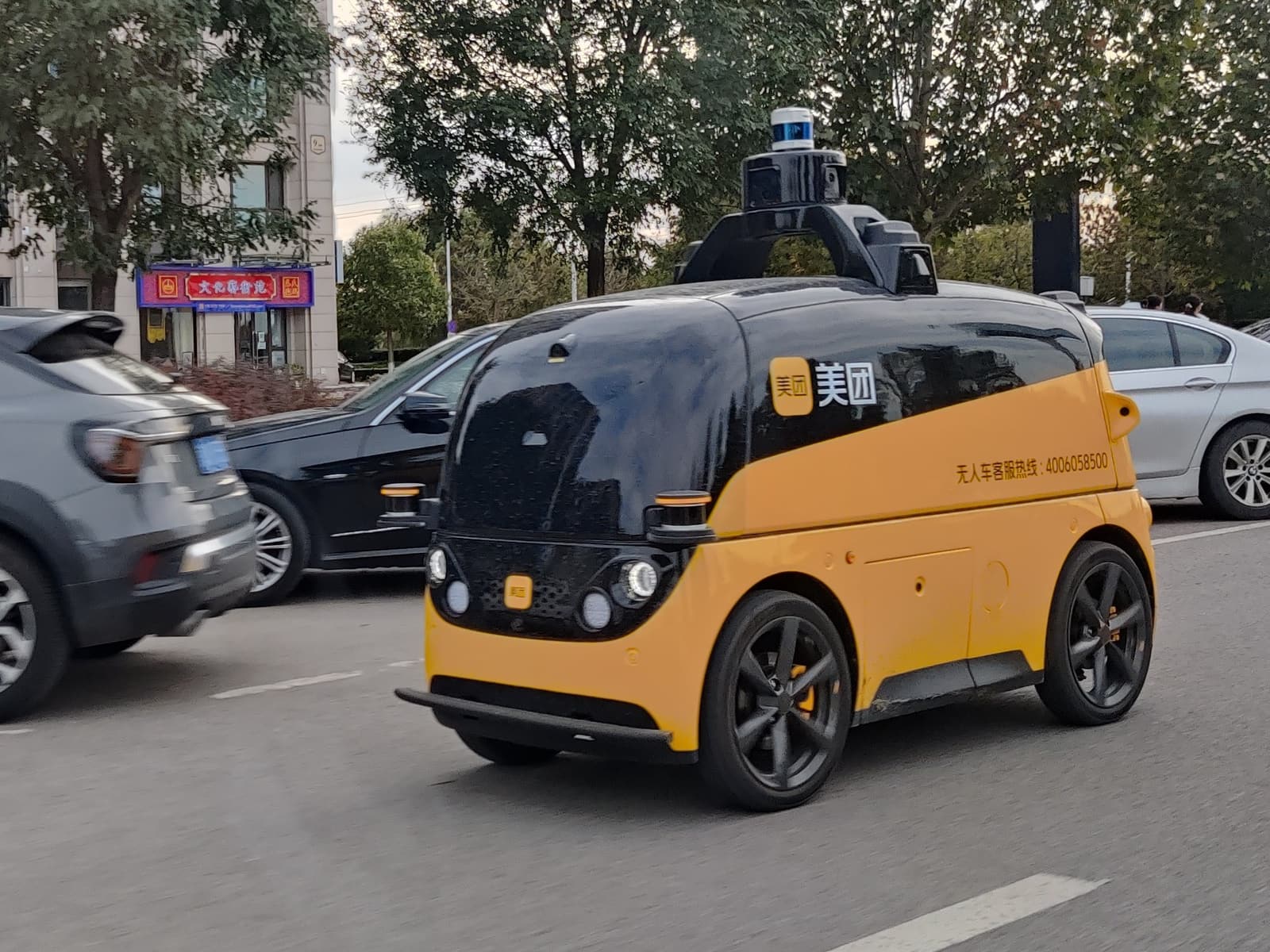
Image context: the cover uses a real Wikimedia Commons photograph of a Meituan autonomous delivery vehicle. It fits this article because the important theme is action under constraints. EvoCUA matters when a model can navigate a real interface, absorb feedback, and keep moving toward a result rather than stop at fluent description.[6]
The score matters because it came from a different training loop
The Meituan technical write-up and the EvoCUA paper both begin with the same complaint: standard imitation learning does not scale cleanly into long-horizon GUI work.[1][3] Static expert trajectories can show what a correct path looks like, but they do a poor job of teaching what happens when a cursor misses, a window renders differently, a keyboard mapping behaves oddly, or a long task drifts off the happy path.[1] That is why the paper frames the core obstacle as static data scaling rather than raw model intelligence.[3]
Seen through that lens, the 56.7% OSWorld result is useful less as a chest-thumping number than as evidence that the training loop changed in a measurable way.[1][3] The paper says the same evolving paradigm improved computer-use capability across different base families, including Qwen3-VL and OpenCUA, and across sizes from 8B to 72B.[1][3] That matters because it suggests the gain is not only a lucky fit between one model and one benchmark. The authors are claiming that the experience-generation pipeline itself transfers.
This is also why OSWorld remains relevant here. The benchmark is designed around multi-turn interactions with real desktop environments, not single-shot screenshot classification.[2][5] A better score is therefore meaningful only if the model can sustain planning, action, correction, and termination over actual interface sequences. EvoCUA's thesis is that this kind of competence needs a different supply chain of data and feedback than classic imitation pipelines provide.[1][3][5]
The real contribution is the verifier-backed task factory
The most important part of the Meituan article is not the leaderboard graphic. It is the section on the verifiable synthesis engine.[1] Meituan says the team moved away from the familiar "LLM generates tasks, reward model filters them" pattern because semantic plausibility is too weak a filter in GUI settings.[1] A task can sound reasonable in text while remaining impossible in the actual interface state. EvoCUA's answer is stricter: generate the natural-language instruction together with executable validation code, then treat the sandbox run itself as the only final judge of whether the task is valid.[1][3]
That is a more consequential move than it first appears. It shifts data quality from a language-only problem to an execution problem. The Meituan write-up says the system builds a structured task space out of reusable atomic skills, synthesizes parameterized resources such as spreadsheets and documents, injects non-parameterized public materials to create visual noise and layout diversity, and then iterates on validator code until it runs successfully inside the sandbox.[1] The same write-up describes additional consistency filtering and three layers of decontamination to reduce overlap with evaluation data.[1]
In plain terms, EvoCUA is trying to industrialize one uncomfortable truth about computer use: a GUI task is only real if a machine can actually do it and a verifier can actually check it. That is a stronger standard than "the prompt looked sensible." It also explains why the project reads differently from many ai-china release stories. The artifact with the most strategic value may not be the final checkpoint. It may be the factory that keeps emitting executable tasks and validators without collapsing into hallucinated junk.[1][3]
The sandbox infrastructure is part of the model, not only a testing harness
The other section that matters is infrastructure. Meituan says EvoCUA's training loop depends on a sandbox platform capable of handling 100,000+ daily active sandboxes, million-level per-minute interaction requests, and the ability to start 10,000+ sandbox instances within one minute during burst sampling windows.[1] Those are company-reported engineering numbers, not third-party audits, but they clarify the design target. EvoCUA is being built as a system that assumes enormous amounts of environment interaction, not a boutique research demo.[1]
The details are revealing. Meituan describes an asynchronous microservice architecture, a split between control plane and data plane, and a hybrid virtualization setup using Docker outside and QEMU-KVM inside to balance orchestration flexibility with strong isolation.[1] The article also goes unusually deep on seemingly boring issues such as keyboard determinism and font-rendering consistency.[1] That is exactly the right kind of boring. Computer-use agents often fail on this layer first. If the same shortcut behaves differently across environments, or if text renders with a shifted layout, the model learns noise instead of durable action patterns.
This is why the benchmark result should be read together with the infrastructure description. In GUI agents, environment fidelity is not a side condition. It is part of the training signal itself. Meituan is effectively arguing that systems engineering belongs inside the model story. The screenshot model, the verifier, and the sandbox fleet are all coupled pieces of one capability stack.[1][2][3]
EvoCUA learns from failure more explicitly than most public agent write-ups do
The paper abstract says EvoCUA internalizes experience by identifying capability boundaries, reinforcing successful routines, and turning failure trajectories into supervision through error analysis and self-correction.[3] The Meituan technical post spells out what that means operationally.[1] Cold start defines a stricter action space and thought pattern. Rejection-sampling fine-tuning uses dynamic rollout budgets to spend more compute near the model's capability edge. Reinforcement learning then drills down to key divergence points instead of rejecting a whole trajectory just because one late-stage action caused the failure cascade.[1]
That last detail is strategically important. Long GUI tasks have terrible credit-assignment problems. One small wrong click at step 5 can poison the state until step 30, where the failure becomes visible. Meituan's answer is to align successful and failed trajectories, locate the branching point, and optimize there.[1] This is a better fit for computer use than treating every failure as equally uninformative noise.
The project's later public updates make the case a bit stronger. The Hugging Face model card says that by 2026-03-31 EvoCUA-32B had reached 56.48% on WindowsAgentArena, beating the base Qwen3-VL-32B-Thinking result of 42.9% and the cited UI-TARS-2 result of 50.6% in that evaluation.[4] The same card also points to a separate 2026 safety study where EvoCUA-32B showed the lowest overall unintended-behavior rate among the tested CUAs at 35.0%.[4] These are still model-card-reported follow-up signals, not an independent meta-analysis, but they matter because they hint that the training loop may transfer beyond the original Linux-heavy benchmark lane.[4]
Why this matters in AI-China
The narrow conclusion is not that Meituan has solved computer use. The stronger conclusion is that one of China's most operationally grounded AI teams is pushing the field toward a different unit of competition. The scarce resource is no longer only model cleverness. It is the combination of task synthesis, validator design, environment throughput, and failure-aware optimization that lets an agent accumulate meaningful experience at scale.[1][2][3]
That has broader implications for ai-china. Chinese labs and platforms increasingly have access to strong open or semi-open base models. The harder moat may emerge where companies own closed-loop action data and the infrastructure needed to keep generating more of it. EvoCUA is interesting because it makes that shift visible. It says computer-use progress can be purchased not just with bigger pretraining, but with better machinery for turning interfaces into verifiable experience.[1][3]
Three follow-up signals matter from here. First, watch whether Meituan publishes more evidence that the same evolving loop keeps generalizing across operating systems, base models, and agent tasks.[3][4] Second, watch whether the open repository becomes a real reproducibility surface rather than only a paper companion; the project already exposes evaluation examples, deployment instructions, and OSWorld-facing code structure, which is a stronger starting point than many benchmark announcements provide.[2] Third, watch whether other AI-China teams start copying the verifier-first pattern. If they do, EvoCUA may turn out to matter less as one model and more as a template for how China's action agents get trained next.[1][2][3]
Sources
- Meituan Tech, "EvoCUA refreshes the open-source state of the art: a computer-use agent that can use computers and keep evolving" (January 26, 2026; core thesis, verifiable synthesis engine, sandbox scale, staged learning design, and Meituan-reported benchmark deltas).
- GitHub, "meituan/EvoCUA" (open repository, project structure, OSWorld evaluation entry point, deployment instructions, and benchmark-resource links).
- Taofeng Xue et al., "EvoCUA: Evolving Computer Use Agents via Learning from Scalable Synthetic Experience" (arXiv:2601.15876, submitted January 22, 2026; abstracted method, scaling thesis, and comparative OSWorld results).
- Hugging Face, "meituan/EvoCUA-32B-20260105" (model card updates on OSWorld release, WindowsAgentArena follow-up result, deployment guidance, and cited unintended-behavior study).
- OSWorld, official benchmark site (benchmark scope: real desktop environments and multi-turn computer-use evaluation).
- Wikimedia Commons, "File:Meituan autonomous delivery vehicle IMG003.jpg" (source page for the cover photograph used in this article).