As of 2026-04-30 UTC, the useful way to read PaddleOCR-VL-1.5 is not as one more OCR model posting a prettier top-line score. The sharper signal sits in the evaluation boundary itself. PaddleOCR's official materials say the model reaches 94.5% on OmniDocBench v1.5, stays at 0.9B parameters, adds seal recognition and text spotting, and introduces Real5-OmniDocBench to test five ugly physical conditions that often break document systems in production: scanning, warping, screen photography, illumination, and skew.[1][2][4][5]
That changes the meaning of the release. A lot of document-model announcements still behave as if the important problem is clean-page parsing on a benchmark sheet. PaddleOCR-VL-1.5 is trying to move the public conversation one step lower and one step closer to field reality. The product claim is not only "we parse text, tables, and formulas well." It is also "we want distorted capture conditions to count as a named benchmark lane, not as an afterthought once the demo is over."[1][4][5]
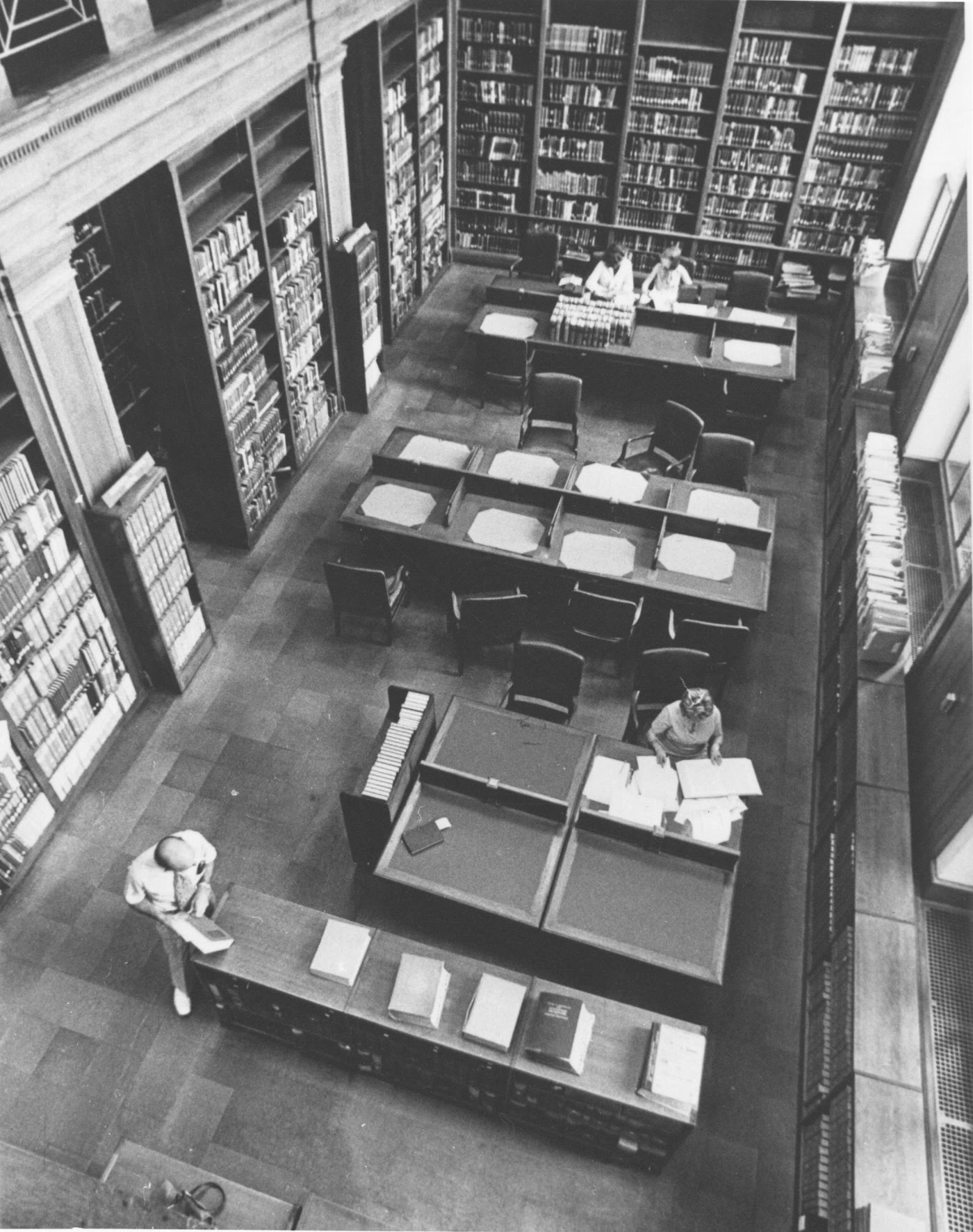
Image context: the cover uses a real Wikimedia Commons photograph of the National Archives library in Washington. It fits this piece because the real workload surface for document parsing is not a synthetic sheet of neatly rendered pages. It is shelves, scans, bound records, camera captures, and the long institutional tail of messy paper.[7]
The benchmark shift matters more than the headline score
The 94.5 figure is worth attention, but the benchmark structure around it is more revealing. OmniDocBench is already broader than a simple OCR accuracy test. The project describes 1,651 PDF pages spanning 10 document types, 5 layout types, and 5 language types, with annotations for text, tables, formulas, and reading order across both block-level and span-level document elements.[6] That is a serious parsing benchmark, not a toy.
But it still leaves a familiar gap between evaluation and deployment. Many document systems look respectable on clean PDFs and then start slipping once the page is bent, the lighting is uneven, the image is captured off a phone screen, or the scan enters at an angle. The official PaddleOCR-VL-1.5 introduction makes that gap the center of the release. It explicitly says the team proposed Real5-OmniDocBench to test robustness against scanning artifacts, skew, warping, screen photography, and illumination, and says the model sets new SOTA records across those five slices.[1][4]
That is the real benchmark story. The model is not only being scored on what a document is. It is being scored on what happened to the document before the model ever saw it. In practice, that often decides whether a parsing system is useful.
There is a boundary worth keeping clean. The official model card says the performance table draws most metrics from the OmniDocBench official leaderboard, but notes that Gemini-3 Pro, Qwen3-VL-235B-A22B-Instruct, and their own model were evaluated independently rather than pulled directly from the public leaderboard row.[4] That does not invalidate the result, but it does mean the 94.5 claim should be read as a strong vendor-backed comparison under the published setup, not as a single neutral scoreboard line that removes all remaining uncertainty.
The product move is compact robustness, not just better parsing
The second reason this release matters is that the robustness story arrives in a relatively compact package. The official docs and model card keep returning to the same fact: PaddleOCR-VL-1.5 stays at 0.9B parameters while extending the task surface.[1][4] This is not a giant multimodal model trying OCR on the side. It is a bounded document parser whose public identity is tied to parsing accuracy under messy conditions.
The GitHub release sharpens that interpretation. PaddleOCR says version 3.4.0, released on 2026-01-29, introduced PP-DocLayoutV3 for irregular shape positioning, expanded support to 111 languages, added seal recognition and text spotting, and improved long-document behavior such as cross-page table merging and hierarchical heading identification.[3] Those are workflow features. They describe a parser that is expected to survive the structure of real records, not only the content of one clean page.
The model card adds another important constraint: the official inference path is recommended because it is faster and supports page-level document parsing, while the simpler transformers example is only for element-level recognition and spotting tasks.[4] That distinction is valuable because it tells readers where the system's operational center of gravity really sits. PaddleOCR-VL-1.5 is not being pitched as a generic vision-language chat object. It is being pitched as a document pipeline with a preferred serving path.
This is why the release reads like infrastructure. The docs highlight Markdown and JSON style outputs, the handling of tables, charts, formulas, seals, and spotting, and practical deployment paths rather than one purely academic benchmark table.[1][3][4] The point is not only that the model can see. The point is that it can hand structured material forward into retrieval, extraction, audit, and indexing workflows.
Why this matters now in AI-China
In the ai-china lane, the larger signal is that document parsing is being treated as a public middleware category rather than as a buried enterprise feature. China's model ecosystem has already spent plenty of cycles on chat rankings, coding agents, and multimodal demos. The next competitive layer is harder to market but easier to monetize: who can turn ugly page capture into dependable machine-readable structure for finance, government, archives, logistics, legal review, and industrial paperwork.
PaddleOCR-VL-1.5 is unusually legible on that front. The repo still presents PaddleOCR as a bridge from PDFs and images into structured data for AI systems, and explicitly says the new release excels on challenging content types including handwritten text and historical documents.[3] That language matters. It says the target is not only office PDFs generated directly from software. It is also the much messier paper edge where document pipelines usually fail first.
There is also a versioning lesson here. OmniDocBench itself keeps moving. The repository says the main branch is now updated to v1.6, and that users who want to evaluate against v1.5 should check out the corresponding version-specific branch.[6] For anyone comparing document models in 2026, this is not bookkeeping trivia. It means benchmark claims are version-sensitive, and a clean comparison requires matching the right dataset and evaluation code branch before drawing strategic conclusions.
So the right takeaway is narrower and stronger than "Baidu's Paddle stack now has the best OCR model." The stronger takeaway is that PaddleOCR-VL-1.5 is helping define a more realistic public test for document intelligence: one where distortion, layout damage, and awkward capture conditions become named parts of the benchmark rather than private excuses after deployment.[1][4][5][6]
The next verification points are straightforward. First, watch whether other teams start citing or contesting Real5-OmniDocBench instead of staying on cleaner parsing leaderboards alone.[1][4][6] Second, watch whether independent reruns keep the same ranking order once version boundaries and serving assumptions are matched.[4][6] Third, watch whether the compact 0.9B footprint really proves sticky in local or hybrid document pipelines, where throughput, GPU budget, and preprocessing friction matter as much as raw accuracy.[1][3][4][5]
If those conditions hold, PaddleOCR-VL-1.5 will matter not mainly because it posted 94.5 once, but because it helped make real-world document distortion a first-class benchmark and product lane inside AI-China.
Sources
- PaddleOCR Documentation, "PaddleOCR-VL-1.5 Introduction" (English; 94.5 on OmniDocBench v1.5, Real5-OmniDocBench, 0.9B size, irregular-shaped localization, text spotting, and seal recognition).
- PaddleOCR 文档,《PaddleOCR-VL-1.5简介》(中文一手页面;版本定位、94.5、Real5-OmniDocBench 与任务扩展)。
- PaddlePaddle, "PaddleOCR" GitHub repository README (2026-01-29 v3.4.0 release notes, PP-DocLayoutV3, 111 languages, cross-page table merging, and deployment framing).
- PaddlePaddle, "PaddleOCR-VL-1.5" Hugging Face model card (0.9B model card, independently evaluated comparison note, Real5-OmniDocBench description, and inference-path caveats).
- Cui et al., "PaddleOCR-VL-1.5: Towards a Multi-Task 0.9B VLM for Robust In-the-Wild Document Parsing" (arXiv:2601.21957; January 29, 2026 technical report introducing Real5-OmniDocBench and the 0.9B robustness framing).
- OpenDataLab, "OmniDocBench" GitHub repository (benchmark scope, annotations, versioning notes, and evaluation structure for text, tables, formulas, and reading order).
- Wikimedia Commons, "File:Photograph of the Library at the National Archives (35877994702).jpg" (source page for the archival cover photograph used in this article).