Five dishes run across a restaurant sign in the 2019 ReCTS competition report. Read from left to right, they form a line. Read as a hungry customer might, they form five choices, among them fried noodles and flatbread in broth. Ask two people to draw a box around the writing and they could agree on every character while handing back quite different pictures. The judges accepted both ways of marking this sign. [1]
That small concession gets at a difficulty in teaching a machine to read a storefront. Someone preparing a test must decide where a piece of writing begins and ends. A shopkeeper arranging words over a door has other priorities.
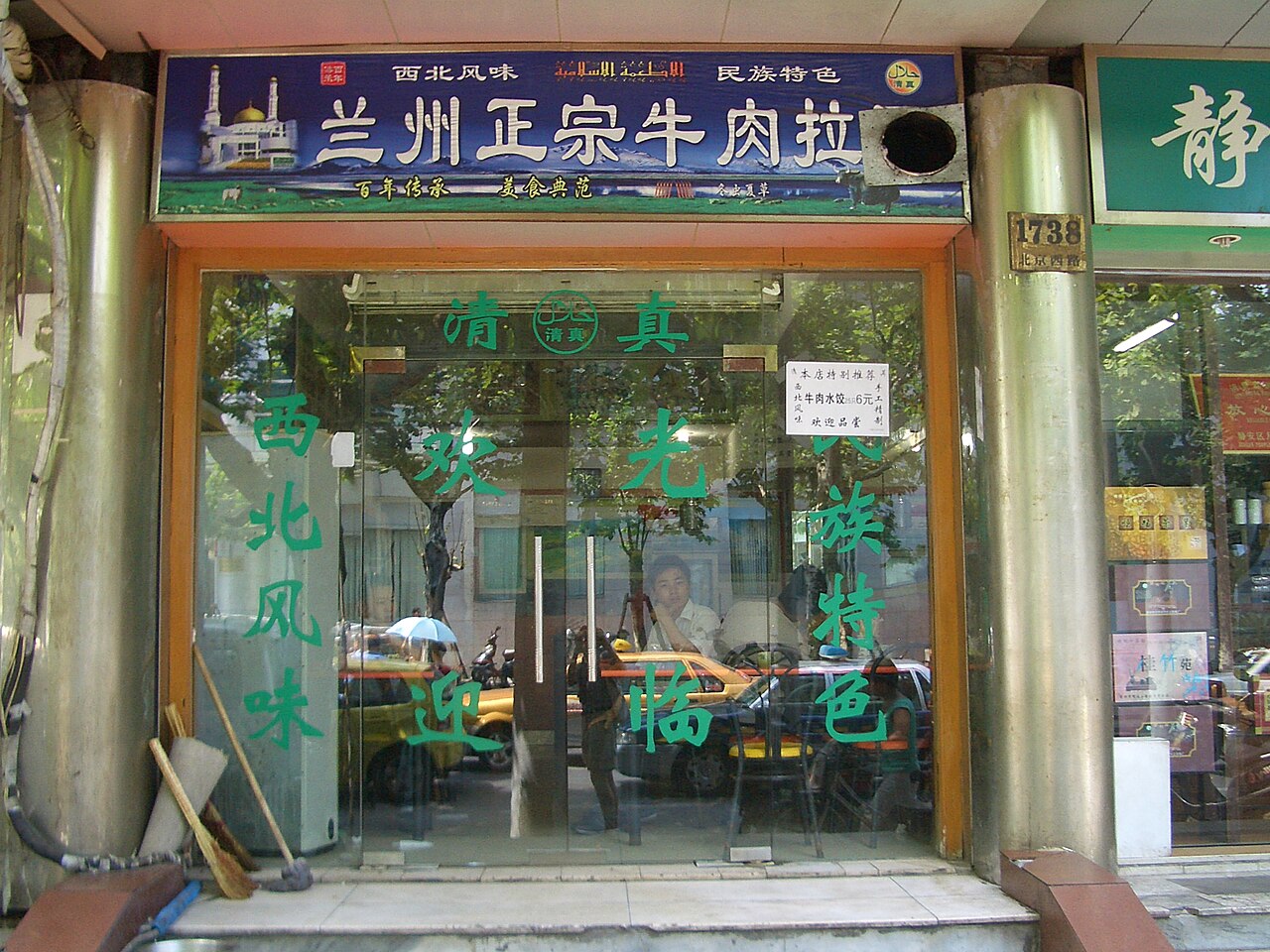
What the crop gives away
Two years before ReCTS, the Reading Chinese Text in the Wild competition had asked entrants to locate writing in natural images and to read it end to end. Its authors documented a revealing failure on long lines. A detector could chop off the last few characters or return a line in pieces. Even a recognizer capable of reading every character it received would then struggle to reconstruct the original. [3]
For ReCTS, merchants working with Meituan photographed signboards with phone cameras. The organizers set aside 5,000 of the 25,000 images for testing. Alongside the full photographs, they made two sets of crops from those test images. One presented a single character at a time. The other supplied a line of text and the coordinates of its outline. That gave researchers a way to ask how much a reader could recover once someone had pointed it to the writing. [1]
Consider a system that drops the last character of a shop name. If it also drops the character on a supplied crop that clearly contains it, the transcription step deserves attention. If it reads the crop perfectly, look at the outline it drew on the full picture. The last character might sit just beyond the edge. A customer searching for the shop sees the same incomplete name in either case.
How two answers became fair game
In the end-to-end task, each submitted line had to come with a four-corner outline. The scorer first matched outlines by how much their areas overlapped. Only then did it compare the submitted writing with the reference transcription, counting the edits needed to turn one string into the other. On the restaurant sign, the judges supplied alternative reference groupings and used the closest match. That let an entrant draw a box around each dish without losing credit simply because another reader saw one long line. [1]
The distinction shows up in the results. SANHL led the supplied-line task with a normalized edit score of 0.9555. Tencent-DPPR led the full-sign task at 0.8150. Subtracting those scores would tell us little about the cost of locating text alone. They belong to different winning systems, and the full-sign test also asks each system to find the lines it will be graded on. Neither figure tells a merchant the chance that a whole shop name came back exactly right. [1]
The distinction survived the competition. When Fudan researchers built a broader Chinese text recognition benchmark, they took the ReCTS training photos and cut out 107,657 text samples, pooling them with crops from four other datasets. A reader tested on that collection receives the result of somebody else’s decision about where to cut. [4] For a menu archive with a person selecting each dish name, that is a sensible division of labor. For a phone asked to read the whole sign from the pavement, deciding where to draw the first box is still part of the job.
Sources
- Xi Liu and colleagues, ICDAR 2019 Robust Reading Challenge on Reading Chinese Text on Signboard, especially Figure 2 and Tables II and IV.
- Vmenkov, photograph of a Lanzhou beef noodle restaurant on West Beijing Road in Shanghai, 7 August 2008. Wikimedia Commons.
- Baoguang Shi and colleagues, ICDAR2017 Competition on Reading Chinese Text in the Wild, error analysis.
- Fudan Vision and Intelligence Lab, Benchmarking Chinese Text Recognition, scene dataset construction.