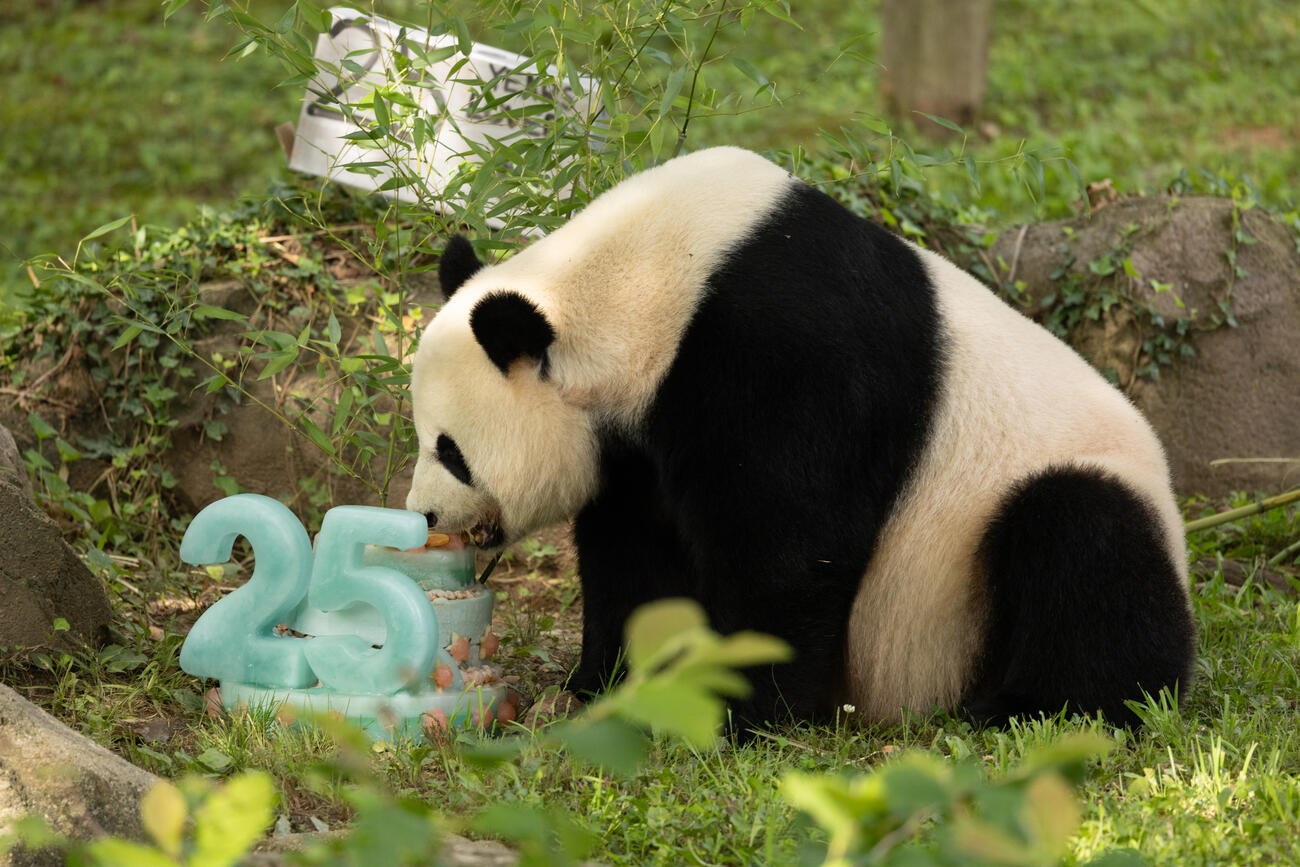
In Roshan Patel’s photograph of Mei Xiang at the Smithsonian’s National Zoo, anyone can tell how old she is. The keepers have spelled it out in ice. On July 22, 2023, the panda turned 25. Crop the photograph down to her face and the question gets considerably harder. A year earlier, researchers in Chengdu had tried much the same exercise with portraits of 218 captive pandas whose ages they could check. Their computer was particularly prone to making bears like Mei Xiang look younger. [1][2]
A fair test requires a stranger
A familiar panda face gives a computer a head start. In an earlier identification experiment, researchers at Xi’an Jiaotong University and their collaborators assembled thousands of photographs of 50 named individuals. The whole point of their iPanda-50 dataset was to see whether a model could pick the same animal out again. For someone trying to measure age, that talent presents a problem. Imagine a bear photographed a dozen times in one afternoon. A model that sees eleven portraits during training could get the age in the twelfth portrait right simply by recognizing its face. [2][3]
The Chengdu team kept each panda on one side of the exam. Animals photographed at several stages of life went into the training set. The test set contained different individuals, and researchers manually cropped the frontal portraits. Given one of those faces, the model had four choices, in order from juvenile through subadult and adult to old. That ordering matters to a biologist even though the accuracy calculation gives the same penalty for every wrong answer. [2]
Of 871 test portraits, 550 showed adults. A classifier that called every bear an adult would therefore score about 63 percent. The team’s EfficientNet model reached 85.99 percent. But consider the oldest group separately. Its 52 test portraits showed just three animals, and the model often assigned elderly bears to the adult group. A fourth elderly bear would bring more fresh evidence about aging than another dozen photographs of the first three. [2]
What would an error cost a census?
Another Chinese research team asked for an estimate in years. Its experiment covered 272 pandas ranging from birth to age 38 and kept individuals separate across the training and test portions of each fold. On the full dataset the mean absolute error was 2.51 years. A prediction of 17 for a 20-year-old would contribute three years to that average, exactly as a prediction of 23 would. The measure tells a keeper roughly how far an estimate might miss across many portraits. To learn whether old animals consistently come out young, the keeper would need the direction of those errors too. [4]
That distinction matters if the aim is to describe a wild population. A survey could count every animal once and still produce an adult group swollen by elderly bears. And before a field camera’s pictures could even enter the Chengdu test, someone would have to decide which offered a usable frontal view. For a census, I would want to know how many encountered animals yielded such a portrait. I would also want a field test showing how often a known elderly bear kept its place in the oldest group. A photograph can supply evidence of age. Which animals get a photograph, and which ages the model tends to erase, will shape the population we see. [2][4]
Sources
- Smithsonian’s National Zoo and Conservation Biology Institute, report and photo gallery from Mei Xiang’s 25th birthday.
- “Giant panda age recognition based on a facial image deep learning system,” Ecology and Evolution, 2022. See Table 1 for the test population.
- iPanda-50, the research team’s dataset for identifying individual giant pandas.
- “Ages of giant panda can be accurately predicted using facial images and machine learning,” Ecological Informatics, 2022.