As of 2026-04-23 UTC, RAGFlow's useful AI-China signal is not that retrieval-augmented generation has become fashionable. That was already obvious. The signal is that a Shanghai-linked infrastructure team is packaging RAG less as a chatbot feature and more as a document operations layer: ingest, parse, inspect, retrieve, cite, remember, and expose the result to agents.[1][3][5]
That distinction matters because most failed enterprise RAG systems do not fail at the last sentence. They fail earlier, when a scanned PDF, a table-heavy manual, a contract appendix, or a stale knowledge-base page becomes broken text with no visible provenance. RAGFlow's public materials keep returning to "quality in, quality out," deep document understanding, template-based chunking, fused retrieval, and citation grounding.[1][5] Read narrowly, that is product copy. Read as stack evidence, it says the hard part of RAG is being moved upstream into the document pipeline.
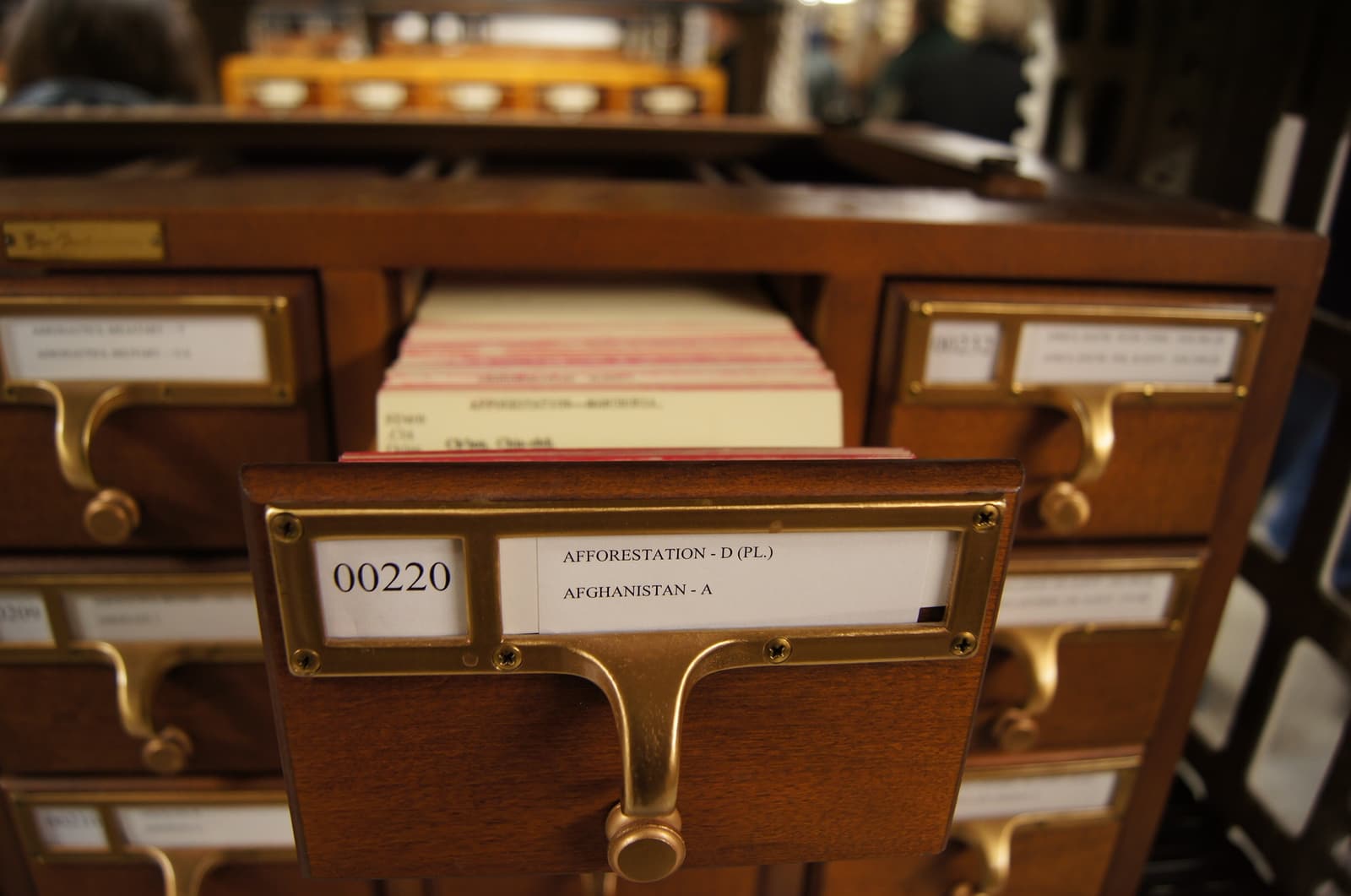
Image context: the cover uses a real Library of Congress card-catalog photograph from Wikimedia Commons. It is not meant to depict RAGFlow or InfiniFlow. It fits the article because the subject is retrieval as institutional memory: drawers, records, labels, and the long labor of making documents findable before any answer can be generated.[6]
The product boundary starts before retrieval
RAGFlow describes itself as an open-source RAG engine that fuses RAG with agent capabilities to create a context layer for LLMs.[1] The homepage sharpens that pitch: the platform presents ETL for AI data, hybrid search, and unified AI agent orchestration as adjacent parts of one system rather than separate tools bolted together after the fact.[3]
The ordering is important. In many RAG demos, the visible unit is the chat box. In RAGFlow, the more durable unit is the dataset. The repository's README points to knowledge extraction from unstructured data with complicated formats, multi-recall plus fused reranking, configurable LLM and embedding models, and APIs for integration with business systems.[1] The Alibaba Cloud startup profile gives the same idea in Chinese product terms: document knowledge bases, intelligent document parsing, table parsing, agent-based advanced RAG, workflow orchestration, and file management all sit inside the product description.[5]
That makes RAGFlow a stack-and-supply-chain story. The "supply" being managed is not only model tokens or vector capacity. It is usable organizational context. A company cannot route an agent through a maintenance manual, a drug-research report, or a legal-precedent corpus until it can control the shape of those documents as data. RAGFlow's significance is that it puts parsing templates, chunk inspection, retrieval components, and agent workflows into one operator surface.
Release notes show the direction of travel
The April 21, 2026 v0.25.0 release notes are a compact map of where RAGFlow is moving. The release adds seven prebuilt ingestion pipeline templates, publishable agent apps, sandbox code execution and chart generation, user-level memory storage and retrieval, and dataset accessibility through OpenClaw.[2] It also adds Seafile, RSS, DingTalk AI Table, and GitHub deleted-file synchronization as data-source work.[2]
Those are not cosmetic changes. Prebuilt ingestion templates imply that the team sees document intake as repeatable workflow design, not a one-off upload button. Publishable agent apps imply that RAGFlow wants the retrieval surface to become reusable business software. Memory APIs and user-level memory pull the context layer closer to agent continuity. OpenClaw dataset access is especially revealing: it lets other agent surfaces reach into RAGFlow datasets instead of trapping context inside the RAGFlow UI.[1][2]
The earlier v0.24.0 and v0.23.0 notes reinforce the same movement. They add memory management APIs, batch metadata management, a chat-like agent conversation interface with retained sessions, multi-sandbox support, optimized retrieval strategies for deep-research scenarios, webhook-triggered agents, multiple Retrieval components per Agent component, table-of-contents extraction in ingestion, parent-child chunking, and auto-generated metadata during file parsing.[2]
The pattern is clear: RAGFlow is widening from knowledge-base Q&A toward a context engine that can be managed, audited, and reused by agents. The technical center of gravity is moving from "retrieve a few chunks" to "operate a corpus."
The document engine choice is strategic
RAGFlow's infrastructure choices also matter. The README says the system uses Elasticsearch by default for storing full text and vectors, but can switch the document engine to Infinity.[1] Infinity, also from InfiniFlow, describes itself as an AI-native database for LLM applications with hybrid search across dense vector, sparse vector, tensor or multi-vector, and full text.[4]
That hybrid retrieval posture is central to production RAG. Dense embeddings are useful, but enterprise documents often contain identifiers, clause numbers, product names, table labels, acronyms, and exact phrases that semantic search alone can blur. A document engine that treats full text, vector, sparse, and tensor retrieval as first-class lanes gives RAGFlow a more credible substrate for messy corporate material.[3][4]
The operational requirements are also honest. The README lists a baseline of 4 CPU cores, 16 GB RAM, 50 GB disk, Docker 24.0.0 or later, Docker Compose v2.26.1 or later, and gVisor only when using code-executor sandboxing.[1] It also notes vm.max_map_count setup, x86-oriented prebuilt images, Elasticsearch as the default document engine, and caution around switching to Infinity because volumes can be cleared when containers are stopped with -v.[1]
Those details are valuable because they keep the adoption story grounded. RAGFlow is not a browser-only SaaS promise disguised as open source. It is a service stack with storage, object storage, task execution, parser workloads, model-provider configuration, and optional sandboxing. Teams evaluating it need platform ownership, not only prompt-engineering enthusiasm.
Why this belongs in the AI-China map
RAGFlow fits AI-China coverage because it shows a different competitive lane from frontier-model announcements. The Alibaba Cloud startup profile frames InfiniFlow around Infinity and RAGFlow, notes an enterprise RAG focus, and describes founders with experience across search engines, vector databases, database kernels, and AI.[5] That background is visible in the product itself: the emphasis falls on retrieval infrastructure, not only model branding.
This is also why RAGFlow should be separated from two nearby stories. It is not the same as a model hub like ModelScope, where the central question is distribution of weights, datasets, evaluation, and managed deployment. It is not the same as a vector database like Milvus, where the central question is storage and query capability. RAGFlow sits above those layers, where documents are cleaned, chunked, cited, searched, and handed to agents as usable context.
The near-term watch item is whether RAGFlow's OpenClaw integration becomes a real cross-surface contract. If agents in chat systems, IM clients, or workflow runners can reliably manage datasets, upload and parse files, and run semantic search through RAGFlow, then the RAG platform becomes a backend for many agent products rather than one destination app.[1][2]
The second watch item is parser accountability. RAGFlow's value rises if teams can see where a table was split, where an image context window came from, why a parent-child chunk was selected, and which source passage justified an answer. That is the part of the stack that turns RAG from "the model found something" into "the system can show its work."
The narrower conclusion is that RAGFlow is worth tracking because it treats RAG as document infrastructure. In China's AI stack, that may prove as important as another model release: agents can only act on enterprise knowledge after someone has made that knowledge parseable, searchable, attributable, and governable.
Sources
- InfiniFlow,
infiniflow/ragflowGitHub repository, README and setup notes (RAGFlow positioning, key features, prerequisites, Docker setup, Elasticsearch and Infinity document-engine options). - InfiniFlow, RAGFlow release notes (v0.25.0, v0.24.0, and v0.23.0 changes covering ingestion templates, memory, OpenClaw dataset access, agent execution, metadata, and retrieval updates).
- RAGFlow official homepage, product positioning around ETL for AI data, hybrid search, and unified AI agent orchestration.
- InfiniFlow,
infiniflow/infinityGitHub repository, README and project description for the Infinity AI-native database and hybrid search lanes. - Alibaba Cloud Innovation Center, "RAGFlow企业级RAG引擎" (June 26, 2024; InfiniFlow company and product context, RAGFlow enterprise use cases, document parsing, table parsing, and agent workflow description).
- Wikimedia Commons, "File:2011 Library of Congress USA 5466788868 card catalog.jpg" (Ted Eytan photograph, February 21, 2011, used as this article's cover image).