As of 2026-04-23 10:02 UTC, DeepSeek's reported first outside funding round should be read less as a simple valuation event and more as a test of cloud-neutral independence under platform capital. Reuters reported on April 22, citing The Information, that Tencent Holdings and Alibaba Group were in talks to invest in DeepSeek at a valuation above $20 billion.[1] That is the part that matters for ai-china: the investor list would not just add cash. It would place China's most visible low-cost model lab next to the two platform companies with the strongest incentives to pull model demand toward their own clouds, apps, payment rails, enterprise accounts, and agent surfaces.[1][5][6]
The headline valuation is useful, but only as a pressure gauge. DeepSeek's public product surface still looks unusually lean: the official site points users to web, app, and API access for DeepSeek-V3.2, while the API docs list both deepseek-chat and deepseek-reasoner against the V3.2 family, with 128K context, different output ceilings, and a very low published price table.[2][3] The company also built its reputation on technical disclosures around DeepSeek-V3: 671B total parameters, 37B activated per token, 14.8T pretraining tokens, and a reported 2.788M H800 GPU-hour full training cost in the official repository materials.[4] A round led or joined by Alibaba and Tencent would therefore ask a very specific question: can a lab whose edge came from efficiency, openness, and distribution friction stay credible once its cap table starts resembling the cloud market around it?
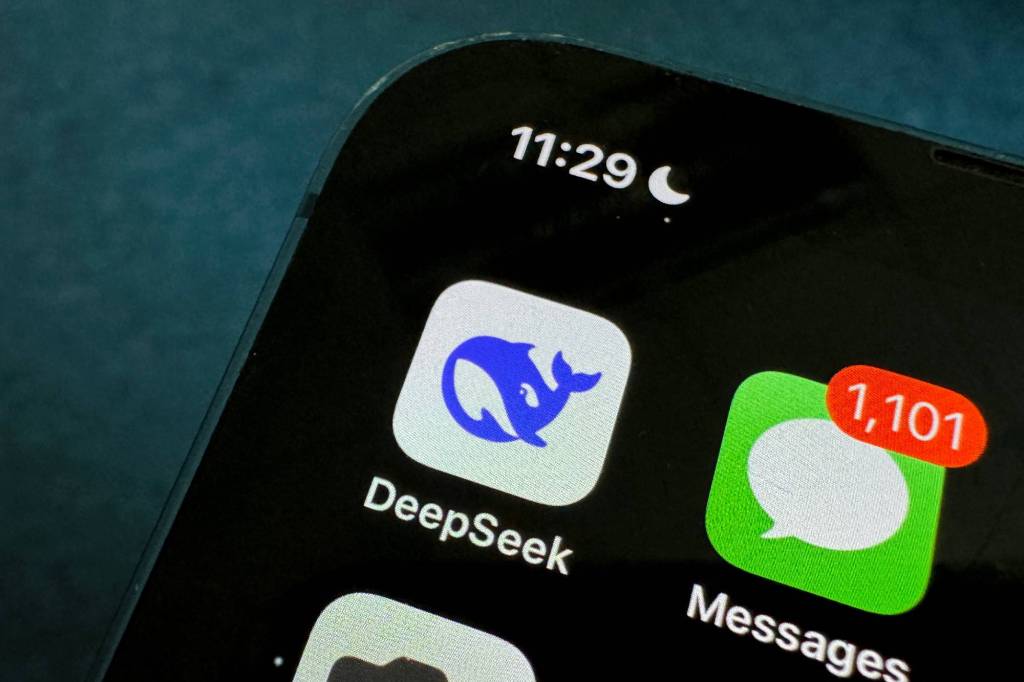
Image context: the cover image comes from TechCrunch's DeepSeek explainer and is credited there to Greg Baker/AFP via Getty Images. It is a real phone photograph, not a diagram or generated visual, and it fits the article because DeepSeek's strategic value sits in the jump from app-level adoption to cloud and platform bargaining power.[7]
The money is not the scarce asset by itself
DeepSeek probably does need more than prestige if it wants to keep competing in frontier reasoning, coding, agent execution, multimodal work, and enterprise delivery at once. The official V3 materials already show why: even with efficiency claims, a 671B-total-parameter mixture-of-experts system is a serious infrastructure object, and the V3.2 API surface now splits chat and reasoning behavior into distinct production lanes.[3][4] Funding can buy compute access, engineering retention, infrastructure redundancy, security work, customer support, and the tedious enterprise machinery that a viral model lab does not automatically possess.
But the strategic scarcity is not only money. It is credible neutrality. Developers and enterprise buyers used DeepSeek partly because it felt portable: cheap API access, permissive model artifacts, third-party hosting, and model-family visibility made it possible to test the lab without committing to one hyperscaler or one super-app ecosystem.[3][4] If Alibaba or Tencent become large shareholders, the test becomes sharper. Customers will ask whether preferential routing, managed deployment bundles, internal procurement pressure, or exclusive distribution rights begin to appear around the model family.
That does not mean platform capital is automatically bad for DeepSeek. It does mean every commercial improvement will need a boundary. Better cloud capacity is useful. Preferential cloud capture would change the product's meaning.
Alibaba would want the cloud-and-app loop
Alibaba's motive is easy to map. The company announced a RMB 380 billion three-year AI and cloud infrastructure plan in 2025, and its public strategy has leaned heavily on turning open Qwen distribution, Model Studio, cloud services, and Qwen App into one connected commercial loop.[6] A DeepSeek position would give Alibaba something different from Qwen: not another in-house model family, but external credibility around the most recognized independent Chinese model brand.
That external credibility matters because Alibaba already owns the monetization surfaces. It has cloud infrastructure, developer tooling, enterprise accounts, marketplace distribution, and consumer services that can turn an AI model into an executable transaction path.[6] DeepSeek's brand could help Alibaba with customers who want optionality beyond Qwen but still need a managed provider. From Alibaba's point of view, the cleanest version of an investment would make DeepSeek more available through Alibaba Cloud while preserving enough independence for developers to still treat it as a neutral model supplier.
The tension is obvious. If DeepSeek becomes too tightly coupled to Alibaba Cloud, it risks losing the very neutrality that would make Alibaba want it in the first place. If it stays fully neutral, Alibaba gets less strategic leverage from the investment. That balance is the deal logic.
Tencent would want traffic, agents, and cloud pull
Tencent's strategic path is different. Its 2025 annual results framed AI as already improving ad targeting, games engagement, and cloud revenue growth, and the company said it expected to more than double investments in New AI Products in 2026.[5] That places Tencent's AI need in a familiar pattern: model capability has to feed product engagement, enterprise cloud demand, social surfaces, game production, content tools, and agent workflows.
DeepSeek could serve Tencent as a credibility and capability layer across those surfaces. A low-cost reasoning model can strengthen cloud offers, internal productivity, coding tools, agent products, game development pipelines, and Weixin-adjacent business services. Unlike Alibaba, Tencent may not need DeepSeek primarily as an e-commerce execution layer. It may want a model asset that improves many product loops without making Hunyuan carry every workload alone.[5]
The control question becomes sharper as any strategic stake grows. A large platform position would give Tencent or Alibaba more influence, but it would also make neutrality concerns more visible.[1] DeepSeek's best market position is not "Tencent's model supplier" or "Alibaba's model supplier." It is a model lab that Tencent, Alibaba, third-party clouds, developers, and enterprises all have reason to support.
The open-weight bargain is the fragile part
The most important risk is not that DeepSeek raises money. The risk is that the company slowly changes the bargain that made it powerful. DeepSeek's technical reputation came from public model materials, API pricing, and the perception that strong Chinese models could spread through open or low-friction channels rather than only through closed platform packaging.[2][3][4] If outside capital leads to delayed weights, private frontier models, cloud-exclusive endpoints, or opaque enterprise tiers, the market will read that as a strategic pivot.
There is a defensible reason for some closed delivery. Frontier agents, enterprise security, data governance, and expensive inference all push companies toward managed services. The question is whether DeepSeek can keep a credible public lane beside those managed lanes. A simple operating rule would preserve the advantage: keep enough open or broadly portable releases to maintain developer trust, then monetize reliability, support, deployment, compliance, and high-throughput serving above that base.
That is where DeepSeek's current API details matter. The published pricing page separates cache-hit input, cache-miss input, and output tokens, and it distinguishes non-thinking and thinking lanes through deepseek-chat and deepseek-reasoner.[3] Those are not just price facts. They show a company already teaching users to think in workload lanes. A platform-backed DeepSeek could extend that logic into enterprise service tiers without breaking trust, provided the basic portability lane remains visible.
What to watch next
First, watch the ownership percentage and governance language. A small strategic round would signal validation and retention capital. A large platform stake would raise questions about future routing incentives and board influence.[1]
Second, watch cloud distribution. If DeepSeek appears more deeply inside Alibaba Cloud or Tencent Cloud while remaining equally usable through first-party API, open artifacts, and other channels, the market will treat the partnership as capacity expansion. If access starts clustering around one platform, it will look like capture.[2][3][5][6]
Third, watch the release pattern. The company can preserve its original bargain by continuing to publish meaningful technical materials and portable model lanes even as it sells higher-grade managed services.[3][4] A sudden move toward mostly private frontier releases would make the funding round look less like scale capital and more like a platform absorption path.
Finally, watch pricing. DeepSeek's current low published API rates are part of its identity.[3] If new capital is followed by price stability, higher throughput, and clearer service guarantees, the round strengthens the model. If prices rise without a corresponding reliability or capability step, the market will infer that ownership pressure has started to change the economics.
Bottom line
DeepSeek's reported first outside round is important because it would turn the company's independence from an assumed fact into an explicit operating test.[1] Alibaba and Tencent can offer compute, distribution, enterprise sales, and product surfaces that DeepSeek cannot easily build alone.[5][6] DeepSeek can offer them a model brand whose credibility came from being efficient, developer-friendly, and less obviously tied to one platform.[2][3][4]
The best outcome is a narrow one: platform capital without platform capture. If DeepSeek can take strategic money while keeping open and portable lanes alive, the round becomes a scaling event for China's independent model ecosystem. If the money pulls the lab into one cloud or app empire, the valuation headline will have bought something more expensive than equity: the loss of the neutrality that made DeepSeek valuable.
Sources
- Reuters via TradingView News, "Tencent, Alibaba in talks to invest in DeepSeek at over $20 billion valuation, The Information reports" (April 22, 2026; reported investor talks and valuation context).
- DeepSeek, official home page (current product surface noting DeepSeek-V3.2 availability on web, app, and API).
- DeepSeek API Docs, "Models & Pricing" (DeepSeek-V3.2 mapping, 128K context, chat/reasoner output limits, cache-hit/cache-miss/output pricing, and pricing adjustment notice).
- DeepSeek-AI, "DeepSeek-V3" official GitHub repository (model architecture, 671B total / 37B activated parameters, 14.8T pretraining tokens, and H800 GPU-hour disclosures).
- Tencent Holdings, "2025 Fourth Quarter and Annual Results" presentation PDF (March 18, 2026; AI product investment, cloud growth, and management framing of front-loaded AI investment).
- Alibaba Cloud Community, "Alibaba to Invest RMB380 Billion in AI and Cloud Infrastructure Over Next Three Years" (February 24, 2025; three-year AI and cloud infrastructure commitment).
- TechCrunch, "DeepSeek: Everything you need to know about the AI chatbot app" (updated September 29, 2025; DeepSeek background and AFP/Getty image credit for the app-icon photograph).