Consider the paper's representative problem at China's Ganyu solar station: a bright active region may be producing a flare just as a cloud bank approaches and wind begins to spoil the images. The telescope has several scientifically defensible options—keep a routine scan, switch to rapid flare observations, pause before the cloud crosses the Sun, or reject data that look sharp enough to a casual eye but are already compromised.[1]
In April 2026, researchers from the National Astronomical Observatories of the Chinese Academy of Sciences deployed JW-ASTClaw on the Solar Full-disk Multi-layer Magnetograph, or SFMM, at Ganyu. Their paper, published online in July, describes what they say is the first end-to-end large-language-model control framework on an operational solar telescope.[1][2] The striking part is not that a chatbot has been given a telescope. It is that the language model is allowed to propose a plan while a separate chain of software, electronics, and mechanics keeps the authority to refuse it.
As of August 11, 2026, the public evidence supports a real deployment and a serious engineering architecture. It does not yet support the stronger picture of an AI observatory proven across seasons of unsupervised live operation. Most reported perception tests replay archival observations, the deployment is at one site, and one advertised fallback model still awaits field hardware and quantitative benchmarking.[1] JW-ASTClaw is therefore most revealing as an attempt to translate a scientist's high-level intent into a bounded observing sequence—and as a lesson in how much more evidence autonomy requires after that interface works.
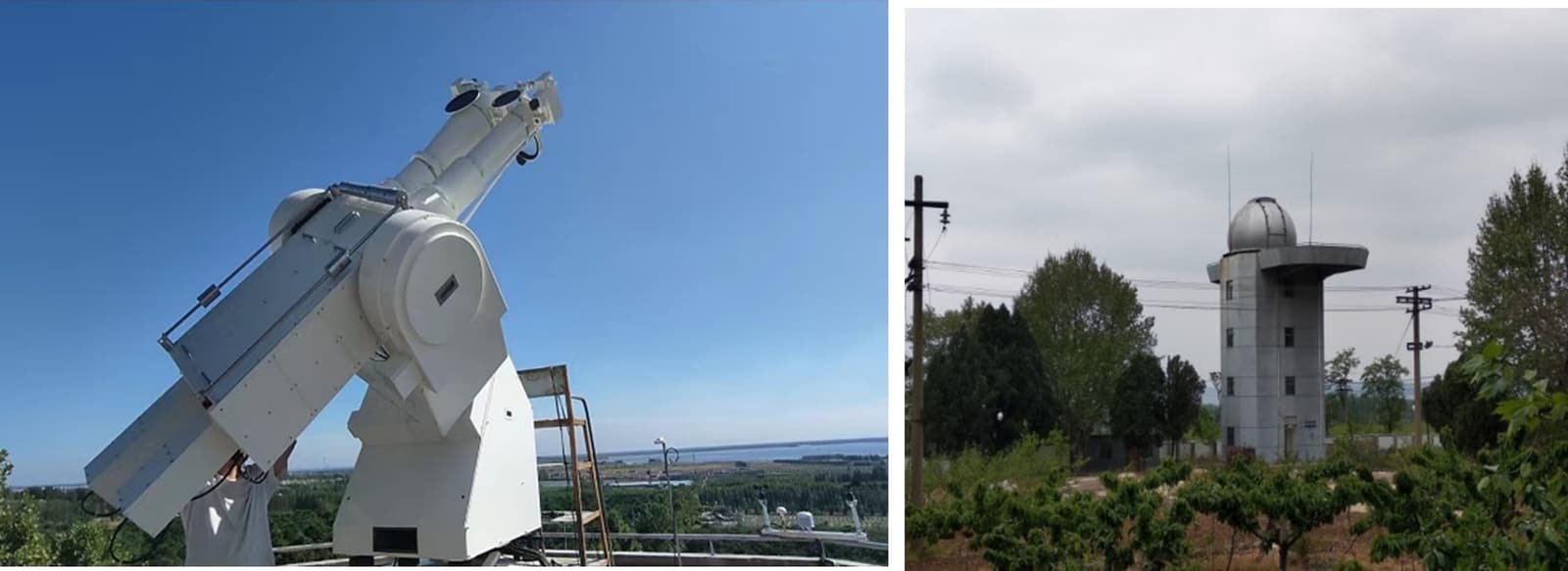
Image context: the cover is a real photograph of the SFMM installation and observing tower at Ganyu, published by the National Astronomical Observatories with the instrument's 2023 site-acceptance announcement. It shows the physical facility discussed here—not a generated AI scene, dashboard, or system diagram.[3]
What changed at the telescope
SFMM was already highly automated before an LLM entered the loop. The instrument observes four spectral lines spanning the photosphere and chromosphere, producing magnetic-field, velocity, and narrow-band images useful for tracking active regions and solar eruptions. Its earlier master-control system coordinated seven subsystems through a microservice architecture and had operated continuously for about two and a half years.[1][3] That baseline matters: JW-ASTClaw did not replace basic pointing, exposure control, or hardware protection. It was added above mature machinery.
The new framework separates the work into perception, decision, and execution. Three specialist agents inspect different evidence. A data-quality agent looks for wind jitter, cloud-created stripe artifacts, and loss of clarity. A cloud agent reads an all-sky camera around the projected position of the Sun. A flare agent combines photospheric spots, magnetic structure, and chromospheric plage to identify active regions and possible flare onset. Their structured advice goes to a central reasoning engine, which reconciles scientific priority with weather and image quality.[1]
Only then does an execution layer translate the chosen intent into the telescope's established command language. A visiting scientist can ask for a scan in natural language, but the system maps that request into ordered parameters for the existing subsystems before anything moves. Ambiguous or invalid instructions return an error rather than an action.[1]
This is a narrow but consequential use of an LLM. Fixed rules are good at known combinations: if wind exceeds a threshold, stop; if the sky is clear, continue. They become cumbersome when several conditions pull in different directions. The paper's representative conflict is a high-priority active region under approaching cloud. JW-ASTClaw is designed to assemble a bounded response—enter a rapid flare mode while preparing to pause for cloud—without requiring engineers to pre-write every possible branch.[1] The model is assigned arbitration, not raw motor control; the paper does not yet quantify how reliably it resolves such multi-condition conflicts.
Six layers of defense
The architecture treats a plausible sentence as untrusted input. Before an LLM-generated command can reach the instrument, it encounters six layers: prompt and output constraints, runtime schema validation, an independent central-control safety check, parameter limits inside each telescope subsystem, electronic protection, and finally mechanical stops and thermal fuses. Every decision records the agent inputs, model response, parsed command, validation result, and execution confirmation or error.[1]
The LLM may decide what observation is worth attempting. Downstream systems decide whether the proposed sequence is valid and physically allowed. A hallucinated exposure or wavelength is meant to fail even if its language sounds confident. The design therefore aims not to make physical safety depend on the model becoming perfectly truthful. The paper describes the layers but does not report a layer-by-layer fault-injection evaluation.[1]
The fallback chain applies the same logic to availability. During validation, a remotely accessed MiniMax M2.7 model performed central reasoning through a secured proxy. If network or model access fails, perception agents can return structured summaries in under 100 milliseconds; the design then provides for a local Qwen3.6-27B model, the legacy rule-based controller, and ultimately manual operation. The health monitor shifts mode after three failed calls and logs the transition.[1]
There is an important boundary inside that description. During validation, the team used controlled external API access through a secured proxy. It says production operation will be physically isolated, but the dedicated hardware for the local model had not yet been installed, and local-versus-cloud performance had not been benchmarked when the paper was written.[1] The graceful-degradation ladder is partly implemented behavior and partly an engineering commitment still awaiting its field test.
The scorecard is promising—and small
The strongest reported results concern the perception modules rather than long-run autonomous decisions. The cloud analyzer was replayed across ten dates from June 2025 through April 2026, covering four seasons. It detected every labeled cloud-occlusion event with no reported false positives. The active-region pipeline found 102 regions across another ten dates, compared with 100 in NOAA Solar Region Summary reports. On the four dates with matching counts, 12 paired regions had a mean positional offset of about 81 arcseconds.[1]
Those are useful anchors, but they are not a universal accuracy claim. NOAA's summary combines reports and may assign a region based on sunspots, flares, or sufficiently large bright H-alpha plage; its location conventions are defined for an operational space-weather product.[5] JW-ASTClaw deliberately uses a broad, multi-band definition that can include magnetic or plage regions without visible sunspots. The paper itself says the 102-to-100 comparison is not precision and recall because it did not perform one-to-one spatial matching across all ten dates.[1] A near-equal total can coexist with individual misses and extra detections.
The data-quality tests are similarly bounded. Thresholds for wind jitter and cloud artifacts were checked on small groups of instrument-specific frames and compared with manual inspection. The natural-language middleware correctly handled the reported test cases across seven subsystems and four observing bands, but the paper does not give a case count or an adversarial test set. Extreme snow, dust, and strong-aerosol conditions remain outside the validation distribution.[1]
Most importantly, the paper says deployment began in April 2026 but describes the validation experiments as offline replay unless otherwise noted. It does not publish a live ledger of autonomous observation choices, human overrides, rejected commands, fallback frequency, missed flares, equipment downtime, or scientific data rescued under partial cloud. Those would be the measurements that turn a capable control architecture into evidence of sustained autonomous benefit.
Why Ganyu is a revealing AI-China use case
JW-ASTClaw sits inside the Chinese Meridian Project, a national ground network built to observe the chain from the solar atmosphere to near-Earth space. Phase II expanded the system to 31 stations and nearly 300 instruments, with an operations center intended to aggregate data and support space-weather services.[4] That setting gives an agent something a browser demo lacks: a stable sensor stream, established procedures, measurable physical outcomes, and an existing control layer against which it can degrade safely.
It also makes the portability claim worth watching. The authors argue that perception and reasoning can be reused while only the execution adapter changes for another telescope. For now, that is an architectural claim, not a demonstrated transfer: SFMM at Ganyu is the only reported deployment, and a move to the Huairou Solar Observing Station was still in preparation.[1] A second instrument would reveal how much of the system is genuinely general and how much is encoded knowledge of Ganyu's coastal haze, camera behavior, command set, and observing routine.
The next proof should be operational rather than theatrical. Publish several months of live decision and fallback logs; separate model proposals from actions that passed the safety chain; report when humans intervened and why; test the local model on the field hardware; and repeat the deployment on a different telescope without quietly retuning every layer. If those results hold, JW-ASTClaw will matter less as “an LLM that controls a telescope” than as a reusable scientific interface: intent at the top, inspectable translation in the middle, and an instrument-specific adapter at the machine.
That is a more modest claim than autonomy by press release. It is also the one most likely to survive contact with the sky.
Sources
- Li-Yue Tong et al., “JW-ASTClaw: A Generalizable Multi-Agent Framework for Autonomous Solar Telescope and Its Implementation within Chinese Meridian Project,” Research in Astronomy and Astrophysics (published online July 2026; accessible author manuscript covering architecture, deployment, validation, safety design, and stated limitations; DOI 10.1088/1674-4527/ae8b87).
- National Astronomical Observatories, Chinese Academy of Sciences, “国家天文台实现大模型驱动的具身智能太阳望远镜系统:JW-ASTClaw” (July 17, 2026; first-hand Chinese deployment announcement and system overview).
- National Astronomical Observatories, Chinese Academy of Sciences, “子午工程II期-全日面矢量磁像仪建成并通过现场工艺验收” (October 23, 2023; SFMM capabilities, Ganyu installation, and source page for the archival facility photograph).
- Chinese Meridian Project, “Brief Introduction” (official overview of the network's history, scientific mission, Phase II station and instrument footprint, and operations center).
- NOAA Space Weather Prediction Center, Report and Forecast of Solar and Geophysical Activity: User Guide (official definitions and reporting conventions for the Solar Region Summary).