A final answer can be right for the wrong reason. A sign error may cancel a second mistake. An invalid shortcut may land on the reference answer by chance. A model may copy a familiar result after a chain that never justified it. If the only reward is “correct,” every one of those paths looks clean.
ProcessBench, built by Alibaba's Qwen team, turns that hidden failure into the object of evaluation. Given a mathematics problem and a proposed solution divided into numbered steps, a verifier must identify the earliest erroneous step or return -1 if the whole solution is sound. The benchmark contains 3,400 expert-annotated cases drawn from GSM8K, MATH, OlympiadBench, and Omni-MATH. It was first released as a preprint in December 2024 and published at ACL in July 2025.[1][6]
As of 2026-08-05 UTC, the useful signal is not the old model ranking. Those rows compare 2024-era model snapshots under different inference budgets. The durable signal is the test design: ProcessBench asks whether a verifier trained on familiar school mathematics still recognizes a subtle failure when the problem becomes competition-level, the chain gets longer, and a plausible final answer stops being trustworthy. The paper, four data splits, prompts, and evaluation code remain publicly inspectable.[1][2][3]
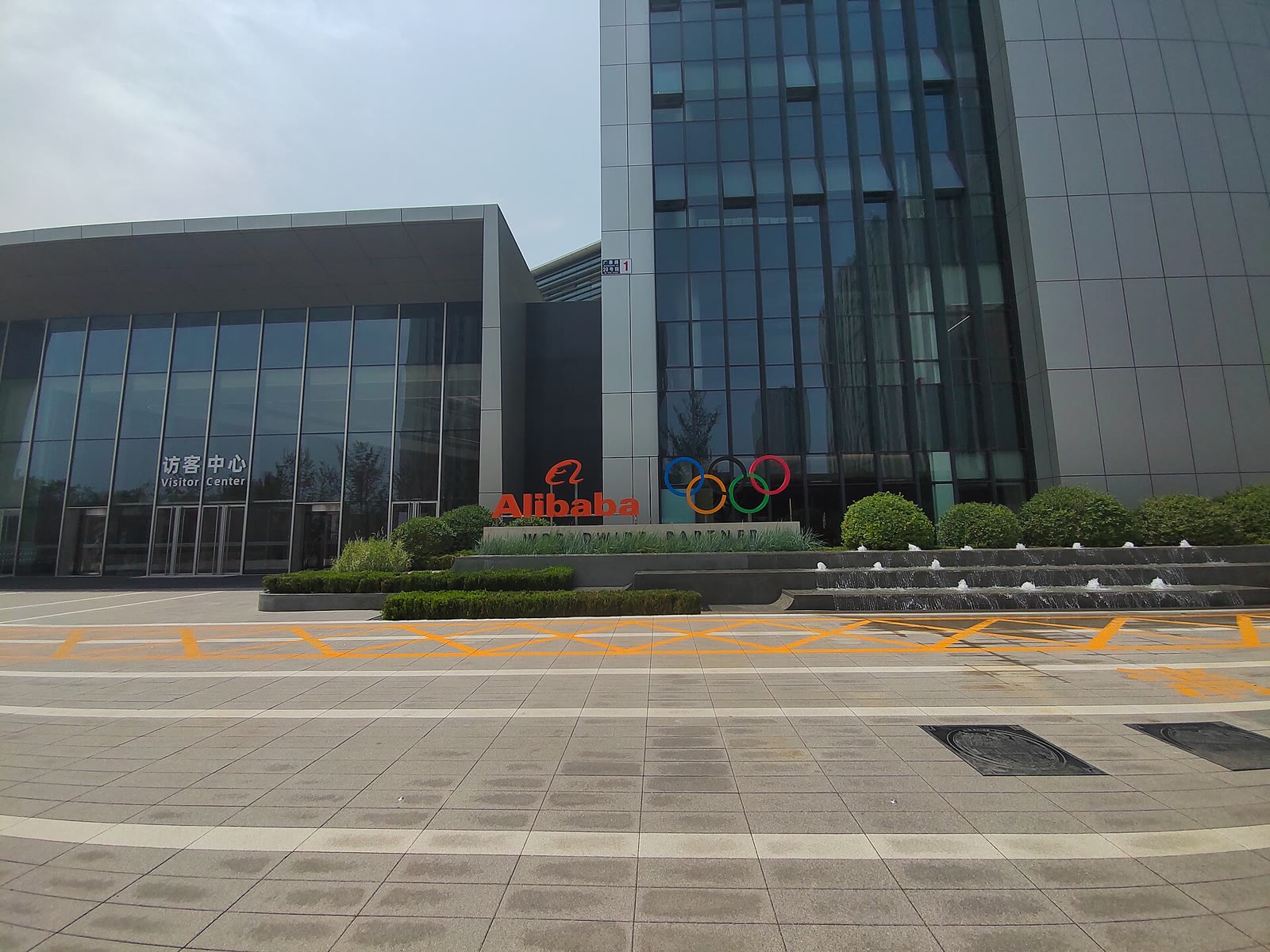
Image context: the cover is a real photograph of Alibaba's Chaoyang Technology Park in Beijing. It connects the work to the company behind the Qwen team without pretending that this particular office is evidence for the benchmark's scores or the location of its authors.[7]
The first error is the only stable target
ProcessBench's narrow task definition is a strength. Suppose step four incorrectly calculates a variable, while steps five through eight apply valid algebra to that wrong value. Calling every downstream line “wrong” confuses local logic with global validity. Calling those lines “right” ignores that they belong to a broken proof. The first bad step is the last point at which the evaluator has an unambiguous question: where did the solution leave the valid path?[1]
That target also permits a fairer comparison between two different verifier families. A process reward model, or PRM, assigns a correctness prediction or scalar reward to each step. A general language model used as a critic reads the entire problem and solution, reasons about it, then returns the first bad paragraph. Both can be reduced to the same output: one index or -1.[1][2]
The simplicity sits on top of expensive curation. The Qwen team generated candidate solutions with 12 open Qwen and Llama models spanning multiple sizes and capabilities. Because those models used line breaks inconsistently, the team removed the original breaks and asked Qwen2.5-72B-Instruct to segment each solution into logically fuller paragraphs. The reformatter altered solution content in fewer than 0.5 percent of cases. The team removed any reformatted solution whose final answer changed rather than silently keeping it.[1]
Human annotation was stricter still. Annotators had doctoral-level mathematical expertise, passed a proficiency test, and received the source dataset's reference solution as an aid—not as an instruction to accept one route blindly. Three experts reviewed each candidate. When they disagreed, a fourth and then a fifth could be added until three converged on one label. If five could not produce a three-person consensus, the solution was discarded. Roughly 30 percent of candidates fell out during this process.[1]
This is important evidence about the benchmark itself. Locating a mathematical error is not merely a labeling chore that a larger crowd can settle cheaply. On the hardest items, even qualified humans needed more review, and the no-consensus filter may have removed precisely the cases where verification is most difficult. The paper acknowledges that surviving labels can still be wrong and that discarding disputed cases may make the released set easier than the underlying problem distribution.[1]
A correct answer is not a clean trace
Before expert review, the builders intentionally sampled equal numbers of candidate solutions with correct and incorrect final answers within each source subset. Expert annotation then exposed a striking gradient among the “correct-answer” group. Only 3.5 percent of those GSM8K solutions contained a process error, compared with 18.8 percent for MATH, 32.2 percent for OlympiadBench, and 51.8 percent for Omni-MATH.[1]
Those percentages are not deployment error rates. They come from a constructed, balanced sample generated by a named set of Qwen and Llama models, not from natural user traffic. They should be read as a controlled comparison across difficulty, not as a forecast that half of all advanced-math answers are secretly broken.
The comparison still matters. As problem difficulty rose, a correct final answer became progressively weaker evidence that the path was valid. That breaks a common shortcut in reinforcement learning with verifiable rewards: use exact-answer matching as a cheap proxy for reasoning quality. If an invalid chain can receive the same positive label as a valid one, then a verifier trained from outcome-derived labels may learn the habits of a particular generator rather than mathematical correctness itself.[1]
Process supervision was supposed to repair this problem. Earlier work accompanying the human-labeled PRM800K dataset showed that rewarding intermediate steps could outperform outcome-only supervision on the MATH benchmark.[4] ProcessBench does not overturn that result. It asks the necessary next question: does the step verifier still work when it leaves the distribution on which process supervision looked convincing?
The metric punishes both kinds of lazy critic
An error detector can fail in opposite directions. It can wave every solution through, achieving high accuracy on clean traces while missing every broken one. Or it can accuse every chain, catching errors while making a verifier useless for accepting correct work.
ProcessBench reports accuracy separately on erroneous and correct solutions, then takes their harmonic mean as its headline “F1” score. This is not the usual class-level precision-and-recall F1. It is a balance between error-location accuracy and clean-solution accuracy. A model has to find the exact first error when one exists and abstain from inventing an error when none exists.[1][2]
The evaluation envelope matters just as much as the formula. Scalar PRM thresholds were selected on the GSM8K split and then carried into harder subsets, making threshold transfer part of the test. Open-source critic models were generally evaluated by majority vote over eight samples; GPT-4o used greedy decoding, while o1-mini used one sample because of API constraints. QwQ received a longer generation allowance than ordinary models. The published table is therefore evidence about the complete setups—not a budget-neutral league table of model intelligence.[1][2]
This boundary is easy to lose when a single average is copied into a model card. A current report should name the split, prompt, revision, decoding parameters, sample count, voting rule, maximum output length, and PRM threshold. It should also publish the two component accuracies. Otherwise, an apparently improved F1 may conceal a critic that simply became more suspicious or more permissive.
The specialist verifier lost the hardest lanes
The paper's most revealing result is a change in slope. Skywork's 7B PRM scored 70.8 on the GSM8K subset but only 22.9 on OlympiadBench and 21.0 on Omni-MATH. The Qwen team's own 7B PRM, fine-tuned directly on human-labeled PRM800K data after removing overlapping problems, held up better: 68.2 on GSM8K, 62.6 on MATH, 50.7 on OlympiadBench, and 44.3 on Omni-MATH.[1][4]
Large prompted critics were not universally good, but the strongest ones degraded less. Qwen2.5-72B-Instruct reached 54.6 on OlympiadBench and 52.2 on Omni-MATH. QwQ-32B-Preview reached 57.8 and 61.3. In the paper's setup, the specialist reward models often lost to a general model allowed to reason through the proposed solution before naming a step.[1]
The safe inference is not “critics beat PRMs.” Some small or mismatched critics performed extremely poorly, and the proprietary rows used different inference rules. The sharper finding is that a compact scalar scorer does not inherit robust verification merely because it is called a process reward model. Training-label provenance, source-model dependence, problem difficulty, and the critic's own reasoning budget all shape what “verification” means.
This is especially damaging for automatically synthesized process labels. One common recipe estimates whether an intermediate state is good by sampling completions and observing how often they reach the correct answer. ProcessBench identifies two failure channels. The label can become on-policy, reflecting which continuations one generator tends to produce rather than whether the step is mathematically sound. And because hard problems can reach a correct answer through a flawed chain, outcome frequency can certify the very process error the PRM is meant to catch.[1]
What ProcessBench measures—and what it leaves open
The public artifact is unusually usable. The Hugging Face release exposes four JSON splits with the problem, generator, segmented steps, final-answer status, and expert label. The GitHub repository publishes the critic prompt and executable evaluation path. That is enough for a team to inspect the contract and rerun a compatible model rather than trusting a screenshot.[2][3]
But three boundaries should travel with any new score.
First, public exposure now matters. ProcessBench has been public since its December 2024 preprint.[6] A model evaluated in 2026 may have encountered the problems, solutions, or derivative benchmark reports during training. A serious claim should pair ProcessBench with fresh private problems or a contamination analysis instead of presenting the public test alone as clean generalization.
Second, the unit is a model-created paragraph, not a formal proof step. Segmentation makes annotation possible, but it can place several mathematical moves inside one label or split one idea across labels. A correct index proves localization only at that chosen granularity.[1][2]
Third, the domain is English-language mathematics. The data card labels the release as English, and the benchmark does not test code execution, scientific experimentation, browser actions, tool calls, or Chinese-language reasoning.[3] The later PRMBench work complements this design by testing finer error categories such as soundness and sensitivity across 6,216 cases and 83,456 step labels.[5] That does not replace ProcessBench's difficulty ladder; it shows that “find the first error” and “understand what kind of error occurred” are separate evaluation axes.
For AI-China readers, that is the lasting lesson. ProcessBench is not proof that a model can supervise itself, nor a timeless ranking of Qwen against foreign systems. It is a well-bounded test of whether oversight survives a difficulty shift. By making the first wrong step—not the polished final answer—the score, it turns a vague promise of reliable reasoning into a failure that can be located, challenged, and rerun.
Sources
- Chujie Zheng et al., “ProcessBench: Identifying Process Errors in Mathematical Reasoning,” Proceedings of ACL 2025 (official paper page; task design, curation, annotation, metrics, model setups, results, and limitations).
- Qwen Team,
QwenLM/ProcessBenchrepository at commite802463(public evaluation code, critic prompt, data-loading contract, and inference settings; inspected August 5, 2026). - Qwen Team, ProcessBench dataset at revision
3bdcd53(four public JSON splits, field schema, language tag, and Apache-2.0 release metadata). - Hunter Lightman et al., “Let's Verify Step by Step” (arXiv:2305.20050; process-versus-outcome supervision and the human-labeled PRM800K dataset).
- Mingyang Song et al., “PRMBench: A Fine-grained and Challenging Benchmark for Process-Level Reward Models,” Proceedings of ACL 2025 (official paper page; complementary error-type evaluation and benchmark scale).
- Chujie Zheng et al., “ProcessBench: Identifying Process Errors in Mathematical Reasoning” (arXiv:2412.06559; December 2024 preprint record and version history).
- HoweyYuan, “Alibaba Chaoyang Technology Park,” Wikimedia Commons (CC BY-SA 4.0 source and license page for the real 2024 Beijing photograph used as the article image; locally resized).