A blast furnace is a severe place to discover that a model was merely persuasive. Ore, coke, hot air, gas, and molten iron interact inside a vessel whose most important reactions cannot be watched directly. An error is not a disappointing chat response. It can disturb product quality, waste fuel, shorten equipment life, or force operators into a slow and costly recovery.
That is why Baosteel's April 3, 2026 launch of what it calls an AI smart blast furnace matters. The important change was not a new conversational model or a brighter control-room screen. Baosteel said the system had moved from predicting furnace conditions to participating in a sense–decide–act loop, with deployments on the Baoshan base's No. 4, No. 3, and No. 2 furnaces.[1] Its first-quarter operating disclosure separately confirmed that the system had entered use, placing it among 122 AI scenarios and 20 agents that the company said it put into operation during the quarter.[2]
As of August 5, 2026, the public record supports a real production deployment. It does not yet support every superlative attached to it. The useful question is narrower: what has to be true for a furnace forecast to become a safe control system, and what evidence would show that the loop keeps working after launch day?
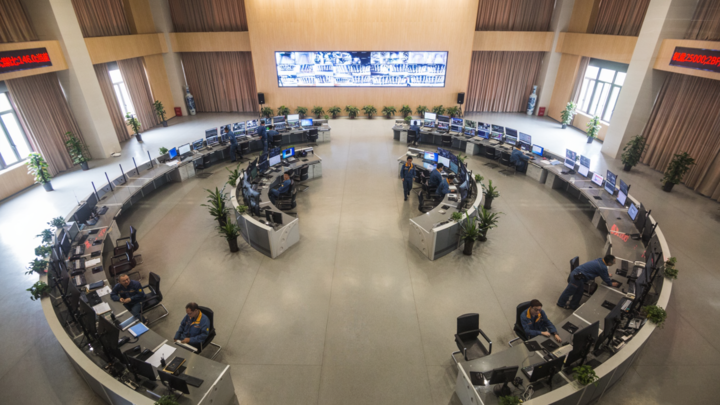
Image context: the cover is a real photograph of Baosteel's blast-furnace control center, not a generated factory scene or an analytical diagram. The operators, nested desks, and production displays show that this use case lives inside an existing industrial command structure rather than replacing it with a single model interface.[3]
The change is a handoff, not a bigger model
Baosteel did not begin with autonomous control in 2026. A 2024 description of China Baowu's steel-model platform already laid out a layered architecture: a foundation-model layer, an industry layer, and task-specific scenario models, supported by central training, edge inference, and production applications. It also described an “AI primary operator” as a target for processes where conventional control struggles.[6] That earlier platform was the substrate. The April launch marked the more consequential handoff from model output into live furnace operation.
The loop can be read in five stages.
First, plant instrumentation and laboratory results turn indirect evidence into a current-state estimate. A blast furnace's interior remains physically opaque; Huawei, Baowu's technology partner, describes temperatures above 2,000°C and more than 5,000 data dimensions around the process.[5] Those are vendor-reported figures, but the engineering point is sound: no single sensor reveals “furnace health.” The system has to reconcile temperatures, pressures, gas composition and distribution, burden data, raw-material properties, and hot-metal assays that arrive on different clocks.
Second, models forecast variables that operators can act on. Reporting from Shanghai Metals Market says Baosteel's system predicts hot-metal temperature and silicon content two hours ahead, with company-reported hit rates above 90 percent.[4] That is more useful than describing the furnace as simply “stable” because the targets and horizon can, in principle, be tested. It is still not a complete evaluation: a hit rate means little without the allowable error band, sampling frequency, missing-data policy, and performance across normal and abnormal furnace states.
Third, a decision layer turns the forecast into an intervention. Depending on the state, that could mean changing fuel, blast, burden, or other process settings. Public accounts use both the language of recommendations and automatic parameter adjustment.[3][5] That distinction matters. A model that proposes a change for an operator to approve has a different authority boundary from one permitted to write directly to the control system.
Fourth, existing automation executes an allowed change. The AI is therefore not “driving” a furnace in the free-form sense implied by an autonomous agent demo. It is operating through plant controls, process constraints, interlocks, and human supervision. The credible version of autonomy here is narrow: select among bounded actions, inside a validated operating envelope, while conventional safety systems retain the power to refuse or fall back.
Finally, the resulting furnace state becomes new evidence. Huawei describes an incremental cycle of training, inference, production verification, and feedback.[5] This is the real product. A one-off prediction model can look impressive in a historical test. A control loop has to absorb the consequences of its own recommendations without amplifying error.
The public numbers show adoption, not yet the whole effect
Several disclosed figures deserve weight because they describe actual operation. The State-owned Assets Supervision and Administration Commission's account says the system had reached three Baoshan furnaces by April and reports both core-model prediction hit rate and control adoption rate above 90 percent.[1] Baosteel's stock-market filing confirms the launch in a document whose main purpose is operating disclosure, not a product keynote.[2] Huawei says a furnace model had run for more than ten months and estimates annual benefit above CNY10 million per furnace through lower fuel use, steadier iron quality, and fewer abnormal conditions.[5]
But all of the outcome figures remain company- or partner-reported. None of the public sources supplies a per-furnace evaluation packet with the tolerance definition behind “hit,” the distribution of forecast error, an intervention log, operator overrides, matched pre-deployment periods, or uncertainty around the claimed savings. The April release says fuel consumption continued to decline; it does not publish the change in kilograms of fuel per tonne of hot metal or isolate the model's contribution from raw-material, maintenance, and operating changes.[1]
Even the adoption figure needs a denominator. If operators accepted more than 90 percent of control suggestions, were suggestions issued only during familiar, stable conditions? Did the system abstain during rare transitions? How often did an accepted action later need correction? High acceptance can demonstrate trust, but it can also reflect a conservative recommendation policy. Without coverage and override data, “90 percent” does not distinguish the two.
The claim of closed-loop control therefore should be treated as an architectural milestone, not a finished safety case. It tells us that predictions can cross the boundary into production action. It does not yet tell us how broad that authority is or how robustly it survives the furnace states that matter most.
The hard test arrives when the furnace changes
Blast-furnace data are not identically distributed samples. Ore quality changes. Coke properties drift. Sensors foul or fail. Maintenance alters equipment behavior. A relined furnace is not exactly the furnace represented in the old training data, and an abnormal episode is precisely where historical examples may be scarce.
A peer-reviewed review from University of Science and Technology Beijing identified the same structural limits before the current foundation-model wave: steelmaking models are highly data-dependent, preprocessing is difficult, and production safety still has to be verified.[7] Larger models do not remove those dependencies. They make governance of the data and control boundary more important.
A credible operating record would separate at least four states:
- Shadow prediction: the model forecasts, but operators and legacy controls act without it.
- Advisory operation: the model recommends; a human accepts, edits, or rejects.
- Constrained closed loop: the system may execute defined actions within an approved envelope.
- Fallback: drift, sensor disagreement, uncertainty, or an out-of-envelope state returns authority to conventional control and operators.
Performance should travel with the state. Forecast error in shadow mode, acceptance and edit rates in advisory mode, intervention outcomes in closed-loop mode, and fallback frequency are different measurements. Combining them into one success rate would hide the very handoffs the system is supposed to make safer.
Campaign-length reporting matters too. A blast furnace is a continuous asset, not a benchmark session. The valuable scorecard would show temperature and silicon error distributions, fuel rate per tonne, hot-metal quality variation, abnormal-condition duration, unplanned recovery events, abstentions, overrides, and sensor-related fallbacks across seasons and material mixes. It would also identify which model version controlled which interval. That is how a plant can tell improvement from a favorable operating window.
Why this is an AI-China signal
China's most consequential AI advantage may not appear first on a public leaderboard. In this case, the scarce assets are decades of process knowledge, synchronized plant data, engineers who can translate metallurgy into model targets, controls that can accept bounded actions, and several similar furnaces on which a working method can be adapted.
Baowu's platform design makes that scaling ambition explicit. The 2024 architecture proposed reusable industry and scenario layers rather than a separate model built from zero for every line.[6] Huawei likewise says the joint team uses a pretrained base plus furnace-specific fine-tuning, with the broader map extending toward casting, rolling, surface inspection, and materials work.[5] If transfer works, the advantage is not one clever forecast. It is a repeatable method for turning process history into constrained production software.
That possibility should not be confused with proof. Furnaces differ in geometry, instrumentation, burden, operating practice, and maintenance history. A system that transfers cheaply may lose calibration; a system that requires extensive re-engineering may still be valuable but is not a scalable “foundation model” in the usual sense. The next informative disclosure would show the time, data, and validation work required to move from one Baoshan furnace to another—and then to a materially different site.
Baosteel has crossed an important line: its AI is no longer confined to describing the furnace. It is being asked to influence what the furnace does next. The quality of that achievement will be decided less by the name of the base model than by disciplined limits—when the system acts, when it abstains, how operators can inspect its rationale and override its actions, and whether fuel, quality, and stability gains persist across a full industrial campaign. In physical AI, the plant always gets the final vote.
Sources
- China Baowu / State-owned Assets Supervision and Administration Commission, “中国宝武AI智慧高炉全球首发上线” (April 9, 2026; official account of the April 3 launch, three-furnace rollout, control loop, and reported operating results, republished by Sina Finance).
- Baoshan Iron & Steel Co., “2026年第一季度主要经营数据公告” (April 29, 2026; official operating disclosure confirming the AI blast-furnace launch, 122 AI scenarios, and 20 agents).
- Li Rong, Xinhua Daily Telegraph, “新华智见丨拥抱AI,中国宝武全线‘动’起来” (June 9, 2026; reported description of automatic furnace adjustment and source page for the company-supplied control-center photograph).
- Shanghai Metals Market, “宝钢发布智慧高炉,实现降本增效低碳减排” (April 3, 2026; launch report specifying the two-hour hot-metal temperature and silicon forecast targets).
- Huawei, “Baowu's Innovative Production: AI Models Unlock the ‘Black Box’ of Blast Furnaces” (2026; technology-partner account of the process dimensions, model architecture, feedback loop, operating duration, and claimed benefits).
- Chinese Society for Metals, “科技新进展:中国宝武钢铁大模型平台的开发与应用” (November 22, 2024; Baosight-supplied description of the pre-launch platform, layered models, central training, edge inference, and scenario architecture).
- Wang Zhongliang et al., “Research progress and application status of deep learning in steelmaking process,” Chinese Journal of Engineering (DOI: 10.13374/j.issn2095-9389.2021.08.17.001; review of data, preprocessing, generalization, and production-safety boundaries).