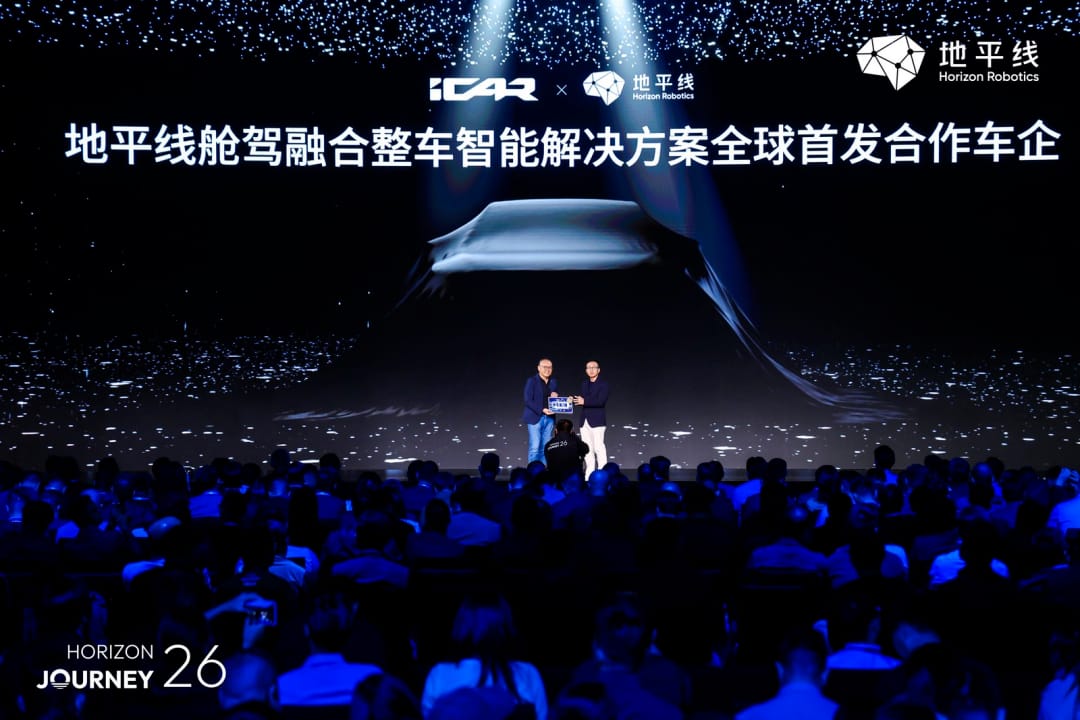
On a Beijing stage on April 22, 2026, two executives held up a board in front of a car hidden under black cloth. The scene looked like a familiar automotive launch. The products did not. Horizon Robotics presented Starry 6, a central processor intended to run both assisted-driving and cabin workloads; KKClaw, an agent operating system meant to coordinate tasks across those domains; and a new version of its HSD driving system. iCAR was named the first vehicle partner for the combined package.[1]
The easy reading is that a Chinese automotive-chip company has caught the agent fever. The more consequential reading is that Horizon is trying to redraw the computer boundary inside a car. Camera perception, trajectory planning, voice interaction, personal memory, entertainment, and vehicle controls have traditionally lived in different boxes with different release rhythms. Horizon now wants one system-on-chip to host both the machine that talks to the passenger and the machine that helps move the vehicle.
That makes this a revealing company dossier. Horizon's strongest asset is not a single TOPS figure or a chatty dashboard. It is the accumulated path from neural-network model to qualified toolchain, automotive processor, driving stack, Tier-1 integration, and production vehicle. Starry expands that path into the cockpit. It also exposes a harder test: whether consolidation can lower cost and latency without blurring the safety boundary between a fallible digital agent and a safety-critical driving function.
The first business was a ladder, not a flagship chip
Horizon has spent a decade building a graded product family. It introduced its BPU architecture in 2016 and the first Journey automotive computing product in 2017. By 2025, Journey 6 covered a wide range of assisted-driving configurations rather than forcing every automaker onto one premium part. That matters in China, where active safety, highway navigation assistance, urban navigation assistance, and higher-end sensor suites have to fit very different vehicle prices and bills of materials.[2]
The 2025 annual report gives the scale, with the usual caveat that these are company disclosures. Horizon shipped 4.01 million automotive-grade Journey processors during the year, up 38.8 percent; hardware supporting navigation-assistance functions accounted for 45 percent of shipments. More revealingly, over 95 percent of all units moved through ecosystem partners. The company also reported more than 110 new vehicle design wins, while HSD—the full-stack driving system that entered production in November 2025—won more than 20.[2]
Those numbers describe two related businesses. One sells a computing substrate that Bosch, ZF, automakers, and other integrators can build around. The other sells more of Horizon's own algorithmic stack. A design win is not a delivered car, and a shipped processor is not proof of safe behavior. Still, the mix shows why Horizon can attempt the Starry move: it already has both the horizontal chip channel and the vertical software route.
The quiet product is the translation layer
Automotive AI does not reach the road when a model finishes training. It reaches the road after operators are supported, floating-point weights are converted for an embedded target, accuracy loss is measured, memory is budgeted, code is compiled, runtime calls are integrated, and the complete system survives validation.
Horizon exposes much of that handoff in its Journey 6 toolchain documentation. The version 3.8.1 manual covers J6B, J6E, J6M, J6H, and J6P targets; names the supported ONNX and Torch operators and their constraints; and provides post-training quantization, quantization-aware training, embedded compilation, a runtime SDK, evaluation tools, and x86 simulation. In other words, the public surface admits that a model can be valid in PyTorch and still fail at the hardware boundary.[3]
That boundary is part of the product. In May 2026, Horizon said the Journey 6 development tool had received ISO 26262 qualification at ASIL D and its runtime software at ASIL B through exida. The certification is meaningful evidence about the development and runtime process; it is not certification that an arbitrary neural model, vehicle integration, or driving behavior is safe. Those still require a system-level safety case and testing in the intended operating conditions.[4]
Partners make the translation layer less theoretical. Bosch has assigned Journey 6B to a multipurpose camera and Journey 6E/M to a midrange assisted-driving family. ZF's separately announced ProAI package combines Journey 6P hardware with a modular central computer for highway, urban, and parking assistance. These disclosures do not validate every performance claim, but they show Horizon's processors entering systems owned, integrated, and sold by other automotive suppliers.[5][8]
That is a stronger moat than a chip launch alone. It is also a source of friction. Every new model architecture, unsupported operator, toolchain release, safety requirement, sensor layout, and OEM middleware choice can reopen the porting job. The value of Horizon's stack is therefore best measured by repeatable conversion and vehicle delivery, not by the largest model shown in a keynote.
Starry changes the bargain
Journey separated the family by driving workload. Starry 6 proposes to collapse two vehicle domains. Horizon says the flagship 6P uses an automotive-qualified 5 nm process and combines a 650-TOPS BPU, a 500K-DMIPS CPU complex, a 3,000-GFLOPS GPU, three audio DSPs, and support for as much as 128 GB of LPDDR5X memory at 273 GB/s. The company presents that mix as sufficient to run advanced driving models and cabin-side digital agents on the same chip.[1]
The specification is less interesting than the concurrency problem it creates. A cabin agent may be transcribing speech, retrieving a personal preference, generating an interface, and calling a cloud service while the driving stack is ingesting cameras, tracking objects, and producing a trajectory under a fixed latency budget. Shared memory can remove copies and make cross-domain features possible. It can also turn contention, reboot behavior, permissions, and update policy into first-order safety questions.
Horizon says its Fortress architecture physically isolates the cockpit and driving functions. KKClaw adds another boundary above it: skills run in a sandbox, unauthorized tool calls are blocked by policy, and a privacy router controls external connections. The operating-system pitch is that a natural-language request can coordinate cabin and driving tasks while local and cloud models work together.[1]
Those are sensible design claims, but the word agent should not be allowed to erase the hierarchy. A personalized assistant may suggest a destination or prepare the cabin. It should not acquire an informal path around deterministic vehicle controls, driver confirmation, or the safety mechanisms that keep a cabin crash from becoming a driving fault. The success of Starry will depend on making those permissions and failure domains more visible as the user experience becomes more seamless.
Volkswagen shows where the proof gets expensive
Horizon does not need readers to accept only its own launch language. Volkswagen's CARIZON joint venture provides a useful external view of the work between a processor and a road-ready system.
In April 2025, Volkswagen described more than 500 software specialists in Beijing and Shanghai building a China-specific assisted-driving stack. Its GAIA data platform was said to collect two terabytes per vehicle per day and process more than 100,000 kilometres of testing daily. These are partner-reported throughput figures, not safety outcomes, but they reveal the industrial machinery behind a polished driving demo.[6]
Volkswagen's April 2026 investor update makes the boundary sharper. Current CARIZON configurations use Journey 6H and 6P hardware across progressively richer camera, radar, and lidar sets. The presentation then separates today's assisted-driving delivery from a future L3-ready program and an in-house C7H chip planned for later deployment. It estimates that validating the target failure rate could require roughly 568 million test kilometres and describes simulation, hardware-in-the-loop infrastructure, more than 300 vehicles, and over 13,000 GPUs as part of the proposed validation system.[7]
The exact estimates belong to Volkswagen's disclosed setup and should not be generalized into a universal recipe. Their strategic message travels: centralizing more vehicle intelligence does not make validation disappear. It increases the number of interactions that must be isolated, simulated, replayed, and explained. It also shows that Horizon's partner model can be productive without guaranteeing permanent control of every layer; a large automaker may license algorithms and use Journey hardware today while co-developing a different processor for a later platform.
Production has to prove four boundaries
First comes isolation. A restart, memory spike, malformed skill, compromised cloud connection, or cabin-model update must not disturb the timing and state of the driving domain. A block-level safety claim becomes credible only when fault injection and vehicle-level evidence show what fails, what degrades, and what remains available.
Second comes model portability. Starry needs a versioned operator matrix, conversion recipes, accuracy reports, and profiler output comparable to the public Journey 6 surface. “Runs large models” is not a deployment contract until developers know which models, precisions, memory footprints, and fallback paths are supported.
Third comes partner delivery. Letters of intent from more than ten vehicle brands and Tier-1 suppliers establish interest, not series production.[1] The decisive milestones are named vehicle programs, start-of-production dates, shipped systems, stable over-the-air updates, and disclosed field behavior after cabin and driving workloads begin competing on the same silicon.
Finally comes authority. KKClaw's memory, skills, local execution, and cloud access need an interface that tells the occupant what the agent can observe and change. The safest system will not be the one that makes all boundaries invisible. It will be the one that makes permission, handoff, and degraded mode legible without forcing a driver to become a systems engineer.
Horizon Robotics is no longer easy to describe as an automotive AI-chip vendor. It has processors, conversion tools, a driving model, a production software stack, partner channels, and now an agent operating system aimed at the whole vehicle. That breadth is the company's opportunity. The burden of proof is equally broad.
If Starry succeeds, the important result will not be that a car can hold a conversation while it helps drive. Cars already combine those experiences across separate computers. The result will be that Horizon can place them on one computing substrate while keeping timing, authority, privacy, and failure containment explicit. Pulling the cockpit and the road onto one chip is the launch. Keeping their consequences apart is the product.
Sources
- Horizon Robotics, “Horizon launches the Starry cockpit-driving fusion chip and KKClaw operating system” (April 22, 2026; official Chinese launch release covering specifications, isolation, agent permissions, iCAR partnership, and source photograph).
- Horizon Robotics, Annual Report 2025, filed with Hong Kong Exchanges and Clearing (April 30, 2026; shipment, channel, design-win, HSD, product-history, and certification disclosures).
- Horizon Robotics, “Journey 6 Algorithm Toolchain Overview,” version 3.8.1 (accessed August 4, 2026; target hardware, quantization, compilation, runtime, simulation, and operator constraints).
- Horizon Robotics, “Journey 6 toolchain passes dual ISO 26262 functional-safety certifications” (May 18, 2026; exida qualification scope for the development tool and runtime software).
- Horizon Robotics and Bosch, “Horizon Robotics and Bosch Intensify Collaboration to Provide Assisted Driving Solutions for Multiple Automakers” (April 24, 2025; Journey 6B and 6E/M integration paths, vehicle programs, and announced production timing).
- Volkswagen Group, “Volkswagen Group in China presents new AI-powered ADAS system for the next generation of intelligent electric vehicles” (April 17, 2025; CARIZON staffing, GAIA data pipeline, and partner development boundary).
- Volkswagen Group, China Investor Update 2026 — Architecture, Software & ADAS: Status CARIZON (April 23, 2026; Journey configurations, delivery roadmap, simulation assumptions, validation resources, and in-house SoC plan).
- ZF Group, “ZF and Horizon Robotics to Jointly Launch Driver Assistance System up to SAE Level 3 on the Chinese Market” (October 27, 2025; Journey 6P integration in ZF ProAI and the stated 2026 production plan).