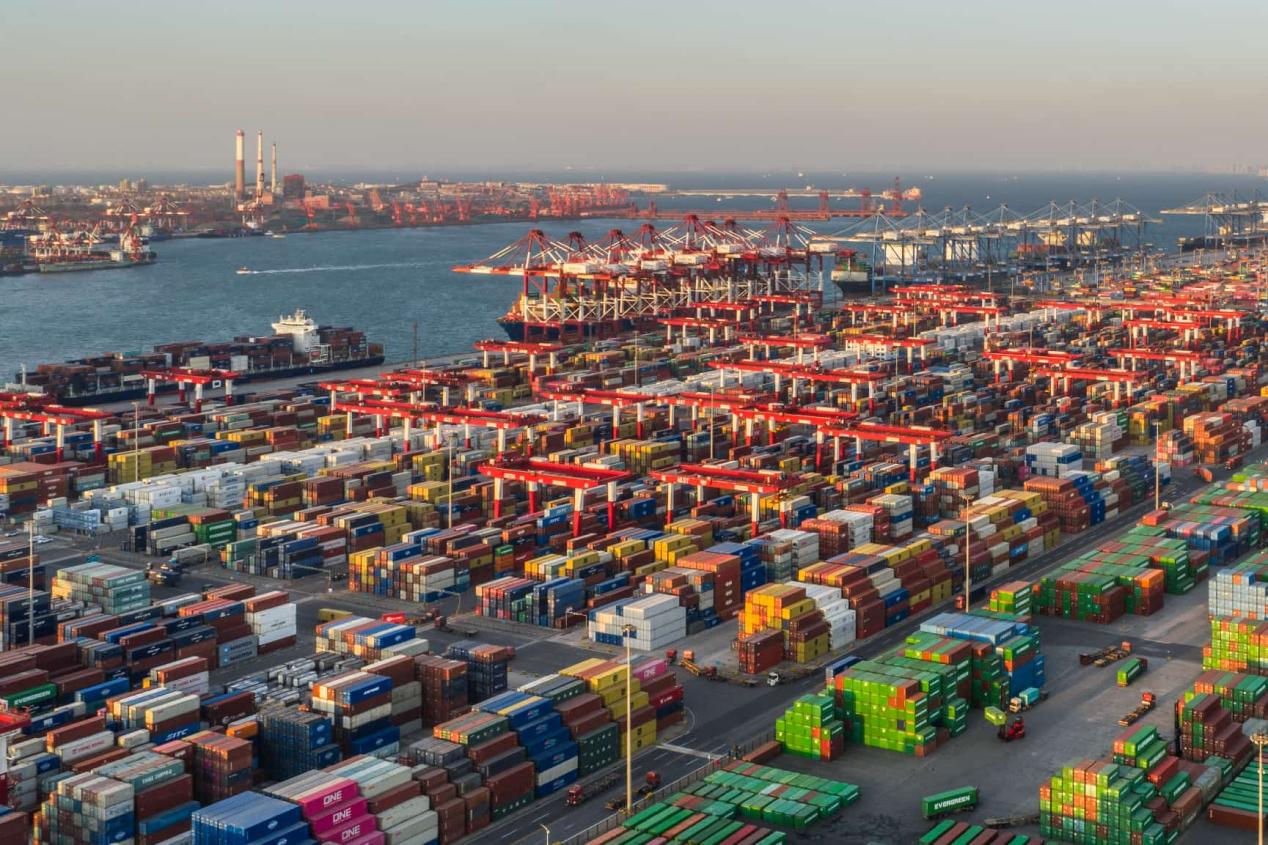
The most seductive image of an automated port is an empty cab: no driver in the yard vehicle, no operator high above the quay, perhaps no deck crew handling a mooring line. But an empty cab is only the visible end of a much larger control problem. A container must be assigned a place on the ship, a berth, a crane move, a vehicle, a slot in the stack, and eventually a route through the gate. Every decision changes the next one.
As of August 10, 2026, signals from Tianjin, Qingdao, and Ningbo-Zhoushan point to the same shift. Chinese ports are moving AI away from isolated perception demos and into the handoffs between planning and machinery. The useful unit is no longer one smart crane or one autonomous ship. It is the chain from ship to berth to yard to human exception control—and the evidence is strongest where that chain becomes inspectable.
The plan is becoming an operating instruction
Container stowage is a good place to see the change because it looks like paperwork until a bad plan reaches steel. A planner has to position thousands of boxes while respecting vessel stability, port sequence, weight, hazardous-cargo rules, crane access, and the cost of moving a container twice.
At Ningbo-Zhoushan's Chuanshan Port Area, a system unveiled in June 2025 was reported to generate a loading plan for 3,000 units in 20 minutes, replacing a manual process that could take more than three hours. Its builders drew on 20 years of operating data and worked with veteran stowage staff to encode practical judgment into the port's self-developed n-TOS system.[3] The important signal is not simply the time reduction. The output is meant to pass directly into a live terminal operating system, where a recommendation becomes a sequence of physical moves.
Tianjin now describes a wider version of that bridge. At a May 26, 2026 municipal press conference, the port said its new JTOS control system runs six higher-order algorithms for stowage, yard allocation, and berth assignment. Officials said vessel stowage planning had moved from hours to seconds; more than 80 percent of large cargo-handling equipment across the port was automated; and one operator could remotely monitor six automated yard cranes. The same account put PortGPT-CV's port-element recognition above 90 percent and said it was already used across the group's container terminals.[1]
Those numbers describe different tasks and denominators, so they should not be collapsed into one composite “intelligence” score. Recognition accuracy does not prove safe actuation, and a fast plan does not prove that the plan survives late vessel arrival, a blocked lane, damaged equipment, high wind, or a misdeclared box. What the figures do show is architectural: perception, planning, and equipment control are being placed inside the same production loop.
Qingdao is closing the seam at the waterline
Qingdao adds the part most port stories leave outside the frame: the arriving vessel. The port's A-TOS control system, online since 2022, covers ten functions including vessel scheduling, yard control, global dispatch, and automated gates. A July 2026 Shandong transport-department account described the terminal as operating with 19 automated quay cranes, 85 automated guided vehicles, and 94 high-speed rail-mounted gantry cranes. It attributed a 14.2 percent rise in overall operating efficiency and a 15 percent fall in yard rehandles to the locally developed system.[2]
In early 2026, that terminal also introduced a vacuum mooring system with 13 suction units and a stated combined holding force of 2,600 kilonewtons.[2] In February, the commercially operated intelligent container ship Zhifei used autonomous navigation to reach the berth without pilot boats or tug assistance, according to a People's Daily account. The vacuum system secured the ship in about 30 seconds; remote quay cranes and automated vehicles then handled the cargo.[4]
The striking part is not that each component can be called autonomous. It is that the components must agree on state. The ship has to arrive where the shore system expects it. Mooring has to establish a safe physical boundary before cargo work begins. Crane plans have to match the vessel plan; yard vehicles have to meet the crane without congesting the apron; the stack has to accept the boxes without creating tomorrow's rehandles. Port AI earns its value in these seams.
Automation moves expertise; it does not remove it
The three ports also show labor being relocated rather than erased. Ningbo's algorithm team learned from experienced stowage planners.[3] Tianjin's operators moved from individual machines into a remote-control relationship with several cranes.[1] At Qingdao, software teams built terminal and equipment-control systems that must be maintained while the port keeps operating.[2]
This changes the skill bottleneck. Routine manipulation can move to machines, while people take responsibility for model limits, maintenance, conflicting instructions, unusual cargo, weather thresholds, and recovery after a failed handoff. A control room with fewer operators may still carry more concentrated responsibility per person. The decisive workforce question is therefore not only how many jobs automation saves. It is whether the remaining team sees enough context, receives alarms early enough, and has practiced taking back control when several subsystems disagree.
Public reporting is much thinner here. The available accounts offer planning speed, equipment counts, recognition accuracy, and average efficiency, but not distributions of intervention rates, false alarms, near misses, recovery time, or performance by weather and traffic condition. Those omissions do not negate the gains. They mark the boundary between an impressive operating result and a safety case that another port could audit.
A port is an unusually demanding AI laboratory
Ports offer AI something consumer apps rarely do: repeated tasks, dense instrumentation, direct outcome labels, and a hard cost for delay. They also combine almost every difficult systems problem at once—vision, forecasting, optimization, networking, robotics, cybersecurity, and human supervision—inside a space where equipment weighs tonnes and schedules connect to global trade.
China has enough automated infrastructure to turn that environment into a learning advantage. At the June 2026 Tianjin shipping expo, the Ministry of Transport said China had built 30 automated container terminals, representing 27 percent of the global total, plus 30 automated dry-bulk terminals.[5] A separate May account referred to 60 automated ports and more than 10,000 kilometers of electronic navigational-chart coverage.[4] The categories are not identical, but together they show a large field base on which scheduling software, remote operations, and autonomous-vessel interfaces can be tested.
That scale also makes failures more consequential. A 2024 peer-reviewed risk analysis of automated container handling identified poor supervision, communication-network failure, sensor and equipment malfunction, weak safety awareness, and power interruption among the most critical factors.[6] These are coupling failures: the machine may work in isolation while the system around it loses visibility, connectivity, energy, or accountable oversight.
The regulatory direction reinforces that point. The International Maritime Organization's non-mandatory MASS Code took effect on July 1, 2026. It covers autonomous and remotely operated cargo ships, emphasizing risk assessment, cybersecurity, connectivity, remote operations, and human oversight; the master retains overall responsibility even when not aboard.[7] The code governs ships rather than terminal algorithms, but Qingdao's ship-to-shore demonstration shows why the boundary cannot stay conceptual. Autonomous vessels will meet automated ports in one shared operating moment.
The next proof is the exception ledger
The field signal is real: China is turning port AI into an orchestration layer that spans planning, perception, transport, cargo handling, and the waterline. Yet a highly optimized terminal can be both efficient and brittle if it cannot explain what happened when the sequence broke.
The next useful disclosures would therefore be less cinematic than another unmanned move. Ports should publish intervention rates by task, the causes and duration of degraded-mode operation, near-miss categories, recovery performance after network or sensor failure, and how often a human rejects or revises an AI plan. Common definitions would matter as much as better averages.
The “black-light terminal” is an evocative symbol because the yard can operate without conventional lighting for drivers. The mature version of port AI, however, still needs a well-lit control room—in both senses of the phrase. Someone must be able to see the whole chain, understand why it changed, and recover it before one mistimed handoff becomes a harbor-wide delay.
Sources
- Tianjin Municipal People's Government, “Press conference for the Fourth Tianjin International Shipping Industry Expo” (May 26, 2026; JTOS algorithms, equipment automation, remote operations, PortGPT-CV, and export claims).
- Shandong Provincial Department of Transport, “Chinese and foreign bloggers visit the domestically developed automated terminal” (July 20, 2026; Qingdao terminal equipment, A-TOS, efficiency, rehandles, and vacuum mooring).
- Ningbo municipal portal / China Daily, “AI stowage system launched at Ningbo-Zhoushan Port” (June 20, 2025; planning time, unit count, operating-data history, and expert collaboration).
- People's Daily, “Smart vessels revolutionize port operations across China” (May 21, 2026; Zhifei handoff, national infrastructure figures, and the Qingdao terminal photograph by Wang Hua).
- Xinhua, “AI steers China's shipping sector toward smarter future” (June 5, 2026; national automated-terminal counts and the shift from command execution toward reasoning).
- Xiaolei Wu et al., “A hybrid SgDT framework for risk analysis of container-handling operations at automated container terminals,” Ocean & Coastal Management 257 (2024) (systemic risk factors and their coupling).
- International Maritime Organization, “IMO adopts first global Code for autonomous ships” (May 22, 2026; MASS Code scope, oversight, risk, connectivity, cybersecurity, and implementation timeline).