As of 2026-06-18T05:33:37Z UTC, the useful AI-China signal in OpenRLHF is not that another reinforcement-learning framework exists. It is that post-training is becoming a scheduler problem: models must generate long rollouts, score or verify those rollouts, update policy weights, keep reference behavior visible, and repeat the loop without forcing every lab to rebuild distributed systems plumbing from scratch.[1][2][3]
That matters because China's open-model race has already moved beyond model cards alone. Qwen, DeepSeek, Kimi, Hunyuan, MiniCPM, and adjacent families made weights, APIs, and benchmark claims abundant. The harder layer now is repeatability after release: can a team take a base or instruction model, run RLHF or RLVR experiments, swap algorithms, keep generation throughput tolerable, and inspect failure modes without turning each run into a custom cluster project? OpenRLHF's answer is to make Ray, vLLM, DeepSpeed, Hugging Face models, and agent-style execution part of one post-training lane rather than separate notebooks.[1][2]
The China-specific point is narrower than "Chinese labs own RLHF." OpenRLHF's earlier arXiv version lists contributors under OpenRLHF Team, ByteDance, NetEase Fuxi AI Lab, and Alibaba Group, while the later ACL system-demonstration paper was presented in Suzhou and frames the project as a Ray-based framework for RLHF and RLVR accessibility.[3][4] That combination makes the project a useful field signal: Chinese model ecosystems are not only shipping models, but also publishing the machinery that makes reinforcement tuning more reusable.
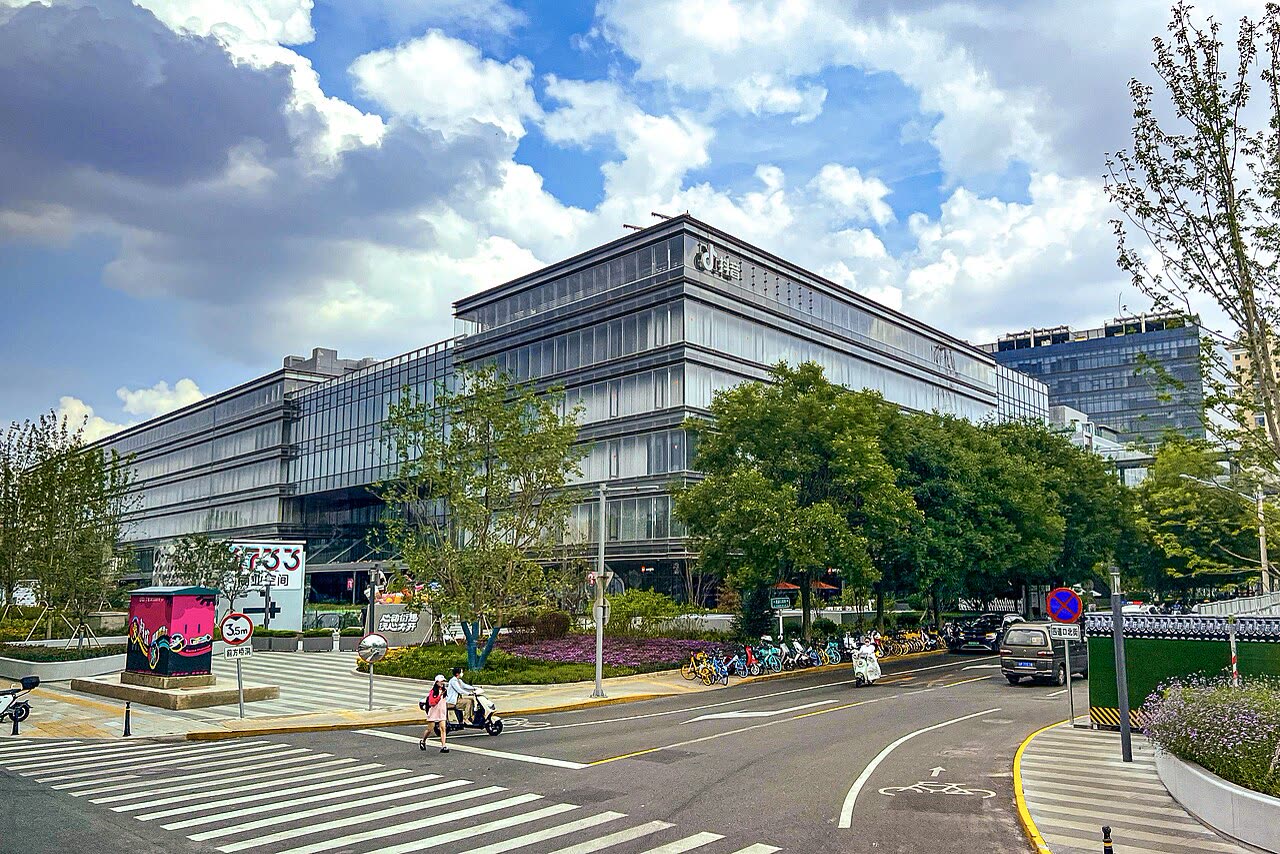
Image context: the cover uses a real photograph of ByteDance's 1733 Commercial Space office complex in Beijing. The image is not evidence that OpenRLHF is a ByteDance-only project; it is a situated visual anchor for the China-linked infrastructure ecosystem named in the project's authorship and sources.[6]
The bottleneck moved to rollout
Classic supervised fine-tuning is comparatively easy to visualize: a model, a dataset, a loss, and a training loop. RLHF and RLVR add roles. A practical run may involve an actor, critic, reward model, reference model, rollout engine, verifier, environment, logger, checkpoint path, and evaluator. OpenRLHF's original technical framing says PPO-style RLHF commonly requires four models, and that scaling beyond 70B parameters makes naive co-location on the same GPUs inefficient.[3]
OpenRLHF's core design response is placement. The project uses Ray to assign distinct roles across GPUs, vLLM to accelerate response generation, and DeepSpeed ZeRO to handle memory-efficient training.[1][3] The project documentation describes this as a Ray plus vLLM distributed architecture that can scale to 70B+ models, with hybrid-engine placement, async training, partial rollout, checkpointing, LoRA/QLoRA support, and SLURM multi-node operation in the same documentation surface.[2]
That is the field signal. The bottleneck is no longer only "can we tune a model?" It is "can we keep rollout generation, weight synchronization, reward calculation, and policy update from starving one another?" OpenRLHF's docs say vLLM-accelerated generation attacks the dominant RLHF bottleneck, and the arXiv paper's profiling section describes PPO sample generation as taking about 80% of overall training time in its LLaMA2 7B/A100 profile.[2][3] Treat the exact number as workload-specific, but the direction is durable: in reasoning-era RL, token generation is infrastructure.
The agent layer is the newer tell
The current OpenRLHF README no longer reads like a narrow PPO utility. It describes a unified agent-based execution pipeline, with single-turn and multi-turn modes decoupled from algorithms such as PPO, REINFORCE++, GRPO, RLOO, and related variants.[1] In the docs, that idea becomes operational: token-in/token-out execution is meant to keep single-turn rewards, custom Python reward functions, HTTP reward models, full multi-turn environments, and local OpenAI-compatible agent servers under one conceptual roof.[2]
This is where OpenRLHF differs from a purely academic RLHF wrapper. China's AI market is now crowded with products that claim agent behavior: coding agents, browser agents, office agents, research agents, app operators, and multimodal assistants. If post-training tools only support one-shot text reward loops, they cannot follow the product surface. OpenRLHF's multi-turn and VLM notes indicate that the framework is chasing the same shift the market is chasing: from answer scoring toward interaction scoring.[1][2]
The strongest implication is not that OpenRLHF solves agent training. It does not. Environments still have to be built, rewards still have to be trusted, long-horizon credit assignment remains hard, and async rollout can change training dynamics if teams do not validate convergence. The stronger and defensible implication is that OpenRLHF makes those questions easier to localize. When execution mode is separated from algorithm choice, a team can ask whether the failure came from the reward, the environment, the rollout server, the async setting, the KL regime, or the policy update rather than blaming "RL" as one opaque box.[1][2]
Why the scheduler layer matters in AI-China
OpenRLHF should be read beside, not instead of, other China-linked post-training systems. Alibaba's ModelScope orbit covers post-training workbenches and model distribution. ByteDance's verl makes RL dataflow and control-plane design explicit. Data tooling projects make curation and filtering visible. OpenRLHF's distinct contribution is a lower-friction scheduler-and-rollout lane: a way for researchers and practitioners to try serious RLHF/RLVR with common model interfaces and fewer bespoke orchestration decisions.[1][4]
The ACL paper makes the accessibility claim directly, describing OpenRLHF as built on Ray, vLLM, DeepSpeed, and Hugging Face Transformers, with a simplified design and documentation intended to lower the barrier for researchers and practitioners.[4] It also reports speedups from 1.22x to 1.68x against state-of-the-art frameworks across different model sizes in its tested setup.[4] Those benchmark numbers should be treated with a boundary: they depend on versions, hardware, model sizes, context lengths, and workload shape. The useful point is not a permanent leaderboard. The useful point is that the project is competing on the right bottleneck.
The vLLM integration note reinforces that reading from the inference side. It calls OpenRLHF the first open-source RLHF framework based on Ray and vLLM and credits the project with practical work around vLLM wrapper and hybrid-engine components.[5] That matters because inference engines are no longer passive serving layers. In RL post-training, serving and training are coupled: generated samples feed the reward and update loop, while policy updates have to return to the generation engine without intolerable synchronization cost.[3][5]
For Chinese labs and builders, this layer has three strategic uses. First, it shortens the path from open-weight release to local adaptation: a team can test RLVR on math, code, tool, or reasoning tasks without starting from a blank distributed-systems design. Second, it makes hardware and cluster constraints visible earlier. Third, it gives product teams a vocabulary for agent post-training that is more precise than "make it smarter." They can reason about rollout length, reward source, async behavior, checkpointing, and environment feedback as separate operating choices.[1][2][4]
The falsifier is straightforward. If OpenRLHF's agent, VLM, async, and scheduler surfaces do not keep up with real model and environment complexity, it will remain an important teaching and research tool rather than a durable production lane. But if its current direction holds, the project points to a durable AI-China pattern: the advantage shifts from who announces the next model first to who can repeatedly post-train, evaluate, and route models under changing task and hardware constraints.[1][2][4]
Sources
- OpenRLHF,
OpenRLHF/OpenRLHFGitHub repository README (Ray + vLLM architecture, agent execution design, algorithm list, news notes, and repository activity). - OpenRLHF documentation, "Welcome to OpenRLHF's documentation!" version 0.10.2 (Ray + vLLM highlights, 70B+ scaling note, agent modes, async rollout, VLM RLHF, CLI hierarchy, and operations pages).
- Jian Hu et al., "OpenRLHF: An Easy-to-use, Scalable and High-performance RLHF Framework," arXiv HTML v3, 2024 (affiliations, four-model RLHF problem, Ray/vLLM/DeepSpeed scheduling design, and original performance tables).
- Jian Hu et al., "OpenRLHF: A Ray-based Easy-to-use, Scalable and High-performance RLHF Framework," ACL Anthology / EMNLP 2025 System Demonstrations (Suzhou proceedings record, abstract, DOI, and reported 1.22x-1.68x speedups).
- vLLM Blog, "Accelerating RLHF with vLLM, Best Practice from OpenRLHF," April 23, 2025 (vLLM integration context and OpenRLHF contributor credits).
- Wikimedia Commons, "ByteDance 1733 Commercial Space (20240731145554).jpg" (source page for the real ByteDance office photograph used as this article image).