
As of 2026-06-17T14:07:23Z UTC, the useful way to watch Nathan Lambert's 2025 open-model landscape talk is not as a scorecard of which model won a given month. It is a diagnosis of a changed release culture. The talk is valuable for ai-china coverage because it treats DeepSeek, Qwen, and the broader Chinese open-model wave as an ecosystem behavior: labs learned to make model weights, reasoning recipes, size ladders, and deployment surfaces travel faster than conventional frontier-model commentary can absorb.[1][2]
That distinction matters because the public AI-China debate often gets trapped between two thin stories. One story says China merely copies or commoditizes frontier work. The other says one dramatic DeepSeek-style shock proves a permanent reversal. Lambert's frame is more useful than either. The meaningful change is not a single upset. It is the emergence of a repeatable release norm: publish capable open-weight models, explain enough of the recipe to make them credible, let downstream developers compare and adapt them quickly, and use the resulting adoption pressure to keep closed incumbents honest.[1][2][5]
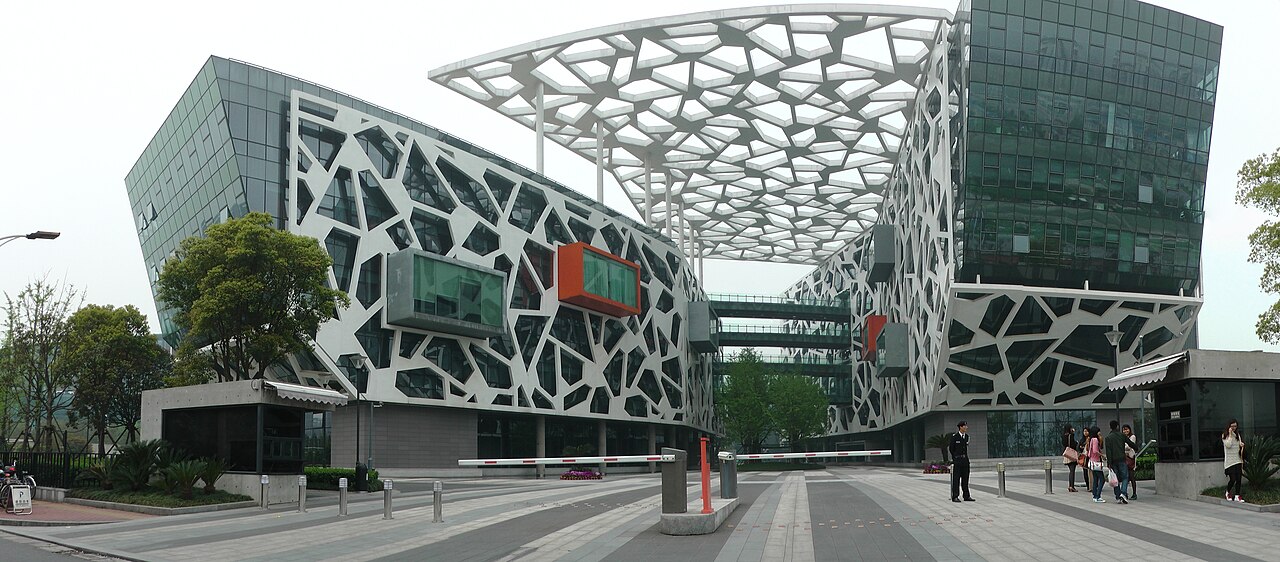
The cover image belongs in that frame. Alibaba's Qwen is only one actor, but its open-weight cadence has become one of the clearest examples of the Chinese release pattern Lambert is describing. A real photograph of Alibaba's Hangzhou headquarters keeps the story attached to companies, teams, campuses, and cloud distribution channels rather than to abstract "AI race" imagery.[3][6]
The first thing to notice is the shift from model ranking to model norms
The talk's strongest move is to make "open model" a behavioral category, not only a license label.[1][2] That is essential for understanding China AI. A leaderboard can tell you whether DeepSeek-R1 or a Qwen variant is near the top of a public benchmark at a given moment. It cannot tell you whether the surrounding release makes the model easier to inspect, fine-tune, quantize, host, route, or compare in the next wave of applications.
DeepSeek-R1 is the cleanest example of why the norm matters. Its technical report emphasizes reasoning capability produced through reinforcement learning, a cold-start path for the main R1 model, and distillation into smaller dense models.[4] The important AI-China signal is not only that the model performed well. It is that the release turned a reasoning recipe into something the global ecosystem could discuss, test, and imitate. A closed model can impress users; an open-weight reasoning model can reset expectations for what other labs must explain.
Qwen shows the complementary pattern. The Qwen3 release framed the family around multiple dense and mixture-of-experts models, hybrid thinking and non-thinking behavior, broad multilingual support, and open-weight distribution.[3] That package shape matters because it lets different users enter at different points: researchers studying capability, developers looking for a deployable checkpoint, cloud customers wanting managed APIs, and product teams testing whether reasoning should be routed only to harder tasks.
Around the China sections, openness becomes a pressure system
Read Lambert's China emphasis as a pressure-system argument.[1][2] Open releases do not have to beat every proprietary model to change the market. They only have to be strong enough, cheap enough, legible enough, and frequent enough to change the default question from "which closed API is best?" to "why can this task not run on an open Chinese model, or on a local derivative of one?"
That pressure is visible in the written record around the talk. Lambert's companion essay says 2025 open-model discussion was shaped by DeepSeek kicking off Chinese open-model norms, Qwen's dominance, and a wider rearrangement of the open ecosystem.[2] Stanford HAI's policy brief reaches a similar high-level concern from a different angle: China's open-weight ecosystem is diverse enough, and globally diffused enough, that policy analysis has to look beyond one company or one DeepSeek moment.[5]
The result is an ecosystem story rather than a hero-lab story. DeepSeek made reasoning releases feel strategically consequential. Qwen made family breadth and deployment packaging feel routine. Other Chinese labs then compete inside the same expectation field: model cards, checkpoints, demos, API access, and quick downstream ports become part of the release itself. My inference from the talk and sources is that this is the real competitive change. China AI is not only shipping models; it is normalizing a faster public proof cycle.
The engineering annotation is about friction
For a technical viewer, the practical question is friction. How many steps sit between reading the announcement and making the model useful? Can an engineer identify the model size, license boundary, context behavior, reasoning mode, serving path, and expected tradeoff without reconstructing everything from social posts? Can a team compare a local open-weight option against a managed endpoint without guessing what changed between variants?
That is where Qwen3's packaging is revealing. Its public release materials do not merely say "new model." They present a family, mode behavior, language breadth, and open availability as part of the adoption surface.[3] DeepSeek-R1's report does something similar from the research side by making reinforcement-learning and distillation choices part of the public conversation.[4] The two releases are not identical, but they share a norm: capability claims arrive with enough surrounding material to make downstream testing fast.
The limitation is important. Open weights do not eliminate governance, security, evaluation, or supply-chain questions. They can even multiply them, because a widely copied model family can appear in wrappers, forks, quantized variants, and hosted endpoints with different operational guarantees. That is why Lambert's talk should not be read as simple open-source boosterism. The hard question is whether the release culture produces trustworthy adoption or merely faster adoption.
The lasting signal is release cadence plus explanation
The most durable insight in the video is that open-model competition now lives in the pairing of cadence and explanation.[1][2] Cadence without explanation produces noise: many model names, little confidence. Explanation without cadence produces admirable papers that do not shape developer behavior. The Chinese open-model wave became consequential because labs began combining both: frequent releases with enough technical and product framing for others to evaluate them quickly.
For AI-China watchers, that changes the checklist. Do not ask only whether the latest Chinese model tops a benchmark. Ask whether the release makes itself usable. Are the weights available? Are the reasoning and non-reasoning modes clear? Are smaller distilled models part of the strategy? Is the model family wide enough to meet different cost and latency envelopes? Is there a path from research release to cloud endpoint, local inference stack, or application surface?
Lambert's talk is worth embedding because it makes that checklist visible. The story is not "DeepSeek happened" or "Qwen is strong." The story is that Chinese labs helped make open-model release norms harder to ignore. Once that norm exists, every closed frontier lab, every open-weight competitor, and every enterprise buyer has to respond to a new baseline: capability is more persuasive when it can be downloaded, tested, adapted, and explained.[1][2][5]
Sources
- PyTorch, "Mapping the Open Model Landscape in 2025 - Nathan Lambert, Ai2," YouTube video.
- Nathan Lambert, "The State of Open Models" at Interconnects AI (2025 talk companion essay on DeepSeek, Qwen, and open-model ecosystem shifts).
- Qwen Team, "Qwen3: Think Deeper, Act Faster" (official release post describing the Qwen3 family, hybrid reasoning modes, language coverage, and open-weight distribution).
- DeepSeek-AI, "DeepSeek-R1: Incentivizing Reasoning Capability in LLMs via Reinforcement Learning" (arXiv technical report on R1, R1-Zero, reinforcement learning, and distillation).
- Stanford HAI, "Beyond DeepSeek: China's Diverse Open-Weight AI Ecosystem and Its Policy Implications" (policy brief on diffusion beyond a single DeepSeek moment).
- Wikimedia Commons, "File:Alibaba group Headquarters.jpg" (real photograph used as the article image source).