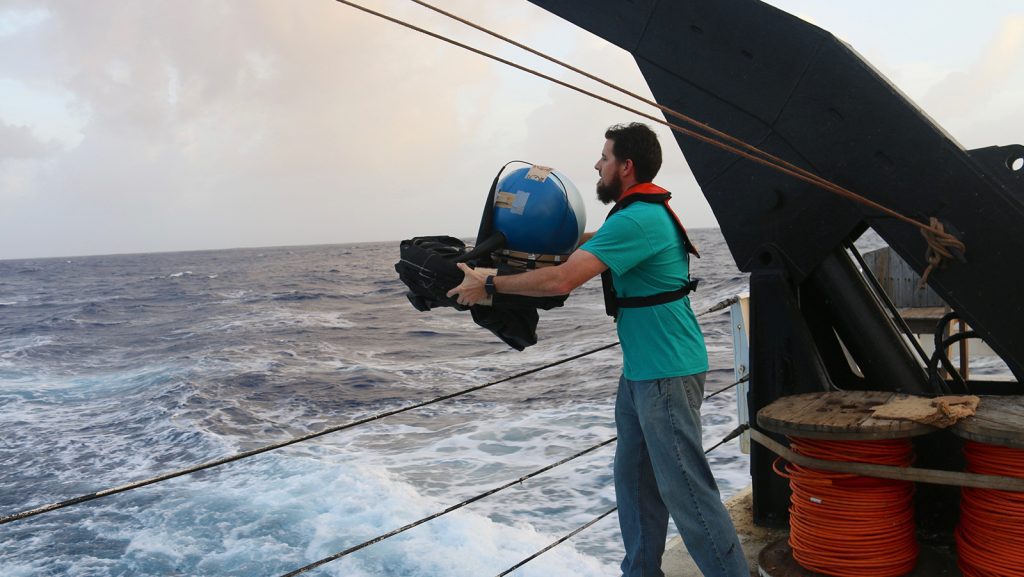
A drifting buoy turns a patch of ocean into a measurement. A sensor records the water temperature; successive positions reveal where the current carries it. Below the surface, a tethered sea anchor helps the instrument follow the water. NOAA’s Global Drifter Program documents that physical arrangement because the meaning of the data depends on it: lose the sea anchor, and wind and waves exert a different influence on the float.[1]
That is an unexpectedly useful starting point for reading China’s ocean AI research. The forecast arrives as an array of numbers, but judging it brings the researcher back to instruments, sampling and the work of preparing observations.
OceanForecastBench makes that return journey a shared research tool. Published on July 28, 2026, by Yi Han and colleagues, principally at China’s National University of Defense Technology, it standardizes training data and observation-based evaluation.[2] Read alongside an earlier model release and a Chinese research forum, it signals a field investing in the means to compare its work.
This synthesis follows those records from 2024 to 2026, with public documentation checked on October 11, 2026.
A model release becomes a shared problem
XiHe’s public repository records the release of pretrained ocean forecasting models on February 8, 2024. It offers forecasts for one through ten days, distributes models in ONNX format, and supplies a worked inference example. Its instructions also spell out the preparation of initial ocean fields, including the depth correspondence required when using alternative input data.[3]
That detail tells a story about access. Downloadable weights let another researcher try a model, but a forecast still depends on how the starting ocean is represented. Two teams can run the same architecture and create different experiments before either reaches the prediction step.
By July 12, 2025, a China Computer Federation forum at Ocean University of China was explicitly discussing the data problems shared by ocean models. Its Chinese-language account identifies sparse, noisy observations and the difficulty of adapting general systems to particular applications. Speakers represented several approaches, including physical and learned forecasting methods and OceanGPT’s language-based tools.[4]
The forum does not establish a single technical consensus, or a direct organizational link to OceanForecastBench. Together, however, these records suggest a shift in what deserves attention: from whether researchers can obtain a model to whether they can assemble a comparable experiment around it.
The ocean in the training files
A central ingredient is GLORYS12, the ocean reanalysis distributed by Copernicus Marine. Reanalysis reconstructs past conditions by combining a numerical model with observations. GLORYS12 uses the NEMO ocean model and assimilates satellite sea level, surface temperature, sea ice and in-water temperature and salinity profiles. Its native grid has a horizontal resolution of 1/12 degree and 50 vertical levels.[5]
This is a carefully constructed account of the ocean. Treating it as an unmediated photograph of reality would erase the modeling and assimilation work that makes a continuous global record possible. For an AI model, that record offers consistency; for its evaluator, it creates a reason to consult measurements as well.
OceanForecastBench’s released training layout uses a 1.40625-degree grid and 23 depth levels.[7] Its published setup trains on 1993–2017, validates on 2018–2020, and evaluates forecasts initialized from operational Mercator analyses in 2022–2023, at leads of one to ten days. The experiments used eight NVIDIA RTX 4090 GPUs.[2]
The coarser grid makes this a particular kind of research entry point. A successful experiment here would justify further testing at finer resolution; it would not establish that the model can describe the current around a harbor entrance. The spatial scale is part of what the result means.
Measurements arrive with a history
The released repository makes the observation side concrete. Its expected testing folders separate temperature and salinity profiles, drifter current and surface-temperature data, and satellite sea-level records. The example filenames identify EN4 profiles and a six-hour drifter dataset.[7] This structure exposes what a candidate model must be compared against.
The Met Office’s EN4 documentation distinguishes two products: observed subsurface temperature and salinity profiles with quality information, and objective analyses made from those profiles with uncertainty estimates.[6] Those products answer different needs. Selecting profiles preserves a comparison at sampled locations and depths; selecting an analysis introduces another reconstruction. An evaluator needs to know which file entered the calculation.
The drifter records have their own preparation history. NOAA’s September 2023 announcement of its ERDDAP service describes access to hourly and six-hour quality-controlled, interpolated datasets, available in common formats and through programmatic requests.[8] A physical measurement has passed through processing before it becomes an easy download.
The implication for China’s AI ecosystem is concrete: reusable evaluation draws on international observational services as well as domestic modeling work. A useful contribution can be the careful joining of those resources. That joining remains scientific work, even when a software interface makes it look routine.
The published test and the repository differ
The final journal paper evaluates five baselines: PSY4, ResNet, SwinTransformer, ClimaX and FourCastNet. The public README additionally lists XiHe. The paper is therefore the authority for the reported experiment; the README describes a broader inventory. Neither list alone establishes a common ranking of every ocean model mentioned in the surrounding literature.[2][7]
This small discrepancy illustrates why a shared benchmark needs versioned records. A reader should be able to connect a result to its paper version, model configuration, observation files and evaluation code. A familiar benchmark name cannot carry all that information by itself.
The next persuasive signal would be independent teams using that common setup, documenting changes, and showing where their gains persist across variables, depths and forecast horizons. Claims about local navigation would require appropriately local tests. Claims about cheaper operation would need the cost of preparing inputs as well as generating predictions.
OceanForecastBench’s contribution is to make more of that comparison possible to inspect. The broader opportunity is cumulative: one group can improve a model while another can test the improvement against a recognizable experiment. Progress then leaves behind something more durable than a headline score—a result that another researcher can challenge using the same observations.
Sources
- NOAA Atlantic Oceanographic and Meteorological Laboratory, “Global Drifter Program”; instrument components, sea anchors and observation practices, accessed October 11, 2026.
- Yi Han et al., “OceanForecastBench: A Benchmark Data Set for Data-Driven Global Ocean Forecasting,” Journal of Geophysical Research: Machine Learning and Computation, July 28, 2026; final published methods and baseline list.
- Ocean-Intelligent-Forecasting, “XiHe-GlobalOceanForecasting”; official release history, model downloads and inference instructions, accessed October 11, 2026.
- China Computer Federation YOCSEF Qingdao, report on the ocean large-model forum held July 12, 2025, published July 19, 2025 (Chinese); firsthand account of participating research groups and data challenges.
- Copernicus Marine Service, “Global Ocean Physics Reanalysis,” product GLOBALMULTIYEARPHY001030; GLORYS12 resolution, model and assimilated observations, accessed October 11, 2026.
- Met Office Hadley Centre, “EN4: quality controlled subsurface ocean temperature and salinity profiles and objective analyses”; distinction between profiles and analyses, accessed October 11, 2026.
- Ocean-Intelligent-Forecasting, “OceanForecastBench”; public README, testing-data layout and baseline inventory, accessed October 11, 2026.
- NOAA/AOML Communications, “ERDDAP Server Increases Access to Drifting Buoy Data,” September 18, 2023; data-processing and access description, and source of the Shaun Dolk drifter-deployment photograph.