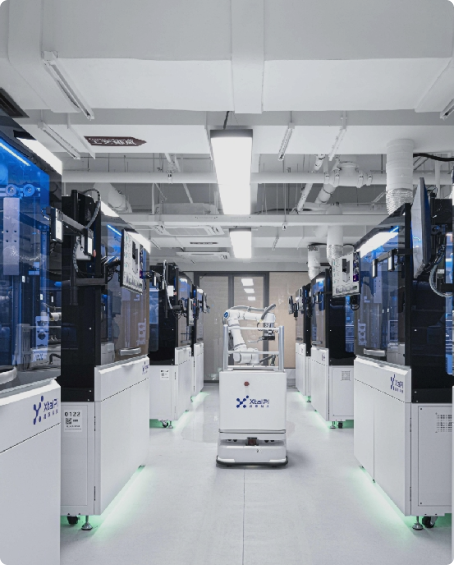
Before an AI system can learn from a chemistry experiment, a sample has to be weighed, mixed, moved and measured. Each step can become a delay; each can also lose information. A promising molecular prediction becomes useful only when the laboratory can connect it to a physical result.
XtalPi has built its company around that return journey. Founded in 2015 by three physicists, it began with crystal-structure prediction and developed laboratory operations alongside its computational tools. Its Chinese company history places wet-lab facilities in 2018, automation research in 2020 and standardized robot clusters in 2022. It now describes a system connecting scientific models, software agents and robotic execution, with large robot installations in Shenzhen and Shanghai.[1]
The interesting question is how much of that connection can be seen outside the company's own description. Public records offer several distinct answers: an awarded laboratory contract, an institution's report of an operating workflow, and a published materials experiment using XtalPi hardware. Together, they make the company's AI strategy unusually tangible.
This dossier examines those records and the company's public documentation as checked on October 10, 2026. The deployments and study below retain their original dates.
The software has to know where the vial went
XtalPi's Chinese platform documentation separates its system into laboratory robots, specialist AI models and management software. The robots perform chemical operations and collect data; the models support prediction and experimental design; the software coordinates equipment, records, scheduling and materials. Its catalog includes the XmartChem synthesis workstation, an electrolyte workstation and the ChemPlus solid dispenser.[2]
The software layer deserves attention. XtalPi describes visual workflow composition, equipment scheduling, inventory traceability and exception handling. Those are practical requirements for connecting an experiment to its record. A model cannot usefully learn from a measurement if the system has lost track of which material, preparation or sample produced it.[2]
Consider a hypothetical screening run in which one vial never receives its intended solvent. Recording that vial as an unsuccessful chemical reaction would teach the model something different from recording an interrupted experiment. More automation creates value when it preserves such distinctions. The useful unit of progress is a result whose history can be reconstructed.
This is the strategic attraction of owning both computational tools and experimental equipment: the company can work on the handoff between them. Whether that advantage survives in a customer's laboratory depends on integration, maintenance and the quality of the records produced there.
Hengqin supplies a traceable customer story
On July 25, 2024, China's government procurement portal named Shenzhen XtalPi as the winning supplier for a customized intelligent automation platform for the Guangdong laboratory devoted to traditional Chinese medicine in Hengqin. The notice specifies one system and an award of RMB44.928 million. It establishes a purchasing decision; by itself, it says nothing about successful operation.[3]
An institutional account supplies the next piece. On June 19, 2025, Guangzhou University of Chinese Medicine published a report from Hengqin Laboratory describing completed debugging and capability validation. It said 14 workstations and two mobile robots had been connected into an automated workflow, spanning separation and extraction of chemical fractions from herbs through cell-function evaluation. The laboratory reported preparing and analyzing more than 2,000 fractions from a single herb.[4]
The university report does not name XtalPi. The supplier attribution comes from the procurement record; the operational description comes from the laboratory. Read together, they support a concrete account of equipment procurement followed by institutional reporting of an integrated platform.[3][4]
That distinction matters because a connected workflow is already a substantial deliverable. Samples must travel between operations and remain identifiable. The documents do not establish how frequently an AI model chose the next experiment, how often people intervened, or whether the workflow produced an effective medicine. Their strongest evidence concerns the laboratory's ability to carry out a defined sequence.
A crystal study makes the division of labor visible
A more granular example appeared online in the Journal of the American Chemical Society on October 30, 2025. Huiyu Liu and colleagues combined machine learning with automated screening of polar organic cocrystals—materials whose molecular arrangement is central to their properties. The platform incorporated XtalPi's ChemPlus dispenser alongside a robotic arm, liquid handling and computer vision.[5]
The paper describes a particularly useful detail: a camera scanned a two-dimensional barcode to connect a physical vial with its digital plan and results. Another camera monitored crystallization. Models helped prioritize candidates, automation prepared and screened samples, and diffraction measurements established crystal structures. The reported campaign tested 13 molecular pairs across 20 solvents, finding six polar cocrystals within six weeks.[5]
Those results belong to a particular chemical family and workflow. They do not measure the speed of XtalPi's whole business or demonstrate unrestricted autonomous discovery. The study's clear contribution is a documented division of labor: prediction narrows the search, machinery executes it, and measurement checks what formed. It should be read as machine-learning-guided automated screening, without assuming an independently demonstrated cycle of autonomous experiment selection and model retraining.[5]
What would make the strategy more convincing
The institutional records and published experiment reveal two ways XtalPi's technology can enter research: as a customized laboratory installation and as a component within a scientist's own platform. The second route is easy to overlook. A useful dispenser can matter even when the surrounding system belongs to someone else.
For XtalPi, the harder ambition is to make experimental data improve subsequent decisions. That proposition calls for evidence across successive rounds: which results changed the model, which experiment it selected next, and whether those choices improved the search under a comparable budget. A photograph of busy robots cannot answer those questions.
Nor is continuous operation itself a measure of discovery. A laboratory could execute many highly repetitive experiments while learning little. Conversely, a small set of carefully selected measurements might resolve a major uncertainty. A persuasive account would connect throughput to usable data and then connect those data to a better scientific decision.
The most revealing next disclosures would therefore follow complete campaigns, including failed runs, interventions and validation. They would show the experimental question at the beginning and the additional knowledge at the end. XtalPi already has visible machinery and identifiable external users. Its larger promise will be judged by how reliably a physical result becomes the basis for the next useful experiment.
Sources
- XtalPi, “About Us” (Chinese), company history and laboratory locations; accessed October 10, 2026.
- XtalPi, “Intelligent Autonomous Experimentation Platform” (Chinese), equipment, model and management-software documentation; accessed October 10, 2026.
- China Government Procurement Network, Guangdong TCM Laboratory intelligent automation platform award notice, July 25, 2024 (Chinese); supplier, system specification and award value.
- Hengqin Laboratory, “Guangdong Laboratory of Traditional Chinese Medicine Holds a Progress Announcement,” Guangzhou University of Chinese Medicine, June 19, 2025 (Chinese); operational platform report.
- Huiyu Liu et al., “Data-Driven Discovery of Polar Organic Cocrystals: Integration of Machine Learning and Automated Screening,” Journal of the American Chemical Society, published online October 30, 2025; final peer-reviewed version, including robotic platform and experimental results.
- XtalPi, company laboratory photograph hosted on its investor-relations website; accessed October 10, 2026.