As of 2026-04-22T05:02:21Z UTC, AgentScope Runtime is a more useful China-AI signal than another model-release headline because it addresses the part of agent work that demos usually hide: where the agent lives after the prompt succeeds. The project frames itself as a full-stack runtime for deployment, serving, sandboxed execution, observability, and framework compatibility, with AgentApp as the application entry point and services for session history, long-term memory, and agent state management.[1] That is a different problem from showing a clever ReAct loop in a notebook. It is the problem of making that loop callable, inspectable, interruptible, and safe enough to run around real files, browsers, code execution, and business systems.[1][2][3]
The use case to keep in mind is a Chinese enterprise team that has already bought into agent prototypes. It may have a document assistant, a data-cleaning workflow, a customer-support triage bot, or an internal coding helper. The question is no longer whether an LLM can call tools. The question is whether the team can expose an agent as an API, preserve state across sessions, decide where tools execute, and keep enough visibility to debug the run when a multi-step task drifts.[1][3][4] AgentScope Runtime matters because it treats those operating boundaries as first-class product surfaces instead of leaving them as glue code around the model.
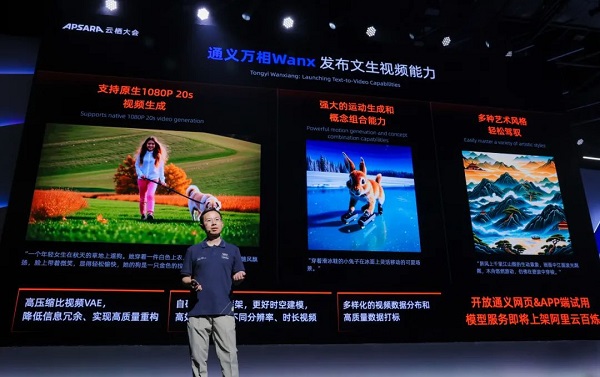
Image context: the cover photograph shows Alibaba Cloud presenting Qwen capabilities at Hangzhou's Apsara Conference in 2024. It is not a screenshot of AgentScope Runtime. That is intentional. The article is about the infrastructure layer underneath China's agent push: the conference stage represents Alibaba Cloud's broader model-and-cloud context, while the runtime turns that context into service mechanics.[7]
The agent becomes an API surface
The most important design move is the runtime's shift toward an agent-as-service boundary. The Runtime introduction says version 1.0 offers a unified "Agent as API" experience across local development and production deployment, with expanded sandbox types, protocol compatibility, and built-in tools.[1] Its changelog explains why that matters. Earlier black-box integration made simple agent demos work, but it created production friction: custom memory could be replaced opaquely, internal state could fail to persist, hooks were limited, and cross-framework multi-agent composition became hard to maintain.[3]
That is the right pain point. In an enterprise setting, an agent is rarely just a function call. A support-triage agent needs conversation history and escalation state. A research agent needs intermediate artifacts, source URLs, and permission boundaries. A browser-control agent needs a disposable execution space. A coding agent needs code execution, shell access, package state, and a clear answer to whether the host machine is exposed.[2][3]
AgentScope Runtime's answer is the white-box adapter pattern described in its v1.0 notes. Through AgentApp and Runner lifecycle methods such as init, query, and shutdown, runtime capabilities can be inserted explicitly rather than swapped in invisibly.[3] The practical value is not elegance. It is that the production version of an agent can stay closer to the development version while adding session persistence, state management, tool registration, and deployment scaffolding in known places.[1][3]
For Chinese AI builders, that is a meaningful shift. Much recent AI-China coverage has focused on model families, cloud pricing, and application surfaces. AgentScope Runtime points to the next layer down: the service contract that lets a model-backed agent become a durable component in an internal platform.
Sandboxing is the adoption boundary
The second useful surface is the sandbox. AgentScope Runtime's sandbox documentation describes isolated environments for tool execution, browser automation, and file-system operations, with different images for base Python/shell execution, GUI use, file-system work, browser control, mobile operation, and training or evaluation tasks.[2] The docs also name deployment options from local Docker or gVisor through Kubernetes, Function Compute, and Alibaba Cloud ACK.[2][4]
This is where the use case becomes concrete. A team can be enthusiastic about agents and still refuse to let a model operate directly on a developer laptop, finance folder, CRM tab, or production shell. Sandbox execution gives the organization a place to put the risk. It does not solve policy by itself, but it creates a technical boundary where policies can attach: which image is used, which tools are registered, which files are mounted, whether the browser is disposable, and whether the run belongs in a local container, a Kubernetes cluster, or a managed cloud lane.[2][4]
The sandbox table in the docs is especially revealing because it maps agent ambition to runtime substrate. "Computer use" needs a GUI image. Web tasks need a browser image. File manipulation needs a file-system image. Basic tool execution needs a Python and shell base. Mobile operation has its own image.[2] That inventory says the same thing in operational language: agent adoption is becoming less about a single chatbot and more about a menu of controlled execution environments.
That is also why the Runtime documentation's emphasis on Alibaba Cloud Container Registry and ACK matters.[2][4] AgentScope is open source, but the deployment path is naturally cloud-shaped. Alibaba benefits if Chinese builders can start with open tooling, keep compatibility with common agent frameworks and SDKs, and then graduate into cloud-backed runtime services when they need scale, isolation, or governance.
Compatibility lowers the switching cost
AgentScope's core framework sits underneath this runtime story. The main repository describes AgentScope as a framework for building LLM applications with visible and controllable agent construction, including ReAct agents, voice agents, human-in-the-loop flows, flexible MCP use, multi-agent workflows, evaluation, and tuning.[5] The 1.0 paper frames the project around unified interfaces, extensible modules, ReAct grounding, asynchronous design, built-in agents, evaluation support, a visual studio interface, runtime sandboxing, and production deployment support.[6]
Runtime turns that framework into something a platform team can reason about. It lists mainstream protocol and SDK integration, including OpenAI SDK support and Google A2A compatibility, and its GitHub examples show how a ReAct agent can be exposed through AgentApp with streaming response events.[1][4] In practice, those details lower switching cost. A team does not have to accept a single closed agent stack all at once. It can keep model choice, framework choice, tool choice, and deployment choice partially separable.
That separability is strategically important in China because the model layer is crowded and fast-moving. Teams may want Qwen for one workload, DeepSeek-style reasoning for another, a domestic OCR or speech model for a third, and an OpenAI-compatible endpoint for cross-border development. An agent runtime that preserves framework compatibility gives those teams a place to stabilize execution while model choices continue to change.[1][3][5]
The counterweight is complexity. A runtime that supports local threads, processes, Docker, Kubernetes, hosted cloud, multiple sandbox types, memory services, observability, and cross-framework composition can become its own operating burden.[1][2][3] AgentScope Runtime's real test is therefore not whether the architecture diagram looks complete. The test is whether ordinary teams can keep the lifecycle clear: which service owns state, which layer owns memory, which tool call is allowed, and which execution environment is responsible when a task fails.
What this says about AI-China
AgentScope Runtime shows a maturing pattern in China's agent stack. The headline layer still belongs to new models and public assistants, but the more durable competition is moving into runtime control: how agents are served, how tools are isolated, how memory is persisted, how logs and traces are collected, and how developers move from local prototype to production lane.[1][2][3]
For Alibaba, this is a coherent complement to the broader Qwen and ModelScope ecosystem. Model releases create demand. Model hubs distribute artifacts. Agent frameworks organize behavior. Runtime turns that behavior into something an enterprise can call, observe, pause, resume, and contain.[1][4][5][6] That is why AgentScope Runtime should be read as infrastructure rather than as another developer framework announcement.
The watch item is convergence. If AgentScope Runtime, AgentScope, ModelScope, Qwen, DashScope/Model Studio, and Alibaba Cloud deployment services keep aligning, Alibaba gets a staged route from open-source experimentation to managed production. If they remain adjacent surfaces with uneven documentation and unclear ownership of state, teams will treat the runtime as another interesting project instead of a default operating layer.
For now, the signal is clear enough. AgentScope Runtime is trying to make Chinese agent work less theatrical and more service-shaped: an agent enters through AgentApp, keeps state intentionally, uses tools inside explicit sandboxes, exposes predictable APIs, and can move toward cloud deployment when the workload deserves it.[1][2][3][4] In a market crowded with agent demos, that boundary work is where adoption becomes real.
Sources
- AgentScope Runtime documentation, "What is AgentScope Runtime?" and v1.0 release overview (Agent-as-API framing, deployment runtime, sandbox runtime, tools, observability, SDK/protocol compatibility, and deployment modes).
- AgentScope Runtime documentation, "Sandbox" (sandbox types, Docker images, tool execution, browser/file/mobile environments, Alibaba Cloud Container Registry, and backend options).
- AgentScope Runtime documentation, "CHANGELOG" (v1.0.0 and v1.0.1 notes on black-box integration limits, white-box adapter pattern, state persistence, hooks, multi-agent composition, and stability updates).
- AgentScope Runtime GitHub repository (AgentApp examples, streaming API behavior, sandbox examples, Docker/gVisor/BoxLite local backends, and Kubernetes/Function Compute/ACK production guidance).
- AgentScope GitHub repository (framework scope, ReAct agents, MCP usage, multi-agent workflows, evaluation, and tuning examples).
- Dawei Gao et al., "AgentScope 1.0: A Developer-Centric Framework for Building Agentic Applications" (paper on unified interfaces, async design, visual studio, sandboxing, and production deployment support).
- eHangzhou, "Apsara Conference showcases cutting-edge AI innovation in Hangzhou" (official context and source page for the real Apsara Conference photograph used as this article's cover image).