As of 2026-05-26 UTC, the useful way to read Alibaba's MNN is not as a small open-source runtime sitting below the real AI-China story. The sharper signal is that MNN is becoming one of Alibaba's bridges from open model release to device-side execution. Its public repo describes a lightweight framework already integrated into more than 30 Alibaba apps and more than 70 scenarios, then places MNN-LLM on top as a runtime for deploying large language models locally on mobile phones, PCs, and IoT devices.[1] That is not the same market lane as selling another hosted Qwen endpoint. It is a distribution lane for cases where the model has to live near the user, near the sensor, or near the enterprise device boundary.
This matters because China's model competition has been moving along two tracks at once. The visible track is frontier-model cadence: Qwen, DeepSeek, Hunyuan, ERNIE, GLM, Kimi, MiniMax, and others keep refreshing benchmark and product surfaces. The less visible track is execution packaging. If model families cannot run acceptably across phones, laptops, embedded boxes, and mixed accelerator backends, open-weight distribution remains more theoretical than operational. MNN is Alibaba's answer to that second track: not "which model won the leaderboard this week," but "how does a model become an artifact that can run outside the cloud control plane?"[1][2][3]
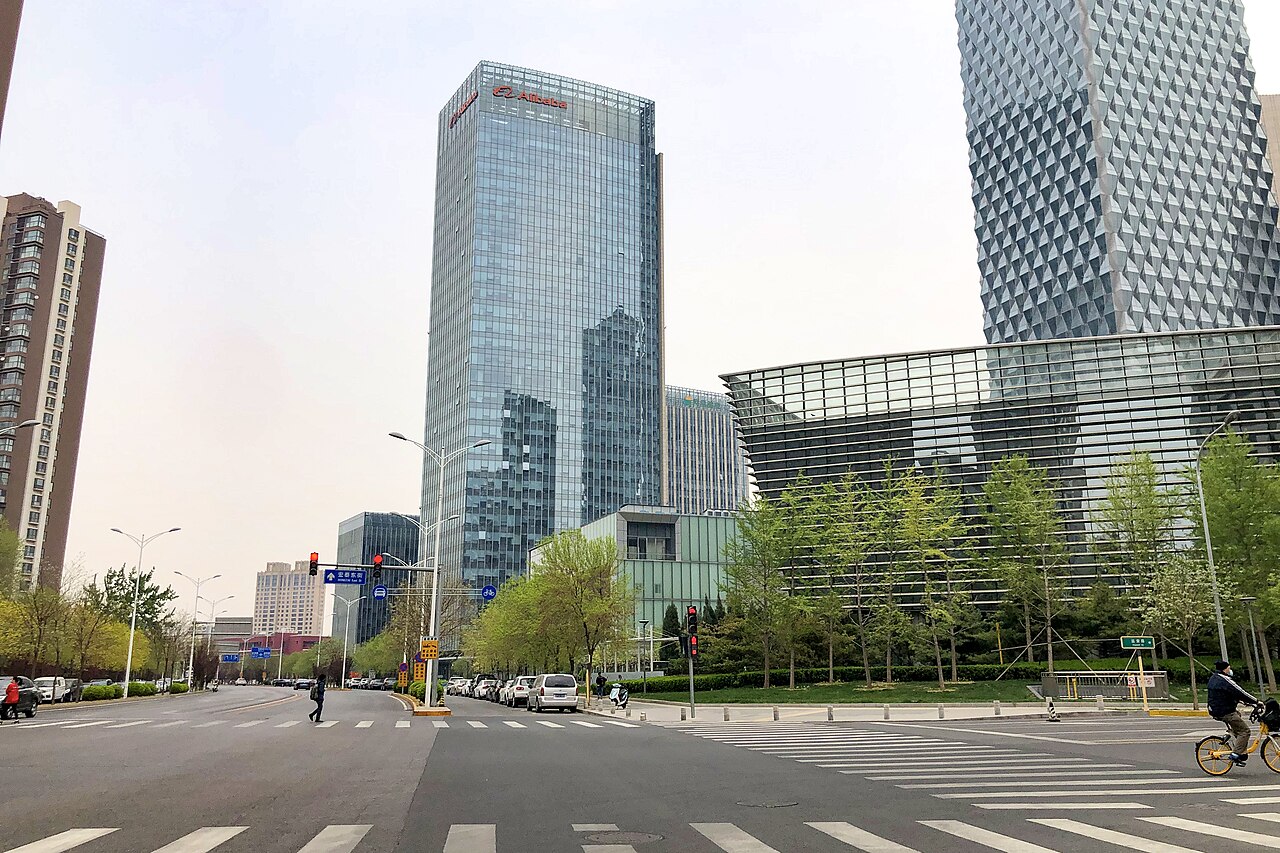
Image context: the cover uses a real Wikimedia Commons photograph of Alibaba's Beijing headquarters at Greenland Center, Wangjing. The image is deliberately institutional rather than diagrammatic. MNN is best understood as company infrastructure: a runtime, app shell, backend layer, model export path, and production history that make Alibaba's model ecosystem portable beyond hosted APIs.[7]
The on-device lane is now a product surface
MNN's README now gives the project a broader identity than classical mobile neural-network inference. The repo says MNN supports inference and training on-device, names Alibaba apps such as Taobao, Tmall, Youku, DingTalk, and Xianyu, and says MNN also serves embedded and IoT scenarios.[1] That production framing matters. Alibaba is not presenting MNN only as a research artifact for phone demos. It is presenting it as a component with a long internal deployment trail.
The LLM layer makes the shift explicit. The same repo describes MNN-LLM as a runtime based on MNN whose mission is to deploy LLMs locally across phones, PCs, and IoT devices, with support for model families including Qianwen/Qwen, Baichuan, Zhipu, and LLaMA.[1] The official news log then shows the product surface widening through time: an iOS multimodal LLM app in February 2025, Android support for Qwen3 in April 2025, Qwen2.5-Omni support in May 2025, and Qwen3.5-series support in March 2026.[1]
That sequence is the important part. MNN is not only chasing one model checkpoint. It is absorbing the release rhythm of Chinese and global open models into an edge runtime lane. For Alibaba, that has two strategic uses. First, it lets Qwen-adjacent experiences move into settings where latency, privacy, intermittent connectivity, or cloud cost make local execution attractive. Second, it gives Alibaba a runtime surface that can carry non-Alibaba models too, which makes the framework more useful to developers who do not want a single-family toolchain.[1][4]
Release notes show where the engineering pressure sits
The recent release notes are more revealing than the headline. MNN 3.4.0, published in February 2026, focused on GPU/QNN backend deepening, attention and long-context memory optimization, and online GPU stability.[2] The concrete list is exactly what an edge LLM runtime needs: Vulkan LLM support for more Android devices, Vulkan CoopMat acceleration, Metal TensorAPI and Flash Attention, CPU Flash Attention, CPU KV-cache quantization, Prefix KV Cache, QNN support for Qwen3 and vision-language models, OmniQuant export, and mixed-precision quantization through llmexport.[2]
The follow-up 3.4.1 release sharpened the same picture. It focused on Qwen3.5 support and Linear Attention across CPU, Metal, OpenCL, and Vulkan backends; resource-management fixes for LLM instances; and security and stability repairs across Shape operators, execution operators, HQQ quantization, large-vocabulary embedding, LLM paths, and GPU backends.[2] Those are not cosmetic app features. They are the failure points that decide whether local inference is usable after the demo: memory, backend coverage, resource release, crashes, operator gaps, quantization behavior, and model export.
This is where MNN differs from a simple model-zoo story. The hard part of on-device AI is not downloading a checkpoint. It is making the same application survive different chips, graphics APIs, OS policies, memory ceilings, tokenizer quirks, model formats, and power budgets. MNN's release notes read like an engineering team pushing on that operational surface.[2][3]
The app shell exposes both the promise and the boundary
The MNN Chat Android README shows how Alibaba is packaging the runtime into something a user or developer can actually touch. It describes a full multimodal LLM Android app with text-to-text, image-to-text, audio-to-text, and text-to-image generation through diffusion models.[3] It also lists broad model compatibility across Qwen, Gemma, Llama, TinyLlama, MobileLLM, Baichuan, Yi, DeepSeek, InternLM, Phi, ReaderLM, and SmolLM.[3]
The performance claims should be read with care. The README says MNN-LLM, in Android CPU benchmarking while inferencing Qwen-7B, achieved 8.6x prefill speed improvement over llama.cpp and 20.5x over fastllm, with decoding 2.3x and 8.9x faster, respectively.[3] The MNN-LLM paper makes a related directional claim: model quantization, DRAM-Flash hybrid storage, mobile CPU/GPU-aware rearrangement, multicore load balancing, mixed precision, and geometry computation together yielded up to an 8.6x speed increase versus mainstream LLM-specific frameworks.[5] These are vendor and author-reported results, not a neutral cross-device bakeoff. The useful conclusion is narrower: MNN's public identity is now built around the specific bottlenecks of mobile LLM inference, not around generic neural-network acceleration.[3][5]
The README's warning is just as important as the speed claim. It says the app version was tested exclusively on OnePlus 13 and Xiaomi 14 Ultra, and that low-spec or budget devices may see slow inference, instability, or failure to run.[3] That caveat keeps the article's thesis honest. MNN is not proof that every phone is suddenly a useful local frontier-model host. It is proof that Alibaba is investing in the runtime machinery needed to make that boundary more workable over time.
Hugging Face packaging turns runtime work into distribution
The Hugging Face taobao-mnn organization shows the other side of the lane: model artifacts packaged for MNN rather than only source code for the runtime. The organization listed 24 collections when checked, including MNN-packaged Gemma, LFM, MiniCPM, DeepSeek-R1-Qwen, Qwen2.5-Coder, and Qwen3.6 variants, with several entries updated in April and May 2026.[4] The exact inventory will keep changing, but the pattern matters more than any one checkpoint.
That packaging tells developers what Alibaba wants MNN to become: not merely a build target after someone else has done the model work, but a recognizable distribution format. If the runtime, Android/iOS apps, export tools, and hosted model artifacts line up, the developer path gets shorter. A team can evaluate whether a model belongs on-device without first inventing its own conversion and deployment ladder.[1][2][3][4]
This is especially relevant inside AI-China because open-weight releases are often judged by availability on GitHub, Hugging Face, ModelScope, or cloud model studios. MNN adds another question: is the model operationally available for local execution? A smaller Qwen, DeepSeek-distilled, MiniCPM, or coding model can matter differently if it ships in a form that a mobile app or edge device can load, benchmark, and update without a bespoke port.[4]
The older Walle history explains why this is not a side project
MNN also has a deeper production lineage than many edge-AI projects. The MNN README ties the framework to Alibaba's Walle system, described in the OSDI 2022 paper as an end-to-end, general-purpose, large-scale production system for device-cloud collaborative machine learning.[1][6] The paper abstract says Walle's core uses MNN mechanisms such as operator decomposition and semi-automatic search to reduce manual optimization across many operators and hardware backends, while its data and deployment pipelines support on-device stream processing and multi-granularity deployment policies.[6]
That history matters because on-device LLMs are not only a model-size problem. They are a deployment-system problem. The moment AI work moves from cloud endpoints to user devices, the platform has to think about push/pull deployment, backend selection, local processing, observability, versioning, and failure recovery. Walle does not prove that MNN-LLM has solved all of that for modern generative models, but it does show that Alibaba's device-cloud muscle predates the current LLM wave.[6]
My inference is that MNN's current LLM direction is not an isolated open-source experiment. It is a continuation of a longer Alibaba belief: some intelligence should run where the data and interaction happen, with the cloud acting as coordinator, distributor, and heavier fallback rather than the only execution site.[1][6]
What to watch
The clean watch item is whether MNN becomes a default launch target for Alibaba's own smaller Qwen and multimodal releases, not just an after-the-fact conversion path. If Qwen releases routinely arrive with MNN packages, Android/iOS app support, llmexport recipes, backend notes, quantization guidance, and device caveats, then MNN becomes part of Alibaba's model distribution contract.[1][2][3][4]
The second watch item is backend breadth. MNN's strongest recent signals are not only CPU speed claims; they are Vulkan, Metal, OpenCL, QNN, Flash Attention, KV-cache quantization, Prefix KV Cache, and model-export work.[2] If those pieces keep arriving close to model release cycles, local inference gets less like a lab exercise and more like a supportable product lane.
The falsifier is also clear. If developers still treat MNN as a neat demo but default to cloud APIs, browser agents, or other local runtimes for serious deployment, then the "device lane" thesis weakens. The same is true if model packaging lags behind Qwen releases, if stability warnings stay too narrow, or if performance claims cannot be repeated outside a small set of flagship phones.
For now, MNN is worth tracking because it shows how AI-China's supply chain is widening below the model layer. The competitive unit is no longer only the model, the price table, or the cloud API. It is the path from model family to deployable local artifact: runtime, backend, quantization, app shell, model package, and production update history. MNN is Alibaba's clearest claim that the device is still part of that stack.[1][2][3][4][6]
Sources
- Alibaba,
alibaba/MNNGitHub repository README (MNN project scope, 30+ Alibaba apps, 70+ scenarios, MNN-LLM mission, model-family support, and release news through Qwen3.5 support). - Alibaba,
alibaba/MNNGitHub releases page (MNN 3.4.0 and 3.4.1 release notes covering Vulkan, Metal, QNN, Flash Attention, KV-cache, Qwen3/Qwen3.5,llmexport, resource management, and stability fixes). - Alibaba, "MNN Chat Android App" README (multimodal Android app features, supported model families, Android build flags, vendor-reported Qwen-7B CPU benchmark claims, and device-support warning).
- Hugging Face,
taobao-mnnorganization page (MNN model collections and recently updated MNN-packaged model artifacts across Qwen, DeepSeek, MiniCPM, Gemma, and related families). - Wang et al., "MNN-LLM: A Generic Inference Engine for Fast Large Language Model Deployment on Mobile Devices" (arXiv:2506.10443; mobile LLM inference design, quantization, DRAM-Flash hybrid storage, CPU/GPU-aware optimization, and reported speedup boundary).
- Lv et al., "Walle: An End-to-End, General-Purpose, and Large-Scale Production System for Device-Cloud Collaborative Machine Learning" (arXiv:2205.14833; OSDI 2022 paper on MNN production lineage, operator decomposition, backend search, on-device stream processing, and deployment-policy context).
- Wikimedia Commons, "File:Alibaba Group Beijing headquarters at Greenland Center, Wangjing (20210410104117).jpg" by N509FZ (source page for the real 2021 photograph used as the article image).