As of 2026-05-26 UTC, the useful signal in GPUStack's MindIE support is not that yet another serving backend appears in a settings menu. It is that Huawei Ascend inference is being translated into the same operational vocabulary that teams already use for GPU serving: workers, backends, model instances, scheduler constraints, quantization, context extension, distributed inference, function calling, and parallelism knobs.[1]
That matters because China's AI stack is no longer only a model-release race. Qwen, DeepSeek, Hunyuan, ERNIE, GLM, Kimi, MiniMax, and others keep shifting the capability surface, but production adoption increasingly depends on whether those models can be run through a repeatable serving layer. GPUStack's docs list vLLM, SGLang, Ascend MindIE, and llama-box as built-in inference backends. In that list, MindIE is not presented as an isolated Huawei appliance. It is placed beside the same open-model serving engines that infrastructure teams use to make deployment choices.[1]
The point is not that MindIE suddenly becomes interchangeable with CUDA-era serving. It does not. GPUStack's own documentation says its MindIE integration supports large language models and multimodal language models, while embedding models and multimodal generation models are not supported yet.[1] That caveat is the story. A third-party orchestrator is drawing a usable boundary around Ascend serving: here are the model classes, here are the features, here is what does not work yet, and here is how the worker can participate in a broader model-serving fleet.
Why this is a field signal, not a headline release
MindIE is Huawei Ascend's inference engine. The Ascend developer documentation describes MindIE as a full-scenario inference acceleration suite for Ascend business workloads, and the surrounding Huawei Cloud material positions Ascend as a toolchain for running mainstream open-source foundation models through training, tuning, deployment, prompt engineering, evaluation, and agents.[2][3] Read narrowly, that is a vendor stack. Read through GPUStack, it becomes more interesting: an external model-management layer is trying to make the vendor stack schedulable.
That difference changes the buyer question. A Huawei-only story asks whether a team is willing to bet on Ascend hardware, CANN, MindSpore or compatible frameworks, and Huawei's model-deployment path. A GPUStack story asks whether Ascend can become one worker type inside a heterogeneous serving estate. The second version is easier for cautious infrastructure teams to test. They can compare a MindIE-backed worker with vLLM or SGLang workers and decide where Ascend fits by model class, latency target, cost, supply availability, and feature needs.[1]
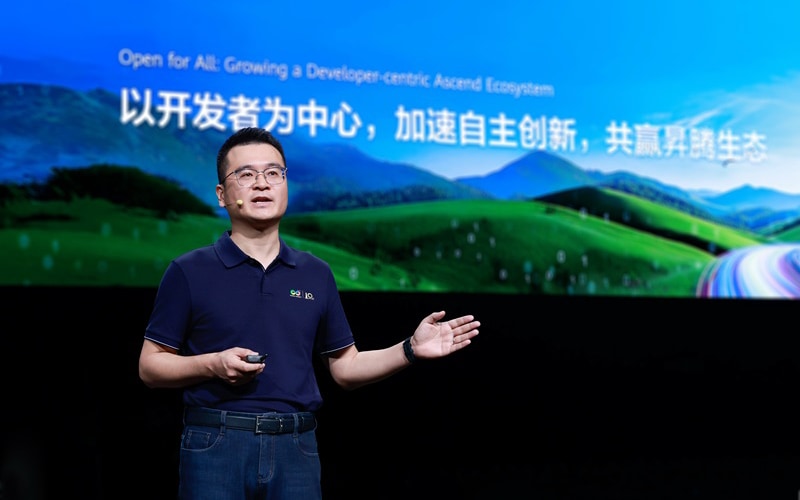
This is especially relevant in China because compute supply is strategic as well as technical. Huawei's September 2025 Ascend announcement put the emphasis on developer-centric ecosystem growth, layered decoupling, collaboration with Triton, PyTorch, vLLM, and verl, and the plan to open source core Ascend software components including domain-specific libraries, GE, Ascend C, and MindIE.[5] The message was clear: Ascend wants to be less of a closed island. GPUStack's MindIE backend is a small but concrete sign of whether that ambition is landing outside Huawei-authored pages.
The OpenAI-compatible surface is doing quiet work
Huawei Cloud's ModelArts guide for Ascend-vLLM is useful because it shows what operational compatibility looks like at command level. The guide starts a service through python -m vllm.entrypoints.openai.api_server, sets Ascend-specific configuration, and then tests the endpoint with OpenAI-style /v1/completions and /v1/chat/completions requests.[4] That does not make the underlying system magically portable. It does make the northbound contract recognizable.
This is one of the underappreciated mechanics in AI-China. Developers do not only choose models. They choose how much application code they must rewrite when moving between model providers, chips, and runtimes. If an Ascend-backed lane can expose familiar OpenAI-style request shapes through vLLM or MindIE-adjacent serving, then more of the migration burden moves downward into backend configuration and scheduler policy rather than upward into product code.[4]
The boundary is still real. Ascend-specific environment variables, plugins, graph settings, parallelism choices, memory behavior, and backend support remain part of the work.[4] GPUStack's MindIE page also makes clear that support is a subset of MindIE's broader feature set: quantization, extending context size, distributed inference, Mixture of Experts, Split Fuse, speculative decoding, multi-token prediction, prefix caching, function calling, multimodal understanding, MLA, tensor parallelism, context parallelism, sequence parallelism, expert parallelism, data parallelism, and buffer response appear in the supported-feature discussion, but the orchestration layer is still choosing which capabilities to expose and how.[1]
My inference from these sources is that the near-term value is not frictionless portability. It is containment. The messy parts of Ascend serving get boxed into a backend and worker model that operators can reason about.
What the stronger version would prove
The strongest version of this signal is simple: Ascend becomes a practical serving pool for specific model families and workloads, not a procurement talking point. Huawei Cloud says its Ascend AI Cloud Service supports major open-source foundation models, includes migration tools, and exposes cloud-based data cleansing, fine-tuning, deployment, prompt engineering, evaluation, and agent toolchains.[3] GPUStack adds the operational wrapper: a way to place MindIE beside vLLM and SGLang in a model-serving system.[1]
If that wrapper matures, infrastructure teams get a cleaner decision tree. Use CUDA-backed vLLM or SGLang where feature coverage and global community proof are strongest. Use MindIE-backed Ascend workers where domestic supply, Huawei cloud alignment, model adaptation, or policy constraints make Ascend attractive. Route only the workloads that fit the supported envelope. Avoid pretending every model type belongs everywhere.
That last sentence is the discipline AI-China needs. China's model ecosystem is full of broad platform claims. The operationally useful layer is narrower: which model, which runtime, which accelerator, which request API, which context length, which quantization path, which function-calling behavior, which failure mode. GPUStack's MindIE support is valuable because it forces that conversation into deployable terms.[1][4]
The limits are visible
There are three limits to keep in view. First, GPUStack's support statement excludes embedding models and multimodal generation models for MindIE at the time checked.[1] That matters because many enterprise AI systems depend on retrieval, reranking, document parsing, image generation, or video generation, not only chat and VLM inference.
Second, the public materials do not prove fleet-scale reliability across mixed Ascend deployments. Huawei's materials state ecosystem intent, technical direction, and cloud-service capabilities; GPUStack documents backend support. None of those sources substitute for a neutral, repeatable production benchmark across real clusters and changing model versions.[1][3][5]
Third, the software stack is still layered. CANN remains the low-level foundation. Huawei's technical article describes CANN as the core Ascend architecture layer, with operator development, graph development, and application development capabilities, and says it had more than 1,500 basic operators and more than 100 fused operators built in at the time of publication.[6] MindIE sits above that foundation as inference service machinery. GPUStack then sits above MindIE as an orchestration surface. Each layer reduces one kind of burden while introducing another interface to understand.[1][2][6]
What to watch
The first watch item is model coverage. If GPUStack's MindIE backend expands from LLMs and VLMs into embeddings, rerankers, and more multimodal workloads, Ascend becomes more useful for complete AI applications rather than isolated chat endpoints.[1]
The second watch item is feature parity under pressure. Prefix caching, speculative decoding, context extension, MoE serving, function calling, and parallelism modes matter only if they behave predictably under real routing, upgrades, and mixed workloads. Documentation support is the start, not the finish.[1]
The third watch item is whether Ascend-vLLM and MindIE lanes converge into a simpler operator experience. Huawei Cloud already shows OpenAI-style API usage for Ascend-vLLM, while GPUStack exposes MindIE as a backend. If those paths feel coherent rather than duplicative, the operator burden falls.[1][4]
The falsifier is equally concrete. If teams still treat Ascend serving as a special project that requires Huawei-specific staffing, separate deployment playbooks, and narrow model choices, then GPUStack's backend is only an integration checkbox. If, however, MindIE-backed workers can sit beside vLLM and SGLang workers with honest support boundaries, then Ascend's software story has moved one step closer to normal infrastructure.
That is why this small backend detail belongs in the AI-China file. The competitive unit is not only the Chinese model or the Chinese chip. It is the serving lane that makes a model run on available compute with a contract developers and operators can actually use.[1][3][5]
Sources
- GPUStack, "Built-in Inference Backends" (MindIE backend positioning, supported model classes, unsupported embedding and multimodal generation models, and supported feature subset).
- Ascend Developer Community, "MindIE 1.0.0 development documentation: Usage guide" (official MindIE documentation entry point and Ascend inference-engine framing).
- Huawei Cloud, "Ascend AI Cloud Service" (AI Compute Service capabilities, open-source foundation model support, migration toolchain, AI Gallery, and model deployment workflow claims).
- Huawei Cloud ModelArts, "Starting an LLM-powered Inference Service" (Ascend-vLLM Lite Server guide with OpenAI-style service API commands and request tests).
- Huawei, "Ascend: Open for All to Build a Vibrant Ecosystem" (HUAWEI CONNECT 2025 speech, developer ecosystem strategy, open-source plan for Ascend components including MindIE, and source page for the event photograph used as the article image).
- Huawei, "Building an open foundational software stack to co-create a new Ascend AI computing ecosystem" (HuaweiTech article on CANN, MindSpore, MindSpeed, MindIE, operator coverage, and Ascend software-stack architecture).