As of 2026-04-09 UTC, the most useful way to read MiniMax is to stop treating it as only a low-price Chinese frontier model vendor or only a creator-tool company riding video and audio demand. The more durable signal now sits one layer higher. MiniMax is trying to export an agent workplace: a company-shaped package in which low-cost frontier models, office-grade deliverables, internal AI-native operations, and developer-facing agent tooling are meant to reinforce one another.[1][2][3][4][5]
The annual-results language makes that shift unusually visible. MiniMax says 2025 revenue rose 158.9% year over year to $79.0 million, with more than 70% coming from international markets, and says it had cumulatively served 236 million users across 200+ countries and regions plus 214,000 enterprise customers and developers across 100+ countries and regions by year-end.[1] Those numbers matter, but the sharper sentence is operational rather than financial: MiniMax says its agent interns now support nearly 90% of employees across software development, data analysis, operations management, recruiting, and sales and marketing, and that in January 2026 it productized those internal capabilities as MiniMax Agent AI-native Workspace.[1] That is not the language of a company content to sell raw inference alone.
The model layer reinforces the same idea. In the 2026-02-12 M2.5 launch note, MiniMax says M2.5 is state of the art in coding, agentic tool use and search, office work, and other economically valuable tasks, highlighting 80.2% on SWE-Bench Verified, 51.3% on Multi-SWE-Bench, and 76.3% on BrowseComp with context management.[2] More important than the benchmark headline, the post frames the model around workflow economics: average end-to-end runtime on one cited agent evaluation dropped from 31.3 minutes on M2.1 to 22.8 minutes on M2.5, and MiniMax says the total cost per task was about 10% of Claude Opus 4.6 in that comparison.[2] The same post then states the company's cost thesis in plain terms: $1 can run the model continuously for one hour at 100 tokens per second.[2]
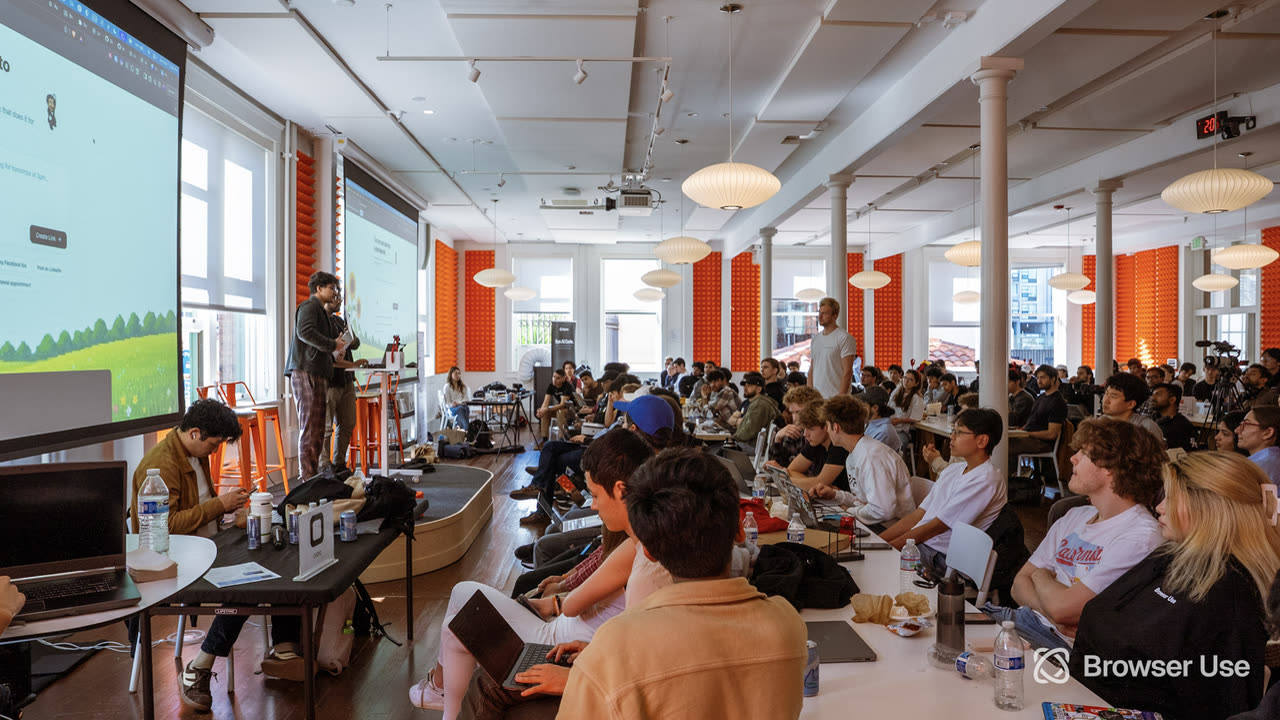
Image context: the cover uses a real photograph from MiniMax's post on the YC Browser-Use hackathon. It fits here because the article is not about a closed lab benchmark. It is about MiniMax trying to push one agent-shaped operating pattern into the hands of external builders and development teams.[5]
MiniMax is turning its own company into the first proof point
The internal-operations language in the annual report is the hinge of this dossier.[1]
Many AI companies say their models help coding or office work. MiniMax goes further and describes the company itself as a testing ground for the evolution of AI-native organizational capabilities.[1] That phrase matters because it changes what counts as evidence. The company is not only claiming that outside users might one day automate more work. It is saying that the firm already uses agent-like systems deeply enough that nearly 90% of employees interact with agent interns in practical functions ranging from engineering through recruiting and marketing.[1]
That is why the January 2026 launch of MiniMax Agent AI-native Workspace matters more than it first appears.[1] Read together with the rest of the filing, the workspace is not a side product added after the fact. It is the outward-facing version of an internal operating pattern. My inference from the filing is that MiniMax wants the market to see a closed loop: frontier models create internal workflow leverage, that leverage gets productized into an agent workspace, and the product then becomes part of MiniMax's external commercial story.[1]
The same filing supports that interpretation from the demand side. MiniMax says average daily token consumption for the M2 text-model family in February 2026 had grown to more than 6x the level of December 2025, while token consumption from the Coding Plan had grown by more than 10x.[1] That is a useful indicator because it shows where usage is thickening. The pull is not only around entertainment or lightweight chat. It is increasingly around repeated work sessions that look like coding-agent activity.
M2.5 is being sold as a workplace model, not just a coding model
The M2.5 post makes this more explicit by bundling three categories that companies often present separately: coding, search, and office work.[2]
The office section is especially revealing. MiniMax says it worked with senior professionals in finance, law, and social sciences to shape the model toward deliverable outputs and then claims significant capability gains in Word, PowerPoint, and Excel financial-modeling scenarios.[2] That is a different commercial ambition from shipping one more benchmark-optimized coding model. It implies the company wants the agent to leave the software-engineering lane and enter the higher-value document and analysis lanes that define daily knowledge work.
This is where the runtime-and-cost language matters. If MiniMax can really keep agent sessions near frontier quality while pushing runtime down and keeping the cost curve shallow, the strategic result is bigger than a price war.[2] It means the company can argue that longer, more tool-heavy work episodes should become normal rather than exceptional. In other words, the cheapness matters because it expands the kinds of tasks that can live inside an agent workplace.
That is also why the M2.5 post places Access API, Coding Plan, and Try Agent Now beside one another at the top of the release page.[2] MiniMax is telling users that the model should be consumed through several adjacent surfaces at once: developer access, packaged usage plans, and a direct agent product. The model is the engine, but the product story is the environment around it.
The external tooling says MiniMax wants the workplace pattern to travel
The strongest evidence that this is an export story comes from the developer tooling.
MiniMax's Mini-Agent documentation describes an open-sourced framework released on 2026-01-15 as a "minimalist yet professional" agent framework meant to demonstrate best practices for building intelligent agents with MiniMax models.[3] The operational details are the important part. The docs highlight file read/write, shell command execution, built-in 15 Claude Skills, native MCP support, and a Session Note Tool for cross-session memory persistence.[3] That is already closer to a practical workbench than to a toy demo. It tells developers that MiniMax wants them to work with agents that can read files, execute commands, keep notes, and call outside tools in an ongoing loop.
The Token Plan page extends the same logic beyond pure text workloads.[4] MiniMax says the plan extends its former Coding Plan into a broader multimodal subscription spanning text, speech, video, music, and image, explicitly so that "more creative agents and application" can be built and used.[4] The surrounding tool list is equally revealing: MiniMax provides configuration guides for OpenClaw, Claude Code, Cursor, Cline, Roo Code, Codex CLI, Droid, Zed, and Mini-Agent itself.[4] That is distribution behavior. MiniMax is not asking developers to abandon their existing agent shells. It is trying to place its models inside the shells they already use.
My inference from [3] and [4] is that MiniMax no longer wants to be understood as a company that only sells access to one strong text model. It wants to become the model-and-tooling layer inside a growing number of agent workplaces, whether those workplaces sit in its own products or in third-party developer environments.
The global builder channel matters because MiniMax is already leaning international
The YC Browser-Use hackathon post shows why the international angle belongs inside the thesis rather than in a footnote.[5]
MiniMax says the event drew 200+ builders, had a prize pool of more than $180K, and that MiniMax was the only open-source frontier model provider among the sponsors in the room.[5] The company's post then emphasizes web agents, browser action, and real-world task completion.[5] By itself, a sponsorship post does not prove durable commercial advantage. But in combination with the annual report's statement that more than 70% of 2025 revenue came from international markets, it becomes easier to see the strategy line.[1][5]
MiniMax appears to be trying to do two things at once: keep the core model economics attractive enough that serious builders will experiment heavily, and then meet those builders inside agent-native workflows rather than only through a bare API endpoint.[2][3][4][5] That is a more defensible international expansion path than simply advertising a cheaper model. Cheaper models can be copied. A model that already sits inside a team's coding loop, office workflow, and multimodal agent stack is harder to dislodge.
What could weaken this dossier's thesis
This reading weakens if the workplace surfaces remain more coherent in marketing than in repeated production use.
It weakens if the internal "agent interns" story turns out to be broad in coverage but shallow in depth, with real employees still doing the decisive work outside the agent loop.[1] It weakens if M2.5's cost curve looks impressive in published examples but degrades once longer enterprise tasks, more conservative tool permissions, and stricter reliability targets are added.[2] And it weakens if Mini-Agent and Token Plan create reach across many tools without creating enough distinct value for developers to keep MiniMax in the loop once experimentation ends.[3][4]
Still, the current public record points in one direction. MiniMax is not only pushing a stronger frontier model. It is trying to package a workplace pattern: internal AI-native operations, low-cost frontier inference, office-grade deliverables, and developer-facing agent tooling that can travel internationally.[1][2][3][4][5]
Bottom line
MiniMax's stronger 2026Q2 move is no longer one cheap model release viewed in isolation. The company is trying to turn frontier-model economics into an exported agent workplace.[1][2][3][4]
The annual report supplies the company-level evidence, M2.5 supplies the productivity-and-cost logic, Mini-Agent and Token Plan show how that logic is being pushed into real developer shells, and the YC hackathon post shows the kind of builder channel MiniMax wants to win.[1][2][3][4][5] If that package holds together, MiniMax matters less as a one-line pricing comparison and more as a company trying to own how agent work gets done.
Sources
- MiniMax, "MiniMax Global Announces Full Year 2025 Financial Results" (March 2, 2026; revenue growth, international mix, cumulative user and developer reach, internal agent interns, MiniMax Agent AI-native Workspace, and Coding Plan token-growth details).
- MiniMax, "MiniMax M2.5: Built for Real-World Productivity." (February 12, 2026; coding/search/office positioning, runtime drop from 31.3 to 22.8 minutes, cost framing, and Word/PowerPoint/Excel workspace claims).
- MiniMax API Docs, "Mini-Agent: Build Your First Intelligent Assistant" (January 15, 2026; open-sourced Mini-Agent framework, file and shell tools, Claude Skills, MCP support, and cross-session memory).
- MiniMax API Docs, "Token Plan Overview" (multimodal subscription extending the former Coding Plan, plus integration guides for OpenClaw, Claude Code, Cursor, Cline, Roo Code, Codex CLI, and Mini-Agent).
- MiniMax, "MiniMax @YCombinator Hackathon: Building the Future of Web Agents" (200+ builders, $180K+ prize pool, MiniMax as the only open-source frontier model provider in the room, and source page for the cover photograph).