As of 2026-04-10 UTC, the useful way to read QwQ-32B is to stop at neither the benchmark image nor the model name. The model card and Alibaba's own docs point to a sharper conclusion. QwQ-32B matters because it pushes frontier-style reasoning into an open-weight 32.5B dense model, while making the serving boundary newly legible: prompt format, sampling settings, context handling, GPU memory fit, runtime choice, and hosted-versus-local deployment all shape whether the headline comparison survives contact with production.[1][2][3][4][5]
That boundary matters because the public packaging already splits into two lanes. On the open-weight side, the Hugging Face card presents QwQ-32B as a reinforcement-learning-tuned reasoning model with 131,072-token context and competitive results against DeepSeek-R1 and o1-mini.[1][5] On the managed side, Alibaba Cloud Model Studio describes QwQ as a reasoning model trained on Qwen2.5, says its math, code, and general benchmarks are on par with the full-performance DeepSeek-R1 line, and exposes it as a hosted reasoning option in international deployment mode with endpoints and data storage in Singapore.[2] Read together, those pages say the same thing: QwQ is not only a model release. It is a deployment surface.
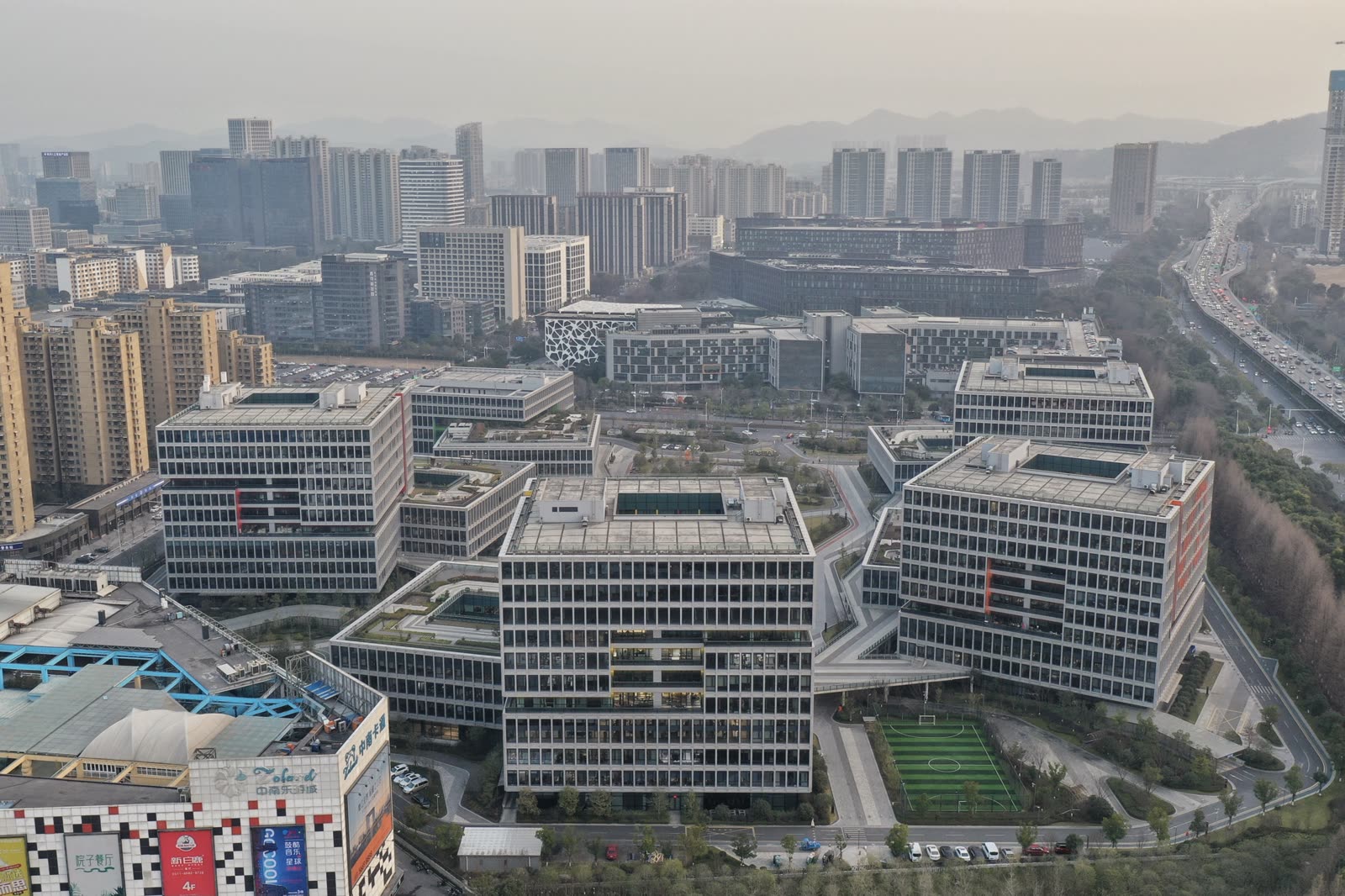
Image context: the cover uses a real Wikimedia Commons photograph of Alibaba's Binjiang campus in Hangzhou. That is the right visual here because this article is about the company-level infrastructure and deployment boundary around QwQ-32B, not about an abstract reasoning leaderboard.[6]
The benchmark claim already comes with an inference contract
The model card makes the first boundary explicit.[1]
QwQ-32B is presented as a 32.5B model with full 131,072-token context, but the same card immediately warns that performance depends on how the model is driven.[1] For prompts longer than 8,192 tokens, the card says users must enable YaRN. In the usage guidelines, the Qwen team recommends forcing the model to begin with \<think\>\n, using Temperature = 0.6, TopP = 0.95, and TopK between 20 and 40, and standardizing output format for math and multiple-choice tasks.[1] That is already enough to change how benchmark claims should be read.
The implication is simple. A score comparison between QwQ-32B and DeepSeek-R1 is not a free-floating truth about weights alone. It sits inside a prompt-and-decoding contract.[1][5] If another evaluator runs a different template, strips the thinking prelude, changes sampling, or ignores long-context setup, the comparison becomes directional rather than cleanly portable. That is exactly why QwQ belongs in benchmark & eval notes rather than in a generic release digest.
Alibaba's hosted model list reinforces the same point from another angle. Model Studio does not describe QwQ as a casual add-on. It frames the model as a reasoning lane trained from Qwen2.5 with reinforcement learning, then ties its "on par with DeepSeek-R1" claim to specific benchmark families such as AIME 24/25, LiveCodeBench, IFEval, and LiveBench.[2] In other words, Alibaba's own managed surface also treats the benchmark story as an evaluated, bounded configuration rather than as a raw, environment-free fact.
Alibaba's own "local deployment" language is the real tell
The second boundary is hardware, and this is where the QwQ story becomes more interesting.[3]
Alibaba's ECS deployment guide says QwQ-32B supports local deployment on consumer-grade graphics cards and presents the model as a lower-threshold reasoning option.[3] Yet the same guide's hardware table says the model footprint is 123 GB, recommends 64 GB RAM, and asks for 4 x 24 GB of GPU memory, with ecs.gn7i-4x.16xlarge as the reference instance type.[3] The guide then builds the inference service around vLLM, with v0.7.2 as the example version, plus Open WebUI for the interaction layer and a driver baseline at 550 or above.[3]
That combination is what makes QwQ strategically interesting. The open-weight reasoning model is indeed far lighter than the giant frontier alternatives it is compared against, but "lighter" is doing a lot of work. In Alibaba's own local-deployment framing, lighter still means a multi-GPU configuration with a non-trivial memory budget and a cloud instance class strong enough to look like an infrastructure purchase, not a hobbyist toy.[3]
This is the part that benchmark headlines hide. A model can feel compact relative to DeepSeek-R1 and still be operationally heavy for ordinary teams. QwQ-32B's significance is that it narrows the gap between frontier-style reasoning and deployable dense models. Its significance is not that the deployment problem disappears.[1][3][5]
The performance table shows why "32B" still does not mean cheap
Alibaba's CAP performance comparison makes the serving boundary even clearer.[4]
That document compares SGLang and vLLM on Ada-series GPUs for Qwen-QWQ-32B-AWQ, Qwen-QWQ-32B, and a smaller Qwen2.5 instruct model.[4] The broad result is that SGLang outperforms vLLM in most test scenarios and that dual-card tensor-parallel deployment helps more as model demand grows.[4] The QwQ-specific numbers are the part that matters here.
For Qwen-QWQ-32B-AWQ, Alibaba estimates maximum concurrency at 5 or below, with throughput of about 35 tokens per second on a single card and about 50 tokens per second on dual cards.[4] For the full Qwen-QWQ-32B, the document again recommends maximum concurrency at 5 or below, but says the model cannot run on a single Ada card because of insufficient memory and reports only a dual-card throughput of about 20 tokens per second.[4]
That is the evaluation boundary in plain language. Once the model moves from marketing image to serving stack, the real comparison unit becomes something like this: what prompt contract are you using, what runtime are you on, do you fit in memory without quantization, what concurrency can you sustain, and what throughput survives at the end?[1][3][4] A benchmark tie with DeepSeek-R1 is meaningful. It is just not the whole economic story.
Why this is an AI-China distribution signal
QwQ-32B matters because it creates a new middle lane in China's reasoning-model market.[1][2][3][4][5]
At one end sit enormous frontier systems whose raw performance comes with obvious serving complexity. At the other end sit smaller instruct models that are easier to place but weaker at multi-step reasoning. QwQ occupies a more commercially useful middle zone: open-weight, dense, strong enough to claim high-end reasoning parity in selected benchmarks, and close enough to Alibaba's cloud tooling that the company can capture value through hosted reasoning endpoints, deployment guides, GPU instances, and runtime choices.[2][3][4]
That is why the right read is a serving-boundary read. QwQ-32B is not only another leaderboard entry for AI-China watchers. It is Alibaba showing that reasoning-model competition is moving into packaging: managed SKU availability, deployment recipes, memory fit, quantization options, and runtime tuning. The model matters because the company is making those operational edges visible.[2][3][4]
Bottom line
QwQ-32B is a serving-boundary story before it is a benchmark story.[1][2][3][4][5]
The model card already tells users that prompt format, sampling, and long-context setup affect results.[1] Model Studio turns the same model into a managed reasoning lane with explicit deployment geography.[2] Alibaba's ECS guide then shows that "local" QwQ still means a 123 GB model footprint and a 4 x 24 GB VRAM recommendation, while the CAP performance report shows that the full model needs dual Ada cards and still lands near 20 tokens per second.[3][4] That does not weaken QwQ's importance. It explains it. The model matters because it compresses frontier-style reasoning into a denser, more deployable lane without making deployment trivial.
Sources
- Qwen Team, "Qwen/QwQ-32B" Hugging Face model card (32.5B parameters, 131,072-token context, YaRN requirement beyond 8,192 tokens, and usage-guideline settings for thoughtful output and sampling).
- Alibaba Cloud, "Model list" for Model Studio (QwQ reasoning-model description, benchmark families, and international deployment-mode note with Singapore endpoints and storage).
- 阿里云 ECS,《在GPU实例上部署千问QwQ-32B推理模型》(123 GB 模型体量、64 GB RAM、4 x 24 GB 显存建议、ecs.gn7i-4x.16xlarge、vLLM 与 Open WebUI 部署路径)。
- 阿里云 CAP,《使用SGLang和vLLM部署Qwen系列模型的性能测试与评估》(Qwen-QWQ-32B-AWQ 与 Qwen-QWQ-32B 在 Ada GPU 上的单卡/双卡吞吐、并发建议,以及单卡显存边界)。
- Qwen Team, "QwQ" GitHub repository page (official release framing and benchmark-comparison context versus DeepSeek-R1 and o1-mini).
- Wikimedia Commons, "File:Alibaba Center in Binjiang Hangzhou2021.jpg" (source page for the cover photograph used in this article).