As of 2026-04-09 UTC, the cleanest way to read Baidu Miaoda is not as one more "anyone can code now" slogan.[1][2] The more durable signal sits in the handoff. A user starts with natural language, but the product promise does not stop at chat. Baidu is promising a route from intent to a working surface: multi-agent collaboration, tool calling, complete front-end and back-end generation, fast iteration, and then a live public gallery where the result can actually sit.[2][3]
That matters because the sequence is unusually clear. At Baidu World 2024, Robin Li introduced Miaoda in a wider speech about AI applications, saying Baidu was not trying to ship one "super app" but to help more people and enterprises build millions of "super useful" applications.[1] Then on March 24, 2025, Baidu says Miaoda went fully live; by the next public update on March 26, the company said the platform had attracted more than 20,000 users in its first 24 hours and generated more than 30,000 applications, while advertising a "3-minute generation + 1-hour iteration" experience.[2]
The current product surface keeps pushing the same story. Miaoda's homepage describes the service as a zero-code application generation platform that can build complete front-end and back-end applications through natural-language interaction and drag-and-drop assembly, spanning websites, mini-programs, H5 pages, games, and lightweight tools; the same page says the service provides a 24-hour online agent team, zero-cost rapid launch, and no operations burden.[3] When I viewed that homepage on 2026-04-09, the live gallery listed 117,466 applications.[3]
The infrastructure context matters too. In Baidu's 2025 annual report, the company says Qianfan kept evolving toward an agent-centric platform, with expanded model libraries, stronger model and data services, and support for complex agent workflows. In the same section, Baidu explicitly lists Miaoda (MeDo) among its AI applications.[4] My inference from sources [2] and [4] is that Miaoda matters because Baidu is turning app generation into a cloud-service handoff: natural-language demand lands on a managed agent and model stack, then exits as a runnable application rather than as a block of code waiting for a developer to finish the job.
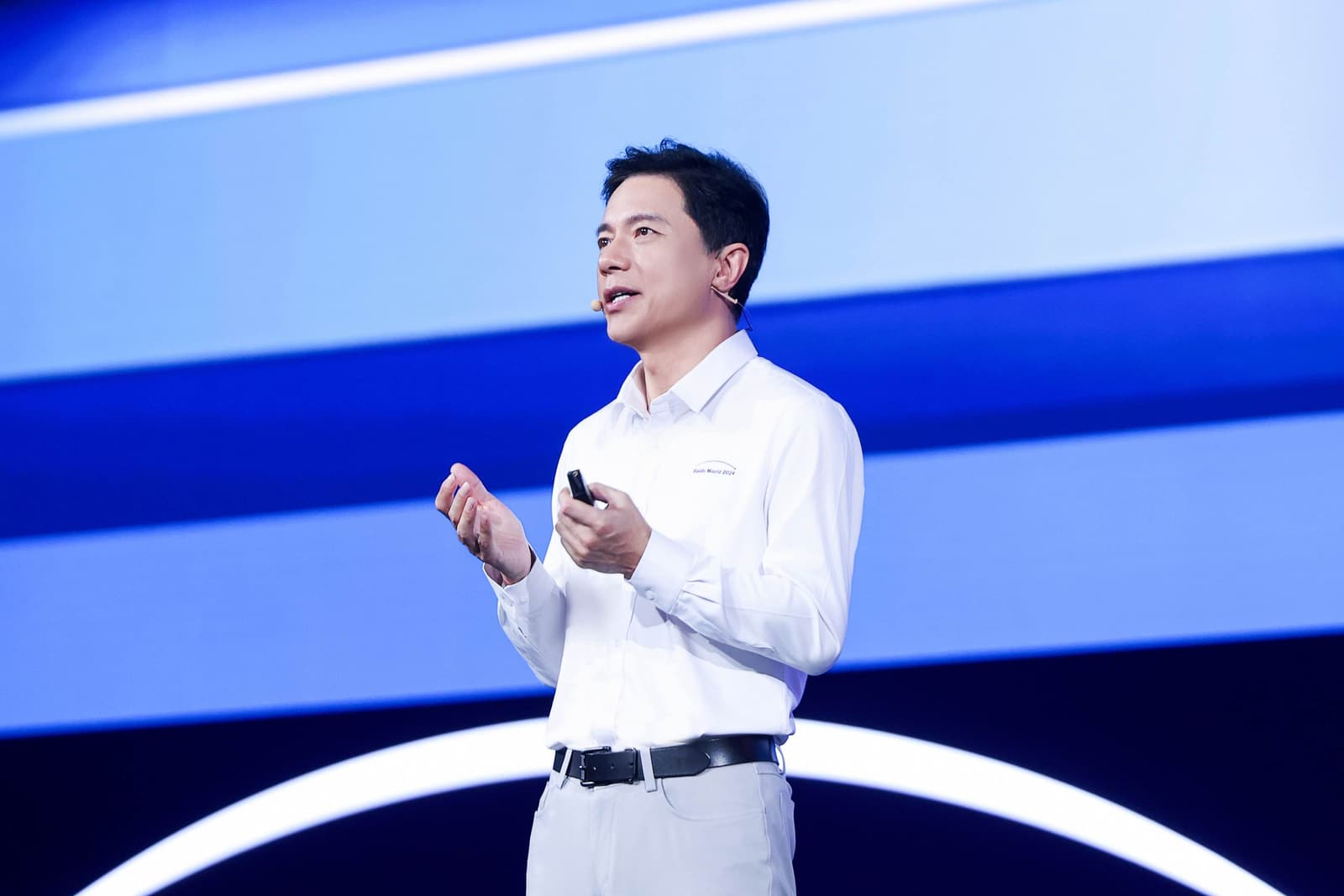
Image context: the cover uses a real stage photograph from Baidu's Miaoda launch article at Baidu World 2024. That is the right image here because the product first appeared as a public argument about application abundance. The visual is not decorative; it records the moment Baidu tried to shift the conversation from one big assistant to many generated applications.[1]
The launch thesis was about application volume, not code elegance
The Baidu World 2024 article is revealing because it frames Miaoda inside an application thesis from the start.[1] Robin Li's speech title was "Applications Are Here," not "programming is solved."[1] The article says Baidu had already seen the daily average API calls of the ERNIE large model exceed 1.5 billion by early November 2024, and then it pivots directly into agents and applications.[1] The point is that raw model usage was being treated as input material for a larger application cycle.
That is why Miaoda's three stated features matter: no-code programming, multi-agent collaboration, and multi-tool calling.[1][2] No-code alone would describe a friendlier interface for app building. Multi-agent collaboration and tool calling describe orchestration. Baidu was telling users that the system should not only draft a page, but coordinate roles, invoke tools, and assemble a functioning workflow.[1][2]
The public demo language reinforces that reading. In the launch article, Baidu described five cooperating agents in the on-stage Miaoda example: a team lead, planner, editor, programmer, and quality inspector, all working together to produce an invitation system and then inspect bugs and operate tools.[1] Even if demo language should not be confused with audited production reliability, the framing is still important. Baidu did not present Miaoda as a prettier code editor. It presented Miaoda as an application factory with role-based orchestration.
Why the cloud-service handoff is the real product boundary
The March 26 cloud update makes the boundary even clearer. Baidu's own wording says Miaoda uses a technical combination of "no-code programming + multi-agent collaboration + multi-tool calling" and lets users generate complete functional code from natural-language requirements, with the promise of "3-minute generation + 1-hour iteration."[2] That is not a claim about developer delight alone. It is a claim about compressing the trip from idea to deployment-ready artifact.
The annual report helps explain why Baidu can tell that story in public. Baidu says Qianfan spent 2025 expanding its model library, enhancing toolkits, improving model services and data services, and strengthening support for complex agent workflows so enterprises could build, deploy, and scale AI-native applications and agents more efficiently.[4] Put next to Miaoda, that reads like a layered stack. Qianfan is the service plane. Miaoda is one application-facing entry point into it.
That distinction matters in AI-China because many products still stop at the assistant boundary. They can reason, search, or draft, but they leave the user holding the final operational burden. Miaoda's public promise is different. It says the user can describe an application, get a complete system, iterate quickly, and avoid traditional ops overhead.[2][3] The interesting part is not that the product avoids hand-written code. The interesting part is that Baidu is trying to absorb more of the delivery stack behind the prompt.
In that sense, "cloud-service handoff" is the most useful label for the use case. The user does not mainly buy syntax reduction. The user buys a managed transition from idea to hosted application surface.
The live gallery shows Baidu wants throughput, not just demos
The current Miaoda homepage adds a second important layer: throughput.[3] The site is not only a product landing page. It is also a public gallery with category navigation across education, websites, marketing, office tools, e-commerce, utilities, games, surveys, and other formats.[3] When the page shows 117,466 applications in the catalog, Baidu is not merely proving that the product exists.[3] It is signaling that the product is supposed to generate a large inventory of runnable things.
That makes the use case more interesting than a conference demo. A no-code launch can generate attention even if nobody ships anything durable. A public gallery changes the loop. It creates discoverable artifacts, reusable patterns, and a visible proof surface for what the platform can already make, however uneven the quality distribution may be.[3]
This is also where Miaoda starts to fit Baidu's broader application business. The annual report says Baidu's AI applications are increasingly tied to sticky subscription-style revenue and that the company is building a growing application portfolio on top of its AI cloud layers.[4] Miaoda may still be early, but the strategic direction is legible. Baidu does not need every generated app to become a breakout destination. It needs the application-generation surface itself to become habitual enough that users keep coming back to build, revise, and deploy work.
What could break this thesis
The thesis weakens quickly if the generated outputs remain easy to demo but hard to run seriously.
It weakens if the multi-agent story mainly produces attractive prototypes while leaving integration, permissions, data handling, and maintenance to the user. It weakens if the public gallery grows faster than the number of applications with real repeat use. And it weakens if "no ops" turns out to mean only that the platform hides complexity until a team needs reliability, analytics, payment flows, or enterprise controls.[2][3]
There is also a category-risk problem. A gallery with more than one hundred thousand applications is evidence of throughput, but not yet evidence of durable product quality.[3] Baidu still has to show that Miaoda can support applications that survive beyond novelty, template reuse, or first-week experimentation. That boundary matters because a factory that can make many surfaces cheaply is not automatically a factory that can make dependable businesses.
Bottom line
Baidu's Miaoda matters because it pushes app creation one layer down the stack. The user starts with a sentence, but the product ambition is to finish closer to deployment: coordinated agents, tool calling, generated front-end and back-end logic, quick iteration, and a public surface where the result can live.[1][2][3]
That makes Miaoda more than a no-code headline. It makes Miaoda a test of whether Baidu can turn its model-and-agent infrastructure into an application service that ordinary users and small teams can actually hand work over to.[2][4] If that handoff keeps getting tighter, Miaoda will matter less as a magic trick and more as a real AI-cloud operating surface.
Sources
- Baidu, "文心iRAG和无代码'秒哒'发布!李彦宏:即将迎来AI应用的群星闪耀时刻" (November 12, 2024; Baidu World 2024 launch article, application thesis, Miaoda feature framing, multi-agent demo, and source page for the cover photograph used in this article).
- Baidu AI Cloud, "秒哒首发即爆发!上线首日吸引2万用户,打造3万应用!" (March 26, 2025; full launch metrics, 20,000+ users, 30,000+ apps, and the '3-minute generation + 1-hour iteration' product claim).
- Baidu Miaoda homepage, "秒哒-无代码应用搭建平台,一句话做应用" (viewed April 9, 2026; official product description, app-category coverage, and live gallery count showing 117,466 applications at time of access).
- Baidu, 2025 Annual Report filed with HKEX (March 17, 2026; Qianfan's agent-centric platform and complex agent workflow support, plus Miaoda listed among Baidu's AI applications).