As of 2026-04-18 UTC, the sharpest ai-china signal from Alibaba is no longer just that Qwen remains a strong model family. The stronger signal is that Qwen App is being trained into a mass-market execution surface. Read across Alibaba's own materials from November 2025 through March 2026, the pattern is unusually consistent: the company first launched Qwen App as a broad consumer assistant with deep research, coding, voice, and camera functions; then upgraded it into an "AI that acts" layer connected to shopping, payment, travel, and maps; then showed that this was not only a demo by publishing real order and user-scale numbers from the Chinese New Year cycle.[1][2][3][4]
My inference from those sources is narrower than "Alibaba has already won consumer AI." The more defensible claim is that Alibaba is proving a specific route to consumer-agent adoption inside China: turn the assistant into an order-routing habit that sits directly on top of owned commerce and service rails.[1][2][3][4] That matters because it pushes agentic AI out of the benchmark-and-demo stage and into repeated everyday behavior.
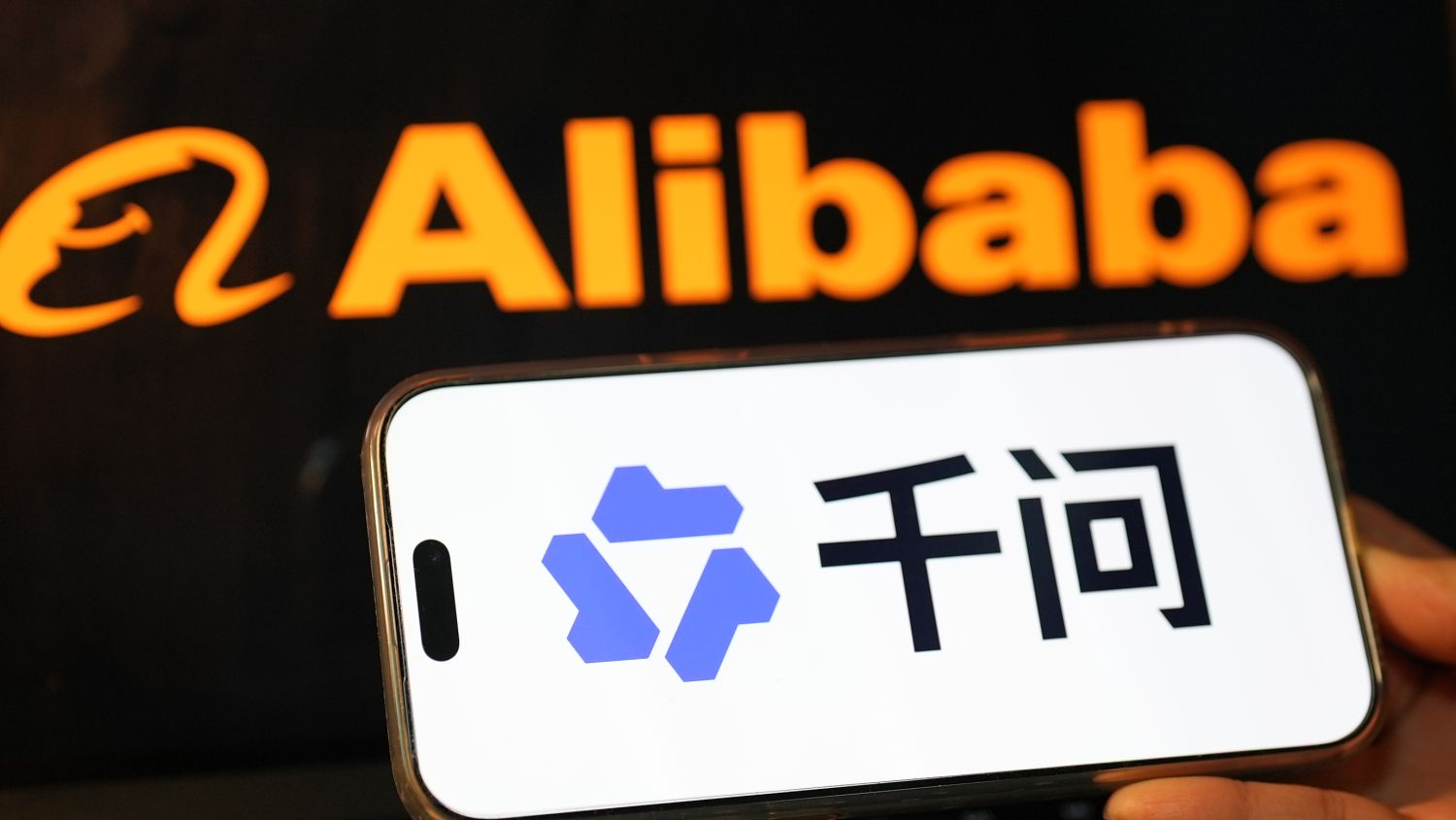
Image context: the cover uses Alibaba's official Qwen App launch photograph. It works here because the article is about a real device interface becoming a transaction surface. A photographed phone in front of the Alibaba brand is more honest and more informative than a synthetic "AI commerce" graphic.[4]
The January upgrade changed the product category
Alibaba's January 15, 2026 announcement is the key hinge point. The company said Qwen App had moved from "AI that responds" to "AI that acts", and it explained the mechanism in concrete ecosystem terms: deep integration with Taobao, Taobao Instant Commerce, Alipay, Fliggy, and Amap.[1] That is not generic assistant language. It is a routing map.
The page is especially revealing because it describes full task chains rather than one-off suggestions. Through a single text or voice request, users can order food, complete in-chat payment, plan and book travel, call restaurants, and manage multi-step tasks without hopping between apps manually.[1] Alibaba even demonstrated a real-time bubble-tea order for 40 cups, completed through Taobao Instant Commerce with discounts applied and payment handled inside the chat.[1] In other words, the product is not being framed as a smarter search box. It is being framed as a conversational dispatcher that can move an intention across selection, payment, and fulfillment.
That is where the category shift becomes important. A consumer assistant that only summarizes, searches, or chats is still competing in the attention market. A consumer assistant that starts routing orders is entering the behavior market. Alibaba's own language makes clear that Qwen App is meant to live in the second category.[1]
November supplied the broad assistant frame, but not yet the proof
The earlier November 25, 2025 launch note matters because it shows what Alibaba wanted Qwen App to mean before the January upgrade hardened the execution thesis. In that first phase, the company positioned the app as a "smart personal assistant that not only chats but gets things done," and highlighted deep research, AI-assisted coding, camera functions, voice calls, and automated output such as turning one command into both a research report and a slide deck.[4]
That broad feature frame was useful, but it did not yet prove durable behavior. It established that Alibaba wanted Qwen App to be more than a chat window. It also showed strong early distribution, with 10 million downloads within the first week after the November 17 public beta launch and a quick rise into the top three of China's App Store free-app chart.[4] Still, downloads and feature lists alone do not tell you whether users will actually hand everyday tasks over to an AI surface.
The January upgrade is what converted that launch energy into a more legible product direction. Once payment, commerce, travel, and maps were deeply integrated, the assistant stopped being only a branded doorway into Qwen models. It became a candidate front end for daily transaction flows.[1]
February is where the behavior signal arrived
The most important February number is not simply that Qwen App handled a lot of traffic. It is that the traffic had a recognizable consumer shape.
Alibaba Cloud Community said on February 12, 2026 that Qwen App generated over 120 million consumer orders in six days, from February 6 through February 11, after launching a 3 billion yuan Chinese New Year incentive campaign.[2] The same post says nearly half of those orders came from users in counties and rural areas, while about 1.56 million users aged 60 and above made their first-ever online purchases through Qwen App.[2]
Those details matter more than the top-line order number. They imply that Alibaba is not only driving AI curiosity among urban early adopters or professional users. It is testing whether a conversational interface can lower the operational friction of ordering and booking for groups that are usually harder to convert through new software habits.[2] If an AI assistant can compress product discovery, payment, and confirmation into one exchange, the surface becomes more inclusive precisely because it removes some of the navigation burden that conventional apps impose.
The February post also widened the execution map. Alibaba said the holiday upgrade added Freshippo, Tmall Supermarket, and Damai, on top of the previously integrated Taobao, Taobao Instant Commerce, Alipay, Fliggy, and Amap stack.[2] That is strategically important. The app is not being taught to do just one narrow commerce action well. It is being taught to route across groceries, food delivery, shopping, travel, navigation, and entertainment planning.
March is where the scale thesis became harder to ignore
Alibaba's March 19, 2026 update is the clearest evidence that Qwen App is becoming part of the company's larger AI-commercialization logic rather than remaining a promotional side project. The company said consumer-facing Qwen surpassed 300 million monthly active users across all platforms as of February.[3] In the same update, Alibaba tied the app directly to business outcomes: the Qwen App helped facilitate nearly 200 million orders for holiday shopping, travel booking, and entertainment planning during the recent Chinese New Year period.[3]
Placed beside the rest of the announcement, the app starts to look like an application-layer monetization surface for Alibaba's broader stack. Alibaba also reported 36% year-over-year Cloud Intelligence Group revenue growth and said AI-related product revenue had delivered triple-digit growth for the tenth consecutive quarter.[3] The company is therefore telling one integrated story: frontier models, chips, cloud infrastructure, and consumer applications are being linked together, with Qwen App acting as the most visible mass-market proof that those AI investments can turn into behavior and transactions.[3]
This is the important distinction. In many AI markets, "consumer AI" still mostly means chat retention. Alibaba is trying to make it mean task completion with attached commerce and service rails.[1][2][3][4]
What the evidence does and does not prove
The evidence is strong enough to support a clear field signal, but not every ambitious claim.
It does support the claim that Alibaba has found a more concrete consumer-agent wedge than a generic chatbot: keep the interface conversational, but attach it to real ordering, booking, payment, and follow-through paths inside the company's own ecosystem.[1][2][3] It also supports the claim that holiday incentives and ecosystem depth can accelerate habit formation at unusual scale.[2][3]
It does not yet prove that this pattern generalizes outside Alibaba-controlled rails, or that users will grant the same level of trust when actions become more expensive, higher-risk, or less reversible. Nor does it prove that Qwen App's current scale would hold without heavy campaign support and deeply integrated first-party services.[2][3] The present evidence is strongest where Alibaba owns both the assistant surface and the transaction infrastructure below it.
Bottom line
Qwen App's most important 2026 signal is that Alibaba is turning agentic AI into an order-routing habit, not just a model showcase.[1][2][3][4] November established the broad assistant frame. January connected the app to commerce, payment, travel, and maps. February showed that the routing surface could drive mass consumer behavior. March made that consumer behavior legible as part of Alibaba's larger AI-and-cloud flywheel.[1][2][3][4]
That is why Qwen App matters in ai-china. It shows one plausible path by which agentic AI becomes ordinary: not by asking consumers to care about model architecture, but by making one chat interface good enough at ordering, paying, booking, and coordinating that it starts to replace app-switching as a habit.
Sources
- Alibaba Group, "Alibaba’s Qwen App Advances Agentic AI Strategy by Turning Core Ecosystem Services into Executable AI Capabilities" (January 15, 2026; deep integration with Taobao, Taobao Instant Commerce, Alipay, Fliggy, and Amap; "AI that acts" framing; end-to-end ordering, payment, travel, and task-assistant examples).
- Alibaba Cloud Community, "Qwen App's CNY Campaign Attracts Over 120 Million Orders" (February 12, 2026; 120 million orders in six days, nearly half from counties and rural areas, 1.56 million first-time older online shoppers, and added Freshippo/Tmall Supermarket/Damai integrations).
- Alibaba Group, "Alibaba Reports Solid Progress in AI + Cloud on the Strength of Its Full-Stack Capabilities" (March 19, 2026; 300 million monthly active users across all platforms as of February, nearly 200 million holiday orders, 36% cloud revenue growth, and triple-digit AI-product growth).
- Alibaba Group, "Alibaba’ Qwen App Surpasses 10 Million Downloads within the First Week of Public Beta Launch" (November 25, 2025; public beta timing, top-three App Store rank in China, deep research, coding, voice-call framing, and source page for the cover photograph used in this article).