As of 2026-05-30 UTC, the durable AI-China signal in Pangu-Weather is not that Huawei built a weather model and published a strong paper. The more useful lesson is the handoff pattern around it: a global neural forecast model becomes valuable only when it can be initialized from trusted weather data, tested by operational forecasters, adapted to regional grids, and placed inside a warning workflow that humans still own.[1][2][3]
That makes Pangu-Weather a different kind of AI-China story from consumer assistants, code agents, or video generators. Weather forecasting is not a demo surface where fluency can hide uncertainty. A forecast has a lead time, a grid, variables, a verification method, and a user who may have to close a port, warn a district, move construction crews, or prepare for a typhoon. The model's output matters only if the surrounding institution knows when to trust it, when to discount it, and how to explain it.
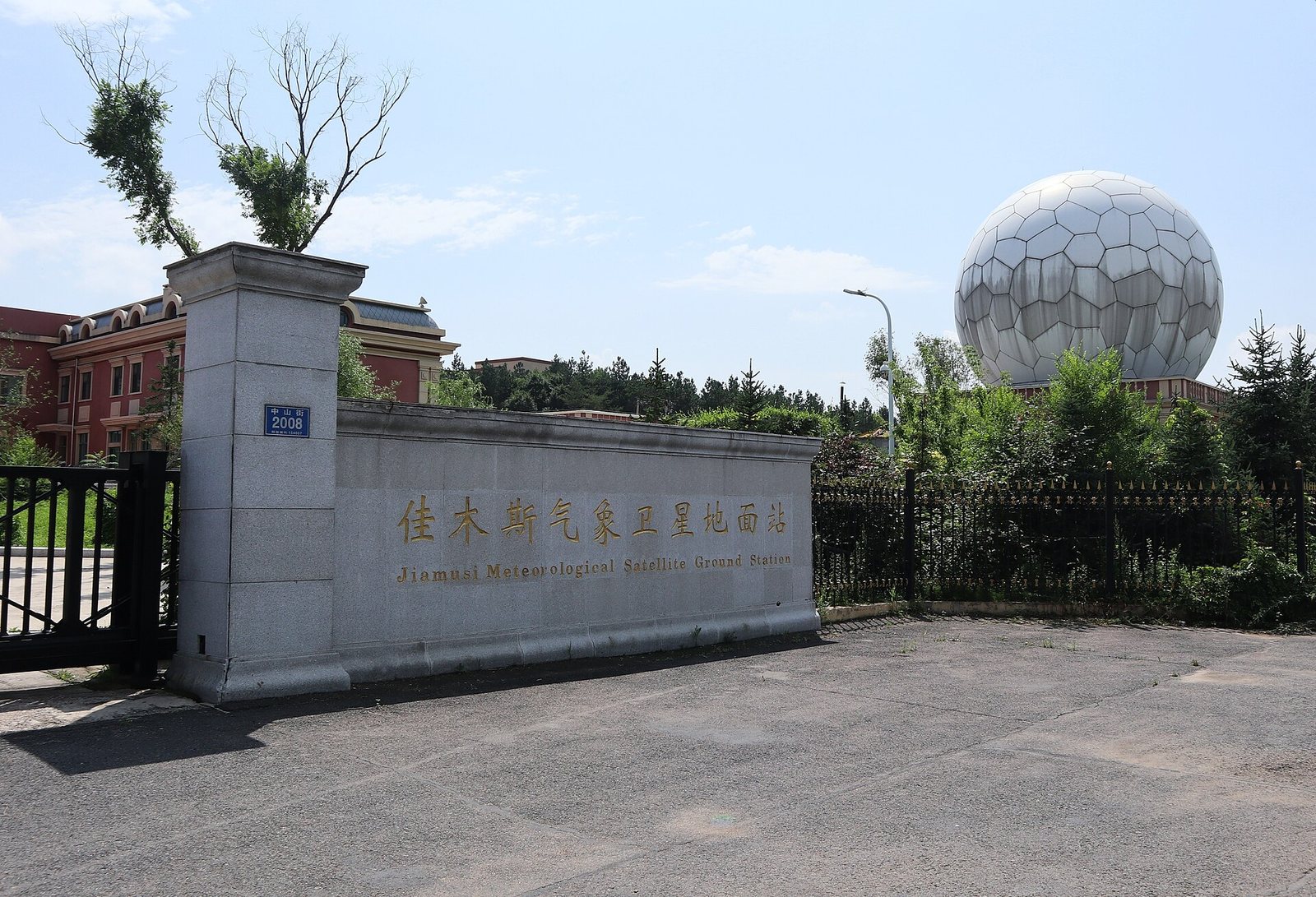
Image context: the cover uses a real Wikimedia Commons photograph of the Jiamusi Meteorological Satellite Ground Station. The ground-station scene keeps the article anchored to the operational side of Pangu-Weather: observations, model artifacts, forecaster review, and the handoff from global prediction to local public service.[5]
The use case begins below the model card
The 2023 Nature paper framed Pangu-Weather as a medium-range global forecasting system built with three-dimensional neural networks. It used atmospheric fields as input and predicted future states across upper-air and surface variables, with a reported spatial resolution of 0.25 degrees by 0.25 degrees and forecast spacing down to 1 hour.[1] The authors compared it with ECMWF's operational IFS and FourCastNet on 2018 reanalysis and forecast data, and reported lower RMSE across tested variables, while also highlighting tropical cyclone tracking as a stress case.[1]
Those are strong research claims. They are not yet a public-service workflow. The practical boundary appears in the data and code details. The paper says the system used roughly 60 TB of ERA5 data for training and released trained models, inference code, and pseudocode for research use.[1] The public repository makes the same boundary visible: the official implementation provides ONNX model files, CPU and GPU inference scripts, required input arrays for surface and upper-air variables, and examples for generating forecasts, but it also notes restrictions around model use and the need to prepare initial fields correctly.[2]
That is why "AI beats numerical weather prediction" is too loose as a headline. A usable forecast product needs the right initial state, the right data conversion, the right lead time, the right verification target, and a human process for reading the output. Pangu-Weather's real use case is not a single model replacing the forecast office. It is a fast forecast component entering a chain that already has observational data, numerical models, forecaster judgment, and public warning obligations.
ECMWF turned the model into a public comparison surface
ECMWF's role is important because it moved Pangu-Weather from a paper into a visible, operational-like comparison environment. In 2024, ECMWF described a workflow where users could run AI weather models from ECMWF open data with tools such as ai-models and ai-models-panguweather, combining open initial conditions with model plugins for Pangu-Weather, FourCastNet, GraphCast, FuXi, and Aurora.[4] This matters because it turns the model into something researchers and forecasters can reproduce, compare, and stress against alternatives.
The 2026 ECMWF update adds a useful caution. ECMWF wrote that since 2023 it had run several external machine-learning models in experimental mode, with forecasts available through openCharts. At the beginning of 2026, the daily external set included Pangu-Weather, GraphCast, Aurora, and FourCastNet, run twice daily at 00 and 12 UTC and initialized from the IFS operational analysis.[3] ECMWF then explained that its own Artificial Intelligence Forecasting System had been operational since February 2025, and that an IFS cycle upgrade changed how external ML models behaved when initialized from the newer analysis.[3]
That is not a dismissal of Pangu-Weather. It is the point. Weather AI is coupled to the data-assimilation and initial-condition regime around it. ECMWF's note says Pangu-Weather and FourCastNet showed a neutral impact from the initial-condition change, while GraphCast, Aurora, and AIFS v1.1 were more negatively affected because fine-tuning made them more sensitive to the exact initiating analysis.[3] The lesson for AI-China is concrete: model skill is not separable from the institution that feeds, verifies, and upgrades the forecast pipeline.
Shenzhen shows the regional handoff
The clearest Chinese deployment signal came from Shenzhen. In March 2024, Huawei Cloud and the Meteorological Bureau of Shenzhen Municipality announced the regional AI weather forecasting model Zhiji 1.0, based on Pangu-Weather and pre-trained on high-quality regional datasets.[6] Huawei said the system could generate five-day forecasts at 3 km spatial resolution for Shenzhen and neighboring regions, a much finer scale than typical global models working around 25 km resolution.[6]
That regional move is the heart of the use case. A global model can capture broad atmospheric evolution. A coastal megacity needs neighborhood-scale warning service: temperature, precipitation, wind, cold spells, monsoon-season rain, and sudden local conditions that affect transport, construction, schools, ports, and hillside districts. Huawei's announcement said the trial beginning in February 2024 had predicted multiple cold-temperature periods in Shenzhen and that the next work would focus on further verification, comprehensive evaluation through the monsoon season, and better precipitation forecasts.[6]
The wording is careful, and the caution is useful. The announcement does not say the model has solved local rainfall. It says the system is being verified and improved. In weather, that restraint is a feature, because precipitation at city scale is exactly where a glossy AI story can overpromise. A useful regional AI model must survive boring daily verification as well as dramatic storm cases.
Why this belongs in the AI-China stack
Pangu-Weather matters for China's AI stack because it shows a path that is not centered on chat. The workflow links scientific AI, cloud infrastructure, open model artifacts, operational verification, municipal data, and public-service delivery. It also highlights a pattern likely to reappear in manufacturing, energy, transport, and medical operations: a foundation model gets attention, but value appears when the model is adapted to a regulated local workflow with real costs for error.
The adoption boundary is equally clear. Pangu-Weather is not a reason to throw out numerical weather prediction. Numerical systems still own data assimilation, physics constraints, ensemble reasoning, and a long institutional record. AI models are fast and increasingly skillful, but they can be brittle around distribution shifts, rare extremes, changing initial analyses, and local variables that were weak in training data. The right question is not whether the neural model replaces the forecaster. It is where it can add a fast alternate forecast, an ensemble member, a scenario screen, or a regional warning signal that forecasters can interrogate.
The falsifier is straightforward. If Pangu-Weather stays mostly as a model-branding asset and regional deployments do not produce transparent verification, forecaster adoption, and measurable warning improvements, then the use-case story is thin. The stronger signal would be public scorecards, case studies by weather bureau teams, documented false-alarm and missed-event behavior, and clear integration with numerical models and human forecast desks.
For now, the handoff is the thing to watch. Nature established the research claim; GitHub made the model artifacts inspectable; ECMWF turned the system into a public comparison layer; and Shenzhen showed how a Chinese city can try to localize the model into a service workflow.[1][2][3][4][6] In a field where wrong confidence can hurt people, that is the mature AI story: not a model standing alone, but a model learning to enter an institution.
Sources
- Kaifeng Bi et al., "Accurate medium-range global weather forecasting with 3D neural networks," Nature 619, 533-538 (2023); model architecture, data scale, resolution, verification framing, cyclone tracking, and code/data availability.
- Huawei Cloud researchers,
198808xc/Pangu-Weatherofficial GitHub repository; released model artifacts, inference scripts, input-array contract, ONNX notes, and research-use boundaries. - ECMWF, "Farewell to the external AI models" (May 2026); external ML model experiment, Pangu-Weather daily runs, IFS initialization, AIFS operational context, and sensitivity to initial-condition changes.
- ECMWF, "Run AI models yourself from ECMWF open data" (September 26, 2024);
ai-modelsworkflow, Pangu-Weather plugin, open-data initialization, and multi-model experimentation. - Wikimedia Commons, "File:Jiamusi Meteorological Satellite Ground Station 1, Jul 2019.jpg"; real meteorological satellite ground-station photograph used as the article image.
- Huawei Cloud, "Huawei Cloud and Shenzhen Meteorological Bureau Announce Regional AI Model" (March 23, 2024); Zhiji 1.0 regional model, 3 km Shenzhen forecast grid, five-day forecast scope, trial notes, and monsoon-season verification plan.