
As of 2026-04-14 UTC, the useful way to watch iFLYTEK Trulearn's 59-second short "Revolutionizing math class! Spark Smart Blackboard transforms hand-drawn geometry into 3D magic." is to resist the easiest reading available to it.[1] The easy reading is that this is one more educational-AI clip where a dazzling visualization stands in for an actual classroom claim. The official materials around the video point somewhere narrower and more commercial. iFLYTEK's product page places the blackboard inside its AI Teaching line and frames it as more than a display: a hardware-software teaching assistant on an 86-inch 4K board with local system specs, a dedicated classroom form factor, and a role inside broader lesson flow.[2]
The company’s own education articles make that broader role explicit. A 2024 award note says the SPARK Smart Blackboard is meant to close the loop across pre-class, in-class, and post-class teaching by joining the large classroom screen with teachers' and students' terminals.[3] A later conference writeup says iFLYTEK's education solutions have already been adopted in more than 50,000 primary and secondary schools, serving over 130 million teachers and students, and it singles out the blackboard's ability to turn formulas into dynamic graphs and produce three-dimensional cross-sections with one click.[4] A 2026 rural-education case study pushes the same pattern into deployment language: AI lesson preparation, live classroom interaction, homework analysis, and feedback are being sold as one integrated system rather than as isolated model tricks.[5]
That context changes what the video is doing. My inference from the short plus the written sources is that iFLYTEK is not mainly trying to prove it has a pretty geometry engine.[1][2][3][4][5] It is trying to prove that one teacher gesture on the board can stay inside a managed classroom loop: sketch on the main screen, convert the drawing into a manipulable object, explain the concept without breaking flow, and keep the same surface connected to preparation and review. In ai-china terms, this matters because it is a familiar Chinese commercialization pattern. The frontier claim is not "our model can reason about geometry." The stronger claim is "our AI can live inside a school device that teachers might actually use every day."
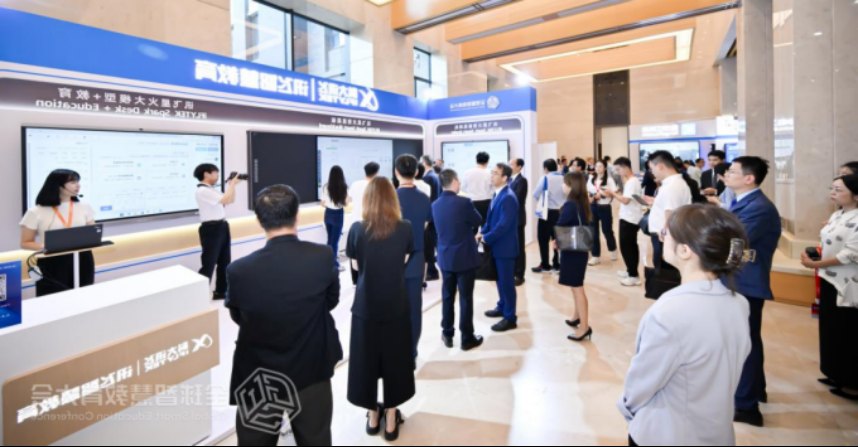
Image context: the cover uses a real iFLYTEK exhibition photo from the company's smart-education award article. That is the right visual here because the video's real subject is deployment surface. The classroom story only matters if the blackboard exists as a product that can be demonstrated, bought, installed, and folded into institutional teaching practice.[3]
Around 0:05, the real pitch is continuity between chalk logic and screen logic
The first useful thing in the clip is how little ceremony it gives the transformation.[1] A teacher-facing hand sketch appears, and the system turns that 2D drawing into a 3D geometry object on the same blackboard surface. The important point is not only that the shape looks impressive. It is that the video refuses to stage this as a separate modeling workflow. There is no dramatic jump to a different app, no sense that the teacher has left the classroom board for a specialized design tool. The clip wants the viewer to feel continuity between drawing, explanation, and spatial visualization.
That continuity matters more than the geometry itself. iFLYTEK's award article says the blackboard is built to join hardware and software across the whole teaching cycle, and the conference note says teachers can use it to turn abstract mathematical ideas into something students can see directly.[3][4] Put together, those written claims help decode the video's opening move. The product is not saying, "Look, we can render solids." It is saying, "A normal board gesture can now stay inside the same explanatory surface while gaining a spatial layer."
That is a stronger sales message. Geometry has always been one of the places where classroom explanation breaks down because the teacher moves between static board marks and the student's need to imagine volume, angle, and section in space. The blackboard demo tries to close that gap without asking the teacher to stop teaching and become a software operator. In other words, the video is selling pedagogical continuity.
Around 0:15 to 0:33, color fill, stacking, and cross-sections turn spectacle into a teacher-control claim
The middle of the short is where the argument sharpens. The demo moves from the initial solid into color filling, stacking, and then the so-called three-point interface for generating and extracting cross-sections.[1] If this were only a marketing reel for mathematical beauty, the clip could have stopped at the first 3D reveal. Instead it keeps showing controlled operations on the object. That choice is telling. iFLYTEK wants the viewer to understand that the blackboard is not just capable of displaying a finished model; it is capable of letting the teacher manipulate that model in class as the explanation unfolds.
The conference article makes exactly this point in prose. It says the system can convert mathematical formulas into dynamic graphs in real time and create three-dimensional cross-sections with one click, allowing teachers to inspect them from multiple angles and make abstract reasoning more intuitive.[4] The short is basically a compressed visual proof of that statement. It is not really about rendering quality. It is about classroom control verbs: create, fill, stack, slice, rotate.
This is where the video becomes more interesting as an ai-china document than as a mere ed-tech clip. Much public AI coverage still defaults to the benchmark frame, especially around reasoning. But schools do not buy benchmarks. They buy time savings, clearer explanation, fewer classroom interruptions, and systems that can be operated under real classroom pressure. By showing stepwise manipulations instead of an isolated final model, the short is translating model capability into teacher-operable actions.
Around 0:33 to the end, dynamic manipulation reveals the larger classroom-loop business model
The final movement, where points move and the geometry changes in real time, is the key to the whole video.[1] Real-time manipulation is not useful only because it looks modern. It matters because it keeps the explanation alive inside the class period. The teacher can alter the object, show a changed relation immediately, and keep the room's attention on the same surface. This is the point where the short connects most clearly to iFLYTEK's larger education claims.
In the award article, iFLYTEK says large-scale application data shows lesson-preparation time for unit teaching designs and task-group plans can fall from 2 hours to 25 minutes, and that the blackboard can automatically generate micro-lesson recordings after class based on what actually happened in the room.[3] The same piece also says a voice-activated smart pen can control large-screen functions and save 6 minutes per class, improving classroom efficiency by 80%.[3] Those are company claims rather than neutral audits, but they are still revealing. They show what the firm thinks the product is for. The product is not being positioned as an isolated visualization toy. It is being positioned as a board-centered workflow instrument that reduces friction before class, during class, and after class.
The rural-school case study reinforces that reading from another angle. It describes an integrated system where AI supports lesson preparation, classroom activities, homework marking, analysis, and personalized error collection, especially in resource-constrained schools where teachers may work across subjects.[5] Once that context is in view, the video's geometry demo looks less like a one-off feature and more like the most legible front-end example of a larger stack. Geometry is simply the cleanest place to show why the board matters.
That is why this short is worth embedding. Its strongest claim is not that iFLYTEK can generate 3D solids from a sketch. Its stronger claim is that the company wants to own a classroom execution surface where AI teaching assistance becomes ordinary infrastructure. The blackboard, the smart pen, the lesson-prep layer, the in-class visualization layer, and the post-class recap layer are being packaged as one system. For ai-china, that is the signal worth keeping. The real competitive move is not a standalone model demo. It is the conversion of model capability into a school device that fits administrative budgets, teacher habits, and daily instruction loops.[1][2][3][4][5]
Sources
- iFLYTEK Trulearn, "Revolutionizing math class ! Spark Smart Blackboard transforms hand-drawn geometry into 3D magic.", official YouTube video, published December 17, 2025.
- iFLYTEK, "Spark Smart Blackboard" product page (AI Teaching placement, product framing, and device specifications).
- iFLYTEK, "iFLYTEK's SPARK Smart Blackboard Wins Global Smart Education Innovation Prize" (August 2024; closed-loop teaching framing, prep-time reduction, smart-pen control, and source page for the exhibition photograph used as this article's image).
- iFLYTEK, "iFLYTEK Showcases AI-Driven Innovation at the China International Conference on Basic Education, Highlights AI's Role in Advancing High-Quality Education Development" (December 31, 2025; 50,000-school deployment claim, 130 million teachers/students, and geometry visualization examples).
- iFLYTEK, "AI-Empowered Rural Education: Eight Years of Practice at a Rural Primary School in China" (February 6, 2026; integrated AI teaching system, rural-school deployment, and post-class analysis workflow).