
As of 2026-04-14 UTC, the right way to watch Alibaba Cloud's 35-second official Agentic SOC short is to ignore the temptation to treat it as one more vague "AI changes security" teaser.[1] The video is too compressed for that reading to be useful. Its own description is already more specific. Alibaba says the product combines environment-layer risk perception, model-driven deep reasoning, autonomous collaborative investigation by agents, and full-link traceability with closed-loop management, with an operating chain of Perception-Decision-Execution.[1] That is not the language of a generic assistant. It is the language of a security operations surface that wants to own the whole path from log intake to recommended handling.
The supporting documentation makes that claim sharper. Alibaba's Security Center docs describe Agentic SOC as a built-in detection-and-response module with unified log analysis, automated incident response, and out-of-the-box threat detection rules.[2] The integration docs say it can centrally collect, standardize, and analyze logs from Alibaba Cloud products and other sources inside one integration center.[3] A second doc adds a management layer on top of that: multiple Alibaba Cloud accounts can feed one delegated administrator account so detection and response stop fragmenting by account boundary.[4] A third expands the perimeter further, saying Agentic SOC can import logs from Kafka, Amazon S3, and OSS to create one security operations center across environments.[5]
Put those written materials beside the video and a more disciplined interpretation appears. The clip is not trying to prove that an LLM can read alerts. It is trying to persuade the viewer that security autonomy becomes credible only when the same platform owns telemetry normalization, case visibility, agent investigation, and response routing.[1][2][3][4][5] That is the thesis worth carrying into the short before pressing play.
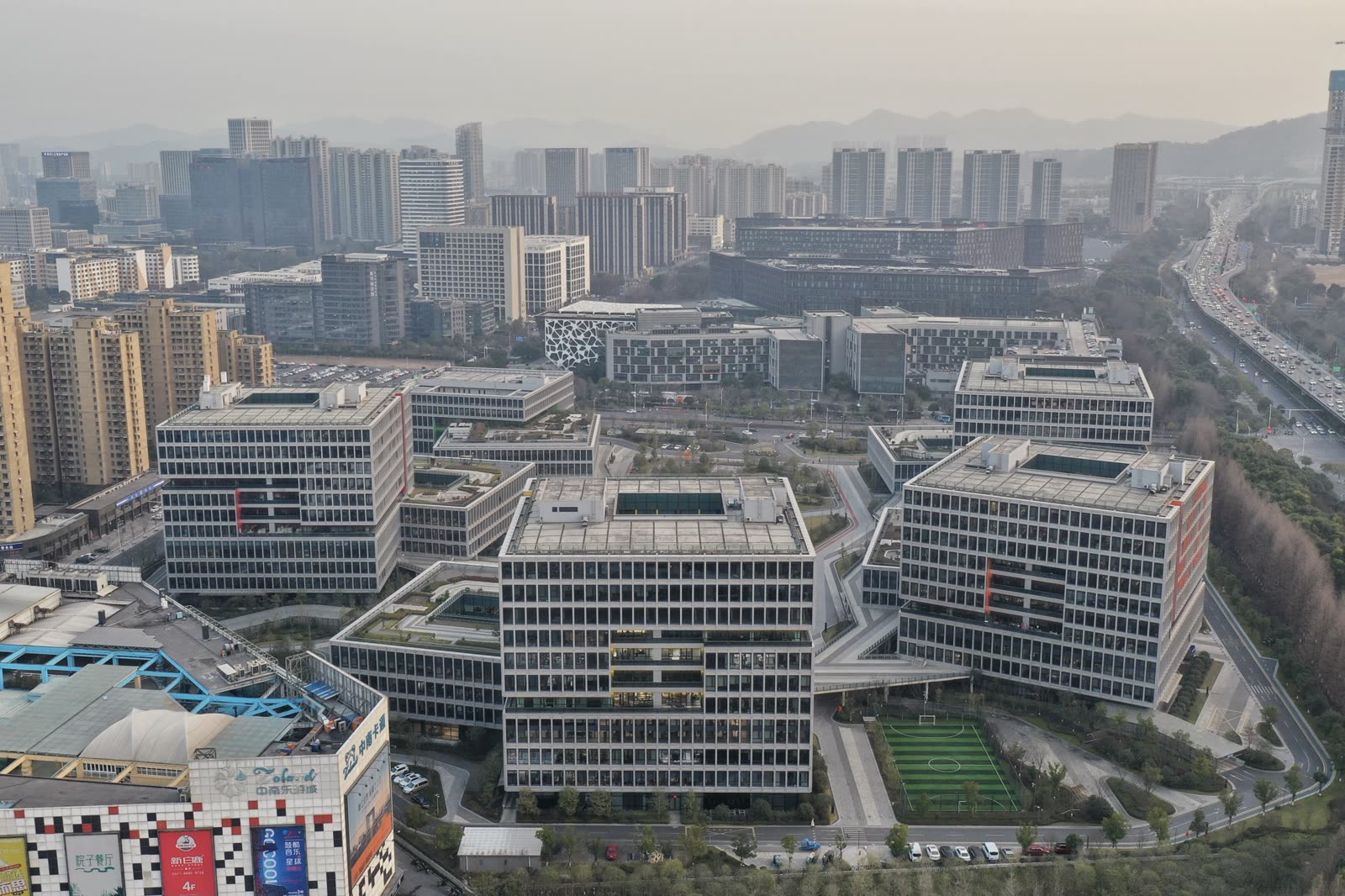
Image context: the cover uses a real Wikimedia Commons photograph of Alibaba Center in Binjiang, Hangzhou. A documentary company-campus image fits this article because the video is really about turning AI security into an institutional product surface, not about decorating the page with an abstract cyber illustration.[6]
By about 0:05, the short turns alert fatigue into a platform argument
The opening seconds are revealing because they do not begin with a broad cloud diagram or a triumphant slogan.[1] The first visual isolates a single red alert card against black space, then the clip moves into a plain title slide reading "Traditional SOC Model."[1] That sequence does two things at once. First, it reduces security work to a familiar pain point: too many alerts arriving as disconnected objects. Second, it suggests that the old problem is not merely analyst labor shortage. The old problem is architectural fragmentation.
That reading matters because the docs describe Agentic SOC in exactly those infrastructural terms. Alibaba does not introduce the module as a chatbot for analysts. It introduces a system that can gather logs centrally, standardize raw inputs, and apply consistent rules over the environment.[2][3] In other words, the short's old-versus-new contrast is not really about humans versus AI. It is about scattered telemetry versus a controlled ingestion layer.
For ai-china, that is the meaningful commercial signal. Chinese enterprise AI videos often flash "agent" language while leaving the underlying data contract unclear. This short does the opposite. Its first move is to imply that autonomy depends on data plumbing being native to the platform.[1][3] The product claim begins below the model layer.
Around 0:09 and 0:17, "the Agentic SOC era" is staged as one dashboard with one event grammar
By roughly 0:09, the text has changed to "Welcome to the Agentic SOC Era," and soon after the viewer is inside a Security Events dashboard with counts, severity buckets, and a single ranked list of incidents.[1] The design choice is simple but important. Alibaba is not dramatizing a conversational assistant window. It is dramatizing a control panel. Even when the product is called "agentic," the core visual is still a normalized queue of events that can be sorted, investigated, and acted on.
That maps cleanly to the docs. The purchase-and-activation page frames Agentic SOC as a built-in module for threat detection and response, while the integration-center docs explain that logs are collected and standardized so the environment can be analyzed through a common schema.[2][3] The multi-account documentation then extends that same grammar across organizations, arguing that separate accounts otherwise create blind spots because each one generates logs, detections, and events independently.[4] The video's single dashboard is therefore not just interface polish. It is the visual summary of a deeper claim: security events should be governed in one place even when the infrastructure underneath is not singular.[3][4]
That is also why the short feels more operational than many AI launch clips. The point is not that the model can talk about threats. The point is that it can inherit a pre-organized event space. Alibaba is selling a system in which "agentic" behavior rides on top of a pre-merged security queue, not a free-floating language model with no durable case structure.[2][3][4]
Around 0:21 and 0:29, autonomous analysis is shown as workflow state, not as magic
The middle of the clip is where the strongest product message lands. Around 0:21, the screen literally says "Autonomous Analysis," and the incident list starts showing machine judgments and workflow labels rather than raw alert text alone.[1] A few seconds later, the table shows statuses like "Unhandled," tags such as "Real Attack," and entries marked "Agent investigating."[1] The visual rhetoric here is subtle but disciplined. Alibaba is not showing the agent as a character. It is showing the agent as a status-bearing process inside the queue.
That choice aligns with the product docs better than a talking copilot demo would. The video description promises deep reasoning and collaborative investigation by agents.[1] The docs, meanwhile, explain the practical substrate beneath that promise: centralized logs, normalized formats, and cross-account management so investigation does not break at the first organizational seam.[2][3][4] When the short labels one incident "Real Attack" and another "Agent investigating," it is effectively saying that the model is not being inserted at the edges. It is being embedded inside the triage path itself.
This is where the piece stops sounding like simple AI branding. In enterprise security, the hard question is never whether a model can summarize an alert. The hard question is whether the model's judgment can remain attached to a case, a timeline, a status field, and a recommended next action. Alibaba's clip understands that. The "autonomous" part is rendered as queue movement, not poetic intelligence.[1][2][3] That is a much more serious sales claim.
The last frame tells the real story: the loop is supposed to survive cross-cloud and end in handling
The closing seconds are the most revealing of all. By roughly 0:33, the viewer sees a case detail screen for a cross-cloud data breach between Alibaba Cloud and AWS, with a blue "Recommended Handling" button ready at the bottom.[1] This is the frame that unlocks the whole short. If the product were only about Alibaba-native security events, the commercial ambition would be narrower. By ending on a cross-cloud case, the video says the loop should survive heterogeneous environments and still resolve back into one handling surface.
The written sources support that exact interpretation. Alibaba's general-data-import documentation says Agentic SOC can ingest logs through Kafka, Amazon S3, and OSS so teams can maintain consistent visibility across cloud environments.[5] The multi-account guide says event response can be centralized under a delegated administrator account instead of splintering across member accounts.[4] Read together with the final screen, the pitch becomes straightforward: Alibaba wants to own the analyst workflow even when the underlying telemetry comes from more than Alibaba alone.[4][5]
That is why this short is worth more than its runtime suggests. It is not evidence that autonomous security operations are already solved. A 35-second product reel cannot prove that. What it does show, with unusual clarity, is Alibaba's chosen packaging of the problem. The company is selling autonomy as the outcome of owning four layers at once: ingestion, normalization, investigation, and handling.[1][2][3][4][5] In the ai-china market, that is a stronger signal than a generic promise of smarter cyber defense.
Sources
- Alibaba Cloud, "Alibaba Cloud Officially Unveils Agentic SOC, Ushering in the Era of Autonomous Security Operations," official YouTube video, published April 14, 2026.
- Alibaba Cloud Security Center, "Purchase and activate Agentic SOC" (built-in module framing, unified log analysis, automated response, and threat-detection rules; last updated March 31, 2026).
- Alibaba Cloud Security Center, "Integrate Product Logs into Agentic SOC for Real-Time Threat Detection" (integration center, log standardization, and centralized analysis; last updated January 20, 2026).
- Alibaba Cloud Security Center, "Agentic SOC multi-account management" (delegated administrator model, centralized log collection, and cross-account response; last updated March 31, 2026).
- Alibaba Cloud Security Center, "Import Logs into Agentic SOC via Kafka, S3, and OSS" (cross-environment import flow and consistent visibility across cloud environments; last updated March 31, 2026).
- Wikimedia Commons, "File:Alibaba Center in Binjiang Hangzhou2021.jpg" (source page for the real campus photograph used as the article image).