
As of 2026-04-13 UTC, the most useful way to watch Huawei Cloud APAC's 70-second short "Power up your journey into the AI era with Huawei Cloud" is to stop treating it like a generic corporate mood reel.[1] The official description under the video is unusually explicit. It names AI Infrastructure, ModelArts, MaaS Token Service, CodeArts, AgentArts, and DataArts as one connected portfolio rather than as separate product bullets.[1] Once the clip is read through that list, the sequence of its images starts to look deliberate. Huawei is not mainly trying to sell one foundation model, one benchmark, or one chatbot surface. It is trying to sell a delivery surface.
That distinction matters in ai-china because many short official videos still compress AI competition into headline-model language. Huawei's clip moves in another direction. The public ModelArts product page calls ModelArts a one-stop AI development platform and highlights an end-to-end model development pipeline for foundation-model and scenario-specific application work.[2] The official MaaS service overview then describes ready-to-use models that can be accessed through the console or APIs, with support for model experience, inference, training, and management from one environment.[3] Read beside the video, those pages turn the clip's fast montage into a more coherent claim: Huawei wants customers to understand its AI stack as an integrated path from compute to model access to software delivery.[1][2][3]
Huawei's own MWC26 summit note reinforces that reading from another angle. In Barcelona, the company said it unveiled an Industry AI Foundry, introduced Huawei Cloud Foundation, and showcased CodeArts as an AI-powered coding agent for customers across industries.[4] My inference from the short video plus these written materials is that Huawei is trying to flatten the distance between model capability and enterprise execution. The message is that value no longer sits at one layer alone. It sits in how infrastructure, model services, coding tools, orchestration, and data services are bundled into a governed operating surface.[1][2][3][4]
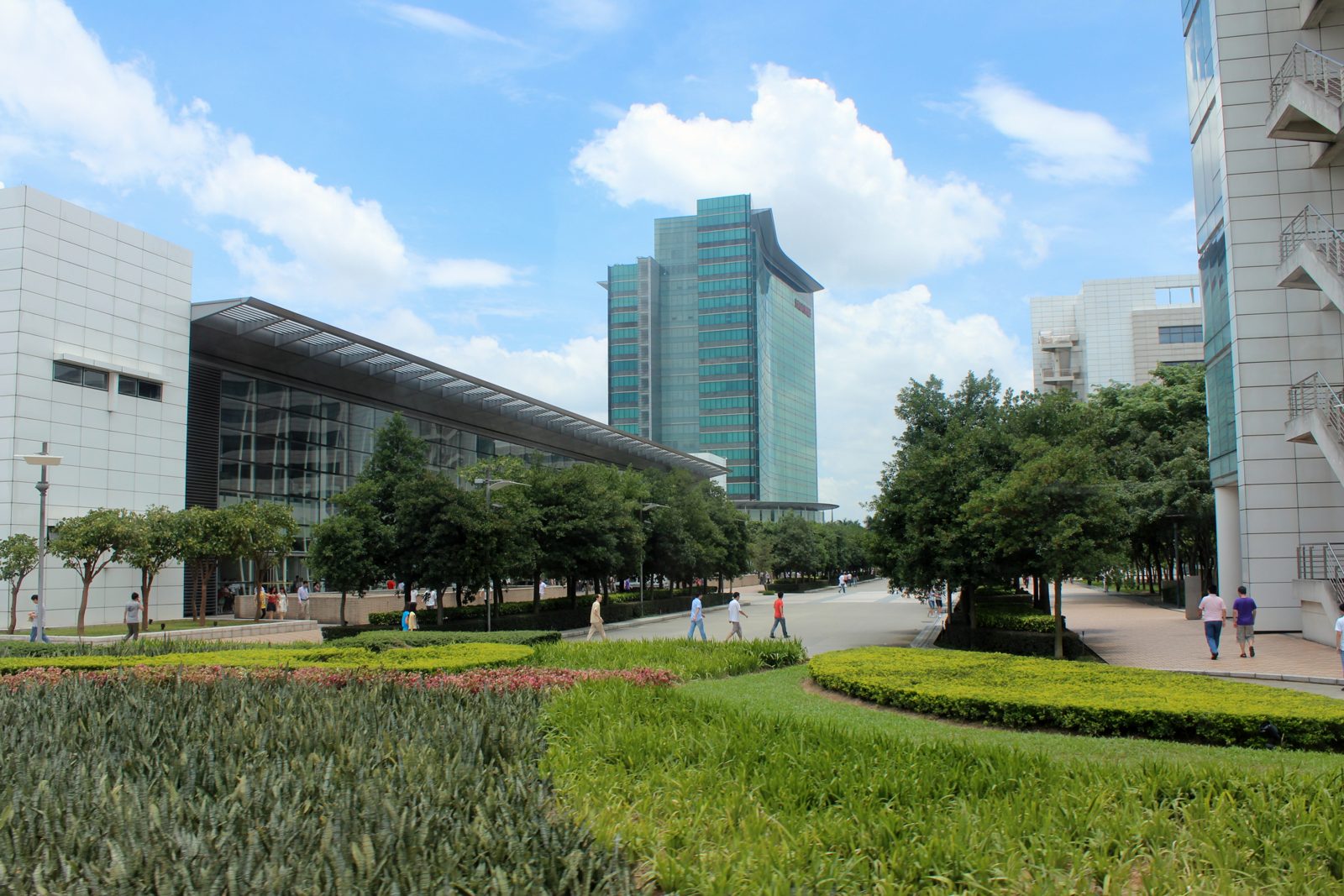
Image context: the cover uses a real Wikimedia Commons photograph of Huawei's Bantian headquarters campus in Shenzhen. That is the right visual here because the clip is not offering abstract AI spectacle. It is offering a company stack. A real campus image keeps the article anchored to a concrete institutional platform while the body traces how Huawei packages compute, model tooling, and orchestration together.[5]
Around the opening seconds, CloudMatrix makes infrastructure the first sentence
The first strong choice in the short is that it opens with a loading motif and then lands on "CloudMatrix AI Infra" before it spends serious time on any model-facing surface.[1] That is a strategic ordering choice. Many AI promos begin by showing a finished assistant, a generated image, or a synthetic persona. Huawei begins lower in the stack. It tells the viewer that compute and platform capacity are the first condition of the story.
That opening is consistent with the wider Huawei Cloud pitch in 2026. The MWC26 note does not frame the company's AI story as one new model alone. It pairs Industry AI Foundry with a next-generation hybrid cloud offer and then places CodeArts inside that broader environment.[4] In other words, the first promise is not personality. It is industrial footing. The video's early CloudMatrix shot works as shorthand for that footing: before a customer gets agent behavior, coding assistance, or model calls, Huawei wants them to picture a controlled infrastructure base.[1][4]
Around the middle, ModelArts turns the clip from portfolio tease into workflow claim
The short becomes more specific when ModelArts enters and the frame shifts into "ONE STOP AI PLATFORM" language, followed by the line about 10-minute fault recovery for 10k-PU training tasks.[1] That is the point where the clip stops feeling like brand atmosphere and starts making an operational claim. Huawei is not only saying it has AI products. It is saying those products are arranged as a workflow.
The written sources make that interpretation much stronger. Huawei's ModelArts product page describes the service as a one-stop AI development platform and highlights an E2E model development pipeline for foundation-model applications and scenario-specific applications.[2] The ModelArts service overview also points readers toward standard workflow, standard data management, development environments, and an introduction to the Model-as-a-Service (MaaS) platform inside the larger ModelArts system.[3] Put beside the video, the middle segment reads like a compression of that official stack. ModelArts is being shown as the place where experimentation, training, deployment, and operational recovery can be grouped into one surface rather than scattered across unrelated tools.[1][2][3]
The MaaS and AgentArts beats matter because Huawei inserts orchestration into the same layer
The short then moves through cost-effective messaging, basketball-style mascot motion, and a distinct AgentArts title card before the close.[1] The clip does not pause long enough to define AgentArts in detail, so the meaning here has to be read from placement and surrounding documentation rather than from on-screen explanation alone. Even so, the sequencing is informative. Huawei does not end at model access. It inserts an orchestration layer between the one-stop platform claim and the final portfolio reveal.[1]
That placement fits the official MaaS materials. Huawei's MaaS service overview says companies can use ready-to-use models through the console or APIs, and that the console supports model experience, inference, training, and management from one environment.[3] The later model-calling guide extends that point by documenting standard APIs, API keys, and access to built-in models and services under the ModelArts Studio (MaaS) umbrella.[6] My inference is that AgentArts appears in the video to solve the next problem after model access: once models can be called and managed, customers still need a way to organize agent behavior and application flow. The clip does not prove how mature that orchestration layer is in every deployment. It does show that Huawei wants orchestration read as part of the same operating surface, not as an afterthought.[1][3][6]
The closing lineup reveals the real product boundary
The last portfolio frame is the most revealing one in the video. Under "Huawei Cloud AI Portfolio," the services are lined up as DataArts, ModelArts, MaaS, CodeArts, and AgentArts.[1] That closing shot is doing classification work. It tells the viewer where Huawei thinks the product boundary now sits. The product is not only the model. The product is the managed route from data to models to coding to orchestration.
That is why the MWC26 source matters here too. Huawei's summit note pairs the Industry AI Foundry story with CodeArts as an AI-powered coding agent for customers across industries.[4] Read together, the article and the video imply a broad enterprise thesis: Huawei wants software delivery, model calling, agent composition, and data handling to appear as parts of one governed menu. The real commercial ask is not "adopt this one model." It is "enter this connected stack."
The short does not settle every practical question. It cannot tell us how much integration work remains for real customers, how much portability exists outside Huawei's own cloud boundary, or how evenly these services perform across markets. What it does settle is the frame through which Huawei wants to be read in ai-china right now. This is a company trying to move the conversation from isolated model capability toward a managed delivery surface where compute, model access, coding agents, and orchestration are sold together.[1][2][3][4][6]
Sources
- Huawei Cloud APAC, "Power up your journey into the AI era with Huawei Cloud," official YouTube video, published March 26, 2026.
- Huawei Cloud, "ModelArts AI Development Platform" (official product page describing ModelArts as a one-stop AI development platform with an end-to-end model-development pipeline).
- Huawei Cloud, MaaS Service Overview, Issue 01, February 12, 2026 (official service overview on ready-to-use models, console/API access, and end-to-end development functions).
- Huawei Cloud, "Huawei Cloud Summit at MWC26: Solving Industry Challenges with AI" (official news post on Industry AI Foundry, Huawei Cloud Foundation, and CodeArts as an AI-powered coding agent).
- Wikimedia Commons, "File:Huawei Headquarter, Bantian, Shenzhen - panoramio.jpg" (source page for the real headquarters-campus photograph used as the article image).
- Huawei Cloud, MaaS Model Calling, Issue 01, April 13, 2026 (official documentation on ModelArts Studio MaaS APIs, built-in models, and service calls).