As of 2026-03-28 UTC, iFlytek is easy to misread as a company still fighting yesterday's model race: one more Chinese foundation-model vendor trying to keep up with faster benchmark headlines from Qwen, DeepSeek, Doubao, or Kimi. The stronger reading is more structural. iFlytek's public materials now point to a device-and-vertical loop in which Spark does three jobs at once: it powers an open developer platform, it lands inside sector-specific deployments such as education and automotive, and it ships through owned hardware surfaces that keep speech, translation, note-taking, and tutoring inside the company's own distribution.[1][2][3][4]
That matters because a company built this way does not need every quarter's narrative to start with an API price sheet. If the model improves, iFlytek can cash out that improvement through its own terminals and workflow surfaces.
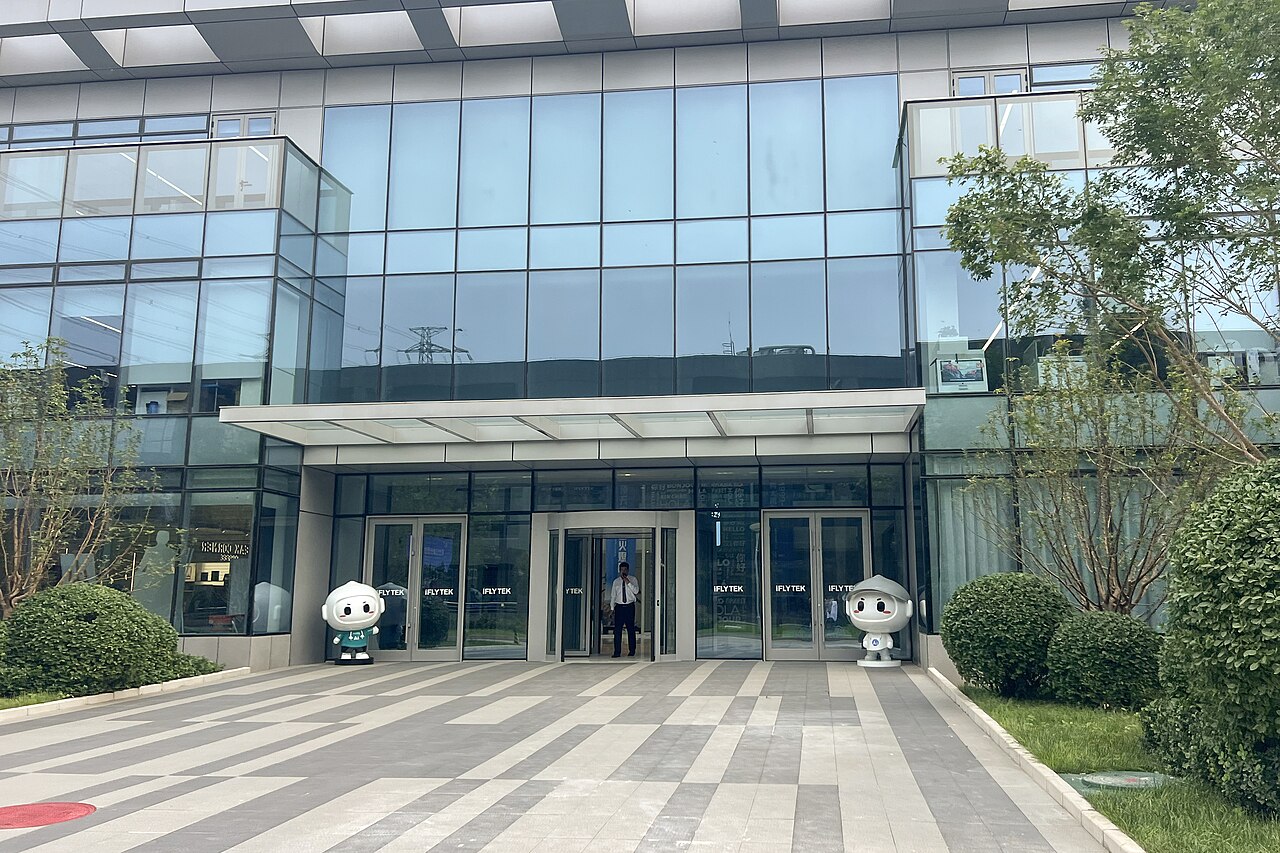
Image context: the cover uses a real Wikimedia Commons photograph of iFlytek's Beijing building at ZPark Phase I. A photographic company-context image is the right choice here because the article is about an operating distribution system with physical terminals, not about an abstract benchmark contest.[5]
1) The company is unusually explicit about its three-lane commercialization logic
The clearest signal comes from iFlytek's 2024 annual report. The company does not describe Spark as a single product lane. It says it is building three AI commercialization paths: industry applications, the open platform and AI agents, and consumer products.[1]
For an AI-China company dossier, that sentence matters more than any isolated model claim. Many companies reveal their real strategy only indirectly through scattered launches. iFlytek states its structure in corporate-report language and then backs it with operating detail. The same report says the open platform had reached 8.024 million developer teams, 8.061 million AI products and Spark agents, and 460,000 overseas developer teams by the end of 2024.[1]
Those numbers do not prove a dominant general-purpose model franchise on their own. They do show that iFlytek is not trying to survive on one monetization surface. The platform lane is large, but it is already being described beside industry deployments and consumer hardware rather than above them.[1]
2) Spark X1.5 is being positioned as a model upgrade that should travel into hardware
The November 2025 Spark X1.5 release note sharpens that point. The official write-up does talk about model capability, but the more revealing line is operational: iFlytek says it released integrated software-hardware solutions built around an autonomous platform and combinations such as AI plus microphone arrays, speaker arrays, camera arrays, and visual-display systems.[2]
That is a very different posture from a company whose main ambition is to win cloud routing on raw token economics. iFlytek is telling customers that model progress should show up in embodied interfaces: what the system hears, sees, records, summarizes, translates, and presents inside a classroom or meeting room.[2]
The same release note keeps the center of gravity inside education. It packages Spark X1.5 together with products such as AI blackboards, intelligent grading machines, exploratory classroom windows, AI learning devices, and language-learning tools.[2] In other words, the flagship model is not being introduced as a detached lab artifact. It is being threaded straight back into owned teaching surfaces.
That distinction matters because hardware changes the durability of distribution. A user who opens a web chatbot can switch tomorrow. A school that has adopted a specific classroom stack, board, grading workflow, and companion learning device sits inside a much denser relationship.
3) Education is not a side vertical; it is one of the company's main model-to-device feedback loops
The annual report makes this even clearer. iFlytek says its smart-education products now cover 32 provincial-level regions in China and are also in use in Japan and Singapore.[1] That is not a casual pilot footprint. It is the shape of a company that can treat education as a recurring deployment environment for model updates, speech systems, and multimodal classroom tooling.
The point is not that every education deployment automatically turns into high-margin software revenue. Public sources do not establish that. The point is that iFlytek owns enough of the interface layer to keep Spark close to repeated user behavior. In education, that means tutoring, assessment, classroom interaction, and teacher workflow can all become testbeds for model iteration.[1][2]
This is also why iFlytek should not be read through the same lens as open-weight-first companies whose main leverage comes from GitHub distribution or low-cost hosted endpoints. Its public AI story is more embedded in institutions and devices.
4) The automotive lane shows the same strategy in another interface-rich environment
At the 2025 Shanghai Auto Show, iFlytek described Spark's role in the car market in similarly structural terms. The company said it had launched the Spark automotive agent platform to help carmakers and developers build agent applications faster, while also showcasing mass-production customer vehicles enhanced by Spark cockpit and audio capabilities.[3]
The annual report adds hard operating context. iFlytek says it had worked with 61 domestic and foreign automobile manufacturers, built an ecosystem of 1,000-plus partners, and supported 16 mass-production vehicle models launched during 2024.[1] It also describes new multilingual coverage for outbound Chinese auto brands, including English, Arabic, Japanese, Korean, Portuguese, Russian, Thai, Turkish, and Vietnamese, for a total of 25 foreign languages in overseas vehicle scenarios.[1]
That combination is revealing. The automotive lane is not only "AI in the car" as a generic slogan. It is a distribution surface where iFlytek's older strengths in speech, acoustics, multilingual interaction, and embedded systems meet the current Spark stack. A cockpit is another owned environment in which the model can be attached to a microphone, speaker, wake-word flow, and product contract instead of floating as a replaceable API.
5) Consumer devices keep the loop close to work and cross-border trade
The consumer-device surface makes the thesis even tighter. The April 2025 launch of the dual-screen translator 2.0 is framed around field research with 300-plus foreign-trade enterprises and around conditions such as noisy exhibitions, factory visits, and business negotiation.[4] The product adds stronger noise reduction, automatic multilingual identification, and professional translation across 17 industry domains.[4]
That is not a generic gadget story. It shows iFlytek taking model and speech capabilities into real transaction environments where speed, recognition accuracy, and terminology matter. The annual report then broadens the picture: the company says overseas revenue from AI hardware such as translators and recording products grew by more than 200% in 2024, while consumer hardware lines such as the smart recorder and translator kept strong e-commerce ranking positions.[1]
Once those details are placed together, the strategic shape becomes hard to miss. iFlytek is not selling Spark only as one more endpoint for developers to compare against rival model families. It is using Spark to thicken the value of devices it already controls, and those devices in turn give the company recurring distribution, usage data, and category-specific habit.
Why this matters in the 2026Q1 China AI landscape
The most important implication is that iFlytek's moat, if it has one, sits lower in the stack than benchmark discussion usually captures.
A pure model company has to keep proving relative intelligence, relative price, or relative ecosystem heat. iFlytek still needs model quality, but its public strategy suggests a different burden of proof. It needs Spark to remain good enough that schools, drivers, office users, and cross-border business users feel the device surface improving over time.[1][2][3][4]
That is a narrower contest and, in some ways, a sturdier one. The company already has long-standing speech and hardware distribution history. Spark gives those surfaces a fresh organizing layer. If the model gets better at reasoning, summarization, tutoring, multilingual dialogue, or agentic control, iFlytek can push that improvement into blackboards, learning machines, translators, recorders, and cockpits rather than waiting for developers to discover it on a leaderboard.
Boundary and falsifier
This thesis should not be inflated into a claim that iFlytek has already won the next Chinese model cycle. Public materials do not prove that. The argument here is narrower: its public edge is structurally different from peers that lean more heavily on cloud APIs, open weights, or consumer chat apps.
The thesis weakens if three things happen together over the next few quarters:
- Spark upgrades stop producing visible product improvement across owned devices and vertical solutions.[2][3][4]
- The open platform grows, but the device and industry lanes fail to turn that growth into durable usage and monetization evidence.[1]
- Rivals copy the same speech-rich, device-linked deployment pattern faster than iFlytek can keep its hardware surfaces distinctive.[1][3][4]
If those conditions arrive, the device-and-vertical loop becomes an expensive distribution footprint rather than a moat.
What to watch next
Three signals matter most.
First, watch whether future Spark releases continue to appear with software-hardware integrated deployment language rather than only abstract model claims.[2]
Second, watch whether education and automotive deployments produce more public workflow evidence, especially around classroom interaction, grading, multilingual in-car assistants, and agent behavior at the interface layer.[1][2][3]
Third, watch whether the consumer-device line keeps translating model progress into exportable products for meetings, translation, and productivity instead of remaining a domestic showcase only.[1][4]
Bottom line
iFlytek's strongest public edge in 2026Q1 is not that it can publish one more Spark release. It is that the company has already arranged Spark inside a three-lane commercialization system: developer platform, vertical deployment, and owned device surface. That makes iFlytek less like a pure model vendor and more like a company trying to turn speech-rich hardware and sector workflows into a durable AI distribution loop.[1][2][3][4]
Sources
- iFlytek, 2024 Annual Report (April 22, 2025) — three AI commercialization paths; open-platform developer and agent counts; education, automotive, and hardware operating detail.
- iFlytek, "讯飞星火X1.5发布:懂教育、更懂你" (November 1, 2025) — Spark X1.5 release framing and software-hardware integrated deployment across education products.
- iFlytek, "讯飞星火大模型'朋友圈'持续扩大,智能座舱、智慧声场引领汽车交互新体验" (April 30, 2025) — Spark automotive agent platform and Shanghai Auto Show deployment framing.
- iFlytek, "大阪世博会首秀!讯飞双屏翻译机2.0新品发布,语音翻译技术再迎新突破" (May 18, 2025) — translator 2.0 research base, business-use scenarios, and product capabilities.
- Wikimedia Commons, "Beijing iFLYTEK Building at ZPark Phase I (20240807160145).jpg" — source page for the cover photograph.