As of 2026-03-28 UTC, the more durable Qwen signal is no longer just that Alibaba has a competitive coding model. It is that Qwen Code is starting to look like an install surface for agent workflows.[1][2][3]
That distinction matters because model competition at the API layer is getting easier to copy. Packaging competition is harder to copy. Once prompts, MCP servers, subagents, hooks, and reusable skills can be shipped as installable units, the product that compounds is no longer only the model endpoint. It is the working environment wrapped around it.[2][3][4][5]
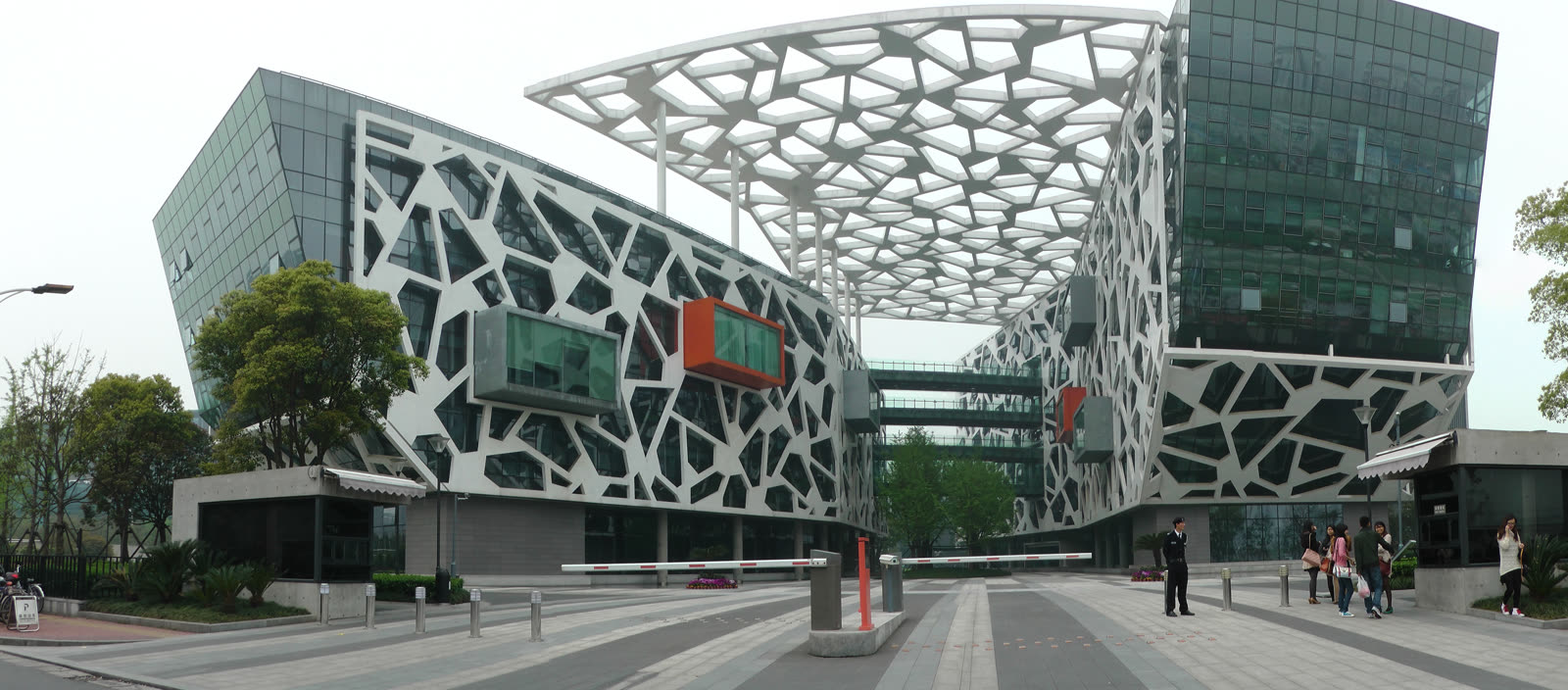
Image context: the cover uses a real Wikimedia Commons photograph of Alibaba Group headquarters in Hangzhou. That is the right visual here because the article is about platform packaging and organizational distribution, not about synthetic benchmark art.[7]
What changed in Qwen Code
The February 3 Qwen Code weekly update is the clearest starting point. Qwen introduced what it called a "brand new Extension system" that can package prompts, MCP servers, subagents, skills, and custom commands.[2] The same update said plugins from the Gemini CLI Extensions Gallery and Claude Code Marketplace could be installed directly into Qwen Code, alongside installs from Git repositories and local paths.[2]
That is a bigger signal than a normal feature drop. A coding shell that can import packaged behavior from rival ecosystems is trying to become a host, not just a client. My inference from the February release is that Alibaba wants Qwen Code to sit where developers actually accumulate workflow logic: inside installable bundles, not only inside model settings.[2]
The March 13 weekly update pushes that reading further. Its headline features were a Hooks System that lets Qwen Code automatically execute scripts, an interactive TUI for extension management described as "Install Extensions Like Browsing an App Store," and an MCP management upgrade that lets users toggle servers on or off anytime, with no restart needed.[3] The same update also noted migration of ACP integration to @agentclientprotocol/sdk.[3]
Taken together, those releases change the center of gravity. Qwen Code is no longer presented as a thin prompt box in the terminal. It is being shaped into a place where automation, tool routing, and packaged behavior can be installed and managed with lower friction.[2][3]
Why subagents and skills matter more than they look
The feature pages make the packaging story more concrete. Qwen's SubAgents documentation describes subagents as specialized AI assistants configured with task-specific prompts, tools, and behaviors.[4] Extension-provided subagents live in an extension's agents/ directory and are automatically discovered when the extension is enabled.[4]
That automatic discovery is important. It means the useful unit is not only "choose a model." It becomes "install a capability package and let the shell surface the right specialist when needed." In product terms, that shifts value toward reusable operating patterns.
The Skills page describes the same logic from another angle. Qwen calls Skills modular capabilities organized in folders, with a SKILL.md file carrying YAML frontmatter and Markdown instructions.[5] Project Skills can be checked into Git so they become available to teammates, which turns local workflow knowledge into something portable and repeatable.[5]
In other words, Alibaba is not only shipping intelligence. It is shipping a way to package institutional know-how around that intelligence. Once a team can hand around subagents, Skills, MCP servers, and hooks as installable artifacts, the shell starts to behave less like a chatbot wrapper and more like a distribution layer for engineering practice.[3][4][5]
Why this is an AI-China signal, not just an OSS product update
The China-AI relevance becomes clearer in Qwen's own positioning. The Qwen Code README describes the product as an open-source AI agent that lives in your terminal, emphasizes multi-protocol support, and presents built-in Skills and SubAgents as part of a full agentic workflow.[1] Meanwhile, the model-provider documentation says Alibaba Cloud Coding Plan authentication can automatically configure models such as qwen3.5-plus, qwen3-coder-plus, and qwen3-max-2026-01-23, with separate China and global endpoints under the coding-specific DashScope domain.[6]
That matters because it shows Alibaba trying to capture the layer above the raw model call. Qwen Code is tied to Qwen's own model family, but it is also being packaged as the working shell through which model choice, extension logic, automation hooks, and tool access are coordinated.[1][3][6]
My inference from these sources is narrower than "Qwen will dominate coding agents." The narrower and more defensible read is this: Alibaba is trying to make the terminal itself a China-AI distribution surface, where installable workflow logic carries as much strategic weight as model quality.[1][2][3][4][5][6]
That is a useful market signal because it changes how competition should be watched. If this layer takes hold, the most durable moat will not come from one benchmark week. It will come from who owns the easiest path to reusable engineering behavior.
What to watch next
First, watch whether Qwen keeps expanding extension portability across external ecosystems rather than closing the shell around only first-party packages.[2]
Second, watch whether hooks, MCP controls, and ACP integration keep getting simpler. If packaged workflow logic is the real product, operational friction has to keep falling.[3]
Third, watch whether more teams publish shared SKILL.md folders and extension-provided subagents into repos and internal templates. If they do, Qwen Code's real distribution unit will be installed practice, not only model access.[4][5]
Bottom line
The strongest Qwen signal this week is not another release note about reasoning or price. It is that Alibaba is building a terminal surface where behavior can be installed: prompts, tools, specialists, and automation. Once that layer starts to travel across teams, the strategic contest moves above the API and into the workflow bundle.
Sources
- Qwen Team, "Qwen Code" GitHub README (terminal agent positioning, multi-protocol support, built-in Skills/SubAgents, and Coding Plan examples).
- Qwen Team, "Qwen Code Weekly: LSP Support, Batch Runner, New Languages" (February 3, 2026; extension system, packaging scope, and marketplace installs).
- Qwen Team, "Qwen Code Weekly: Automated Workflows, Better Extension & MCP Management, VS Code Sidebar" (March 13, 2026; hooks, extension TUI, MCP toggles, and ACP integration).
- Qwen Team, "SubAgents" documentation (specialized assistants, extension discovery, and
agents/layout). - Qwen Team, "Skills" documentation (
SKILL.md, modular capabilities, and project-shared skills). - Qwen Team, "Model Providers" documentation for Alibaba Cloud Coding Plan (auto-configured models and China/global coding endpoints).
- Wikimedia Commons, "File:Alibaba group Headquarters.jpg."