
As of 2026-03-28 UTC, the useful way to watch Alibaba Cloud's 161-second video "Momentum: How Alibaba Cloud Is Leading the New AI Paradigm | Qwen, 5A Cloud & Global Impact," published on January 21, 2026, is to resist the instinct to treat it as one more broad corporate sizzle reel.[1] The clip does use glossy language, but its sequencing is unusually disciplined. It moves through three layers in order: regional infrastructure, open-model positioning, and partner ecosystem proof.
That order matters because Alibaba's written material from 2025 points in the same direction. The Apsara Conference 2025 roadmap announcement describes a full-stack push spanning Qwen3, agent-development and application platforms, and upgraded infrastructure, while Alibaba Group's February 24, 2025 investment announcement commits at least RMB 380 billion over three years to AI and cloud infrastructure.[2][4] Read beside those texts, the video stops looking like generic brand theater. It starts looking like a compressed packaging brief for how Alibaba wants Chinese AI to travel internationally.
My inference from the video's structure is that Alibaba Cloud is trying to solve a trust problem before it tries to win a benchmark argument. It is not asking viewers to fixate on one flagship endpoint. It is asking them to see a bundle: infrastructure that can be region-tuned, open Qwen models that can enter multiple surfaces, and a partner map that makes the whole offer feel already socialized inside global enterprise software.[1][2][3][5] That is the frame worth holding before pressing play.
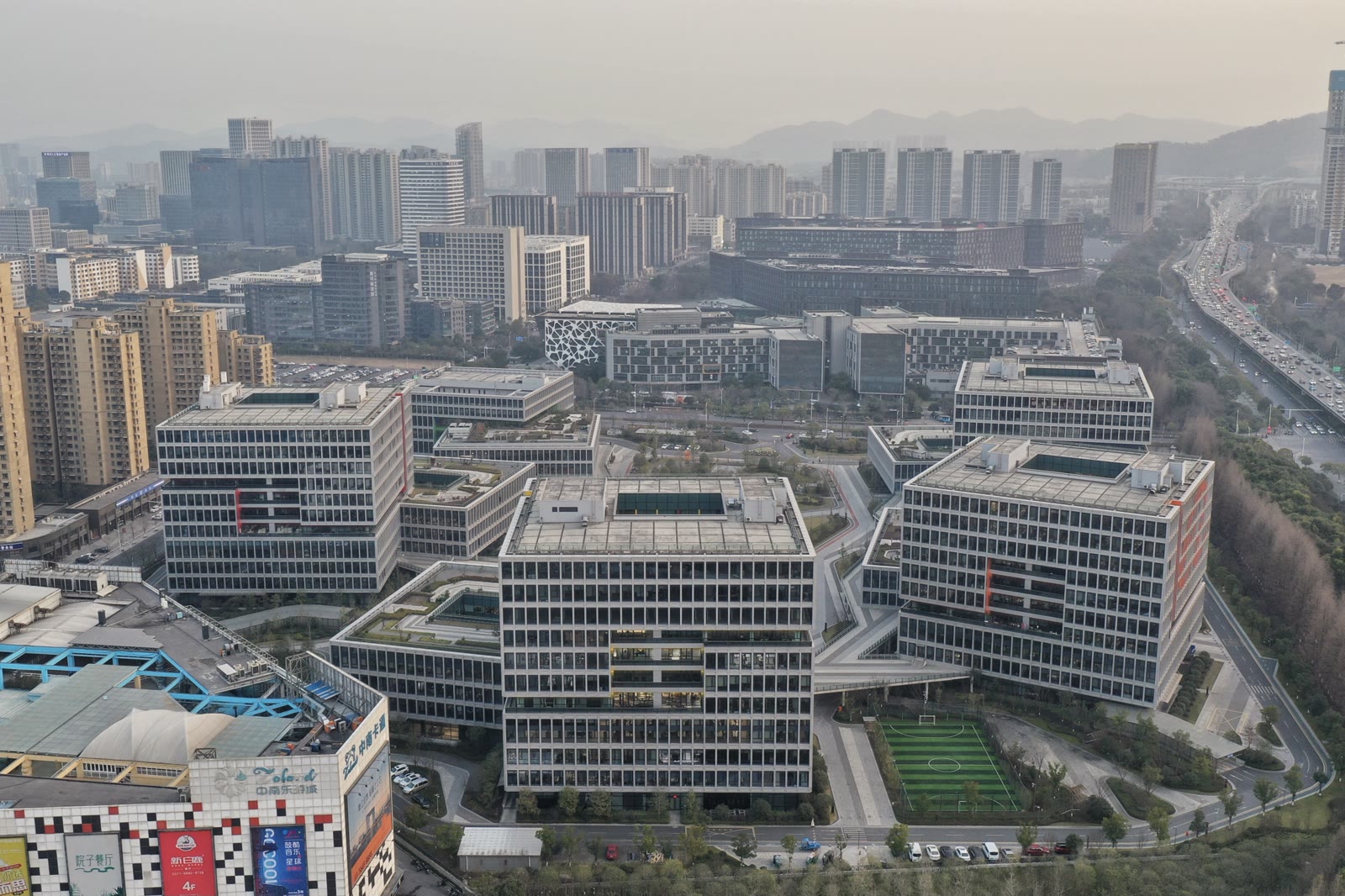
Image context: the cover uses a real Wikimedia Commons photograph of Alibaba Center in Binjiang, Hangzhou. A documentary campus photo is the right visual here because the article is about institutional delivery and packaging, not a generated visualization of model internals.[6]
Around 0:25, "global scale" really means deployment options, not just bragging rights
The first substantive turn comes after the line that "2025 wasn't just a moment. It was momentum." By roughly 0:25, the video says Alibaba Cloud leads at global scale, built the foundation for AI at scale, then brought it closer "region by region," before naming its 5A cloud strategy.[1] An executive then glosses that idea in portability terms: AI innovation with any stack, anytime, anywhere capabilities.[1]
That is more revealing than it first sounds. The video's cloud section is not built around a datacenter vanity metric or a raw-capacity boast. It is built around deployability. Alibaba's current Model Studio documentation sharpens the same logic in operational language: region defines where the service is accessed and where static data is stored, while deployment mode defines where inference runs, and the combination affects latency, cost, available models, and compliance posture.[5] In the international mode, the same documentation says endpoints and data storage sit in Singapore while inference is scheduled globally outside Chinese mainland lanes.[5]
Read together, the video's "region by region" claim and the documentation's deployment-mode rules suggest that Alibaba wants international buyers to hear cloud scale as route design, not only as hardware abundance.[1][5] The RMB 380 billion investment pledge matters in that context because it underwrites the same story from the balance-sheet side: Alibaba is telling the market that the infrastructure layer is supposed to be durable enough to carry the model layer abroad.[4]
Around 1:25, Qwen is presented as an open foundation, not a premium endpoint
The middle of the clip shifts from infrastructure to model identity with a very specific sentence: innovation is never one-size-fits-all and therefore demands an open foundation. The video then introduces Qwen and calls it the world's most popular open-source AI model family before moving through a list of global adopters and builders.[1] Even if one takes the superlative as marketing language, the framing is the important part. Qwen is being pitched here less as a luxury flagship and more as a base layer that other parties can actually build on.
Alibaba's written releases reinforce that reading. The April 29, 2025 Qwen3 announcement describes a family with six dense models and two mixture-of-experts models, explicitly positioned for developers building across devices, smart glasses, autonomous vehicles, and robotics.[3] The Apsara Conference 2025 roadmap goes further and quotes Alibaba CEO Eddie Wu on shaping Qwen into an "operating system of the AI era," linking open-source continuity to a wider application and agent stack.[2] That is not the language of a company trying to trap every user inside one hosted endpoint. It is the language of a company that wants its models to become infrastructural habits.
This is the most consequential move in the video. Alibaba is trying to translate Chinese-model strength into a form global builders can consume without first accepting a closed Alibaba-only worldview. Open Qwen becomes the bridge between national model capacity and international software legitimacy.[1][2][3]
Around 1:55, the partner montage turns model capability into procurement comfort
After the Qwen passage, the clip becomes even more strategic. It starts naming counterparties and ecosystems: OpenRouter, AI Singapore, HashMicro, YTL AI Labs, then later SAP, Crayon, ATOSS, Salesforce, and the AI Alliance, before ending on the Alibaba Cloud AI Catalyst Program.[1] This is the opposite of an isolated model demo. The viewer is being shown a network.
That matters because enterprise AI adoption rarely turns on model quality alone. Procurement teams want signs that a vendor can already sit next to software they recognize, partners they trust, and markets that matter commercially. Alibaba's Apsara roadmap announcement serves the same purpose in prose: it packages models, agent-development tools, application platforms, and upgraded infrastructure as one connected program rather than separate launches.[2] The video's closing montage is that same thesis rendered as logo choreography.
My inference is that Alibaba understands a basic export problem in AI-China: international adoption depends on whether Chinese model capability can arrive inside familiar organizational channels. Partner names solve part of that translation problem. They tell viewers that Qwen and Alibaba Cloud are meant to be routed through coalition, not only through direct sales. That is why the final emotional register of the clip is not brilliance. It is comfort.[1][2]
What to watch for if you replay it now
Replay the video and notice how little time Alibaba spends on benchmark theater. The opening moves from scale to regionalization. The middle moves from Qwen to openness and developer adoption. The end moves from models to counterparties, alliance language, and startup formation.[1][2][3][4][5] The sequence is deliberate.
That is what makes the clip worth annotating. Alibaba Cloud is using a short corporate reel to argue that Chinese AI becomes exportable when it is packaged in three layers: infrastructure that can be placed and governed, models that are open enough to circulate, and ecosystems that make the whole bundle feel enterprise-safe. The video may look soft on first watch. Its actual claim is highly concrete.
Sources
- Alibaba Cloud, "Momentum: How Alibaba Cloud Is Leading the New AI Paradigm | Qwen, 5A Cloud & Global Impact," official YouTube video, published January 21, 2026.
- Alibaba Cloud, "Alibaba Cloud Unveils Strategic Roadmaps for the Next Generation AI Innovations" (Apsara Conference 2025 roadmap announcement, September 27, 2025).
- Alibaba Cloud, "Alibaba Introduces Qwen3, Setting New Benchmark in Open-Source AI with Hybrid Reasoning" (April 29, 2025).
- Alibaba Group, "Alibaba to Invest RMB380 billion in AI and Cloud Infrastructure Over Next Three Years" (February 24, 2025).
- Alibaba Cloud Model Studio, "Choose region and deployment mode" (Last Updated March 25, 2026).
- Wikimedia Commons, "File:Alibaba Center in Binjiang Hangzhou2021.jpg."