
As of 2026-04-03 UTC, the useful way to watch Baidu's December 4, 2025 video "Introducing ERNIE 5.0 Preview" is not as a glossy keynote recap.[1] The clip is long, demo-heavy, and occasionally theatrical, but its structure is more disciplined than that. It spends its first stretch establishing native multimodal unification, its middle stretch showing that this unified core can persist across video reasoning, audio, image generation, coding, and agent workflows, and its final stretch opening outward into model access, OCR, and deployment tools.[1] In other words, the video is trying to bridge two audiences at once: people who want a frontier-model story and developers who want an adoptable stack.
The official ERNIE 5.0 materials make that reading much easier to defend. Baidu's English and Chinese technical write-ups describe ERNIE 5.0 as a 2.4 trillion-parameter unified multimodal model trained from scratch across text, image, video, and audio with a shared next-group-of-tokens objective, modality-agnostic routing, and elastic training for multiple deployment shapes.[2][3][4] Those are not minor implementation details. They tell you what the video is trying to sell beneath the demos: ERNIE 5.0 is supposed to be one backbone that can reason across modalities without the usual "language core plus attached decoder" split.[2][3][4]
The preview branding matters too. Baidu has repeatedly pushed ERNIE 5.0 preview builds into public comparison surfaces such as LMArena's Vision Arena, where the company highlighted the Preview-1220 checkpoint as the top-ranked Chinese model and the only Chinese entry in that global top ten at the time of its January 8, 2026 post.[5] That context makes the video feel less like a self-contained product launch and more like a handoff moment: the architecture is now strong enough that Baidu wants to connect internal model ambition to public developer adoption.[1][2][5]
My inference from the video and the surrounding materials is that Baidu's real message is narrower and more useful than "ERNIE 5.0 is powerful." The message is that a native multimodal core becomes strategically valuable only when it can travel outward into agents, open-weight companion models, OCR, and deployment tooling without feeling like a bag of disconnected products.[1][2][3][6][7]
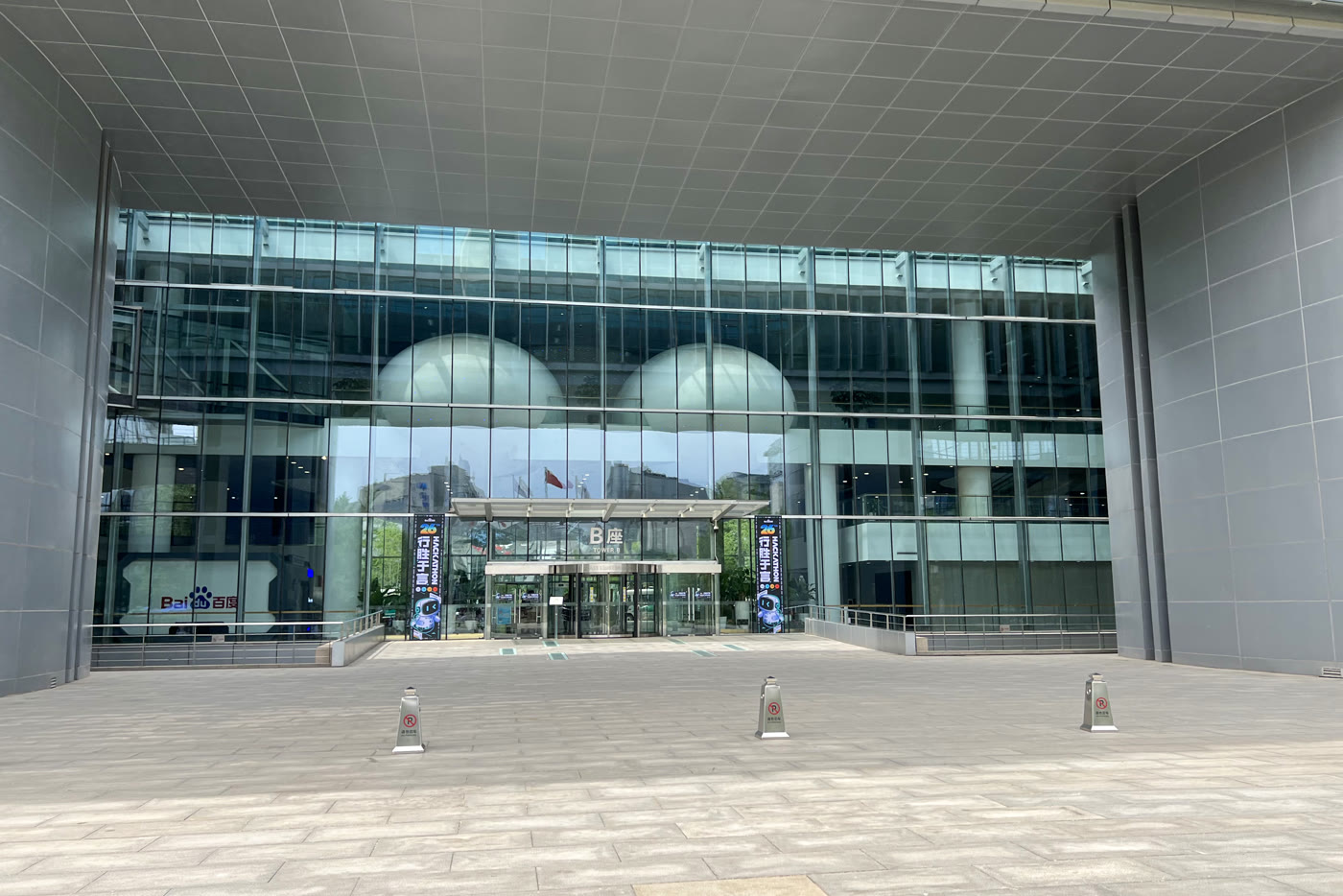
Image context: the cover uses a real Wikimedia Commons photograph of the entrance to Baidu's Shangdi headquarters. It works here because the article is about platform entry. The preview video keeps asking viewers to move from one layer to the next: core model, workflow demos, then the practical surfaces where developers can actually enter the system.[8]
Around 0:49 to 2:01, the video insists that ERNIE 5.0 should be read as one backbone rather than a stitched stack
The decisive claim arrives early. Around 0:49, the presenter frames ERNIE 5.0 as a next-generation model that integrates language, images, video, and audio "from day one," then at roughly 1:27 says it can "read, see, listen, and respond as one unified intelligence."[1] By about 1:34, the language becomes even more explicit: all modalities are modeled in a unified discrete space.[1] This is not ordinary demo copy. It is the video version of the technical report's central argument that multimodal generation should move beyond late-fusion patchwork toward a shared autoregressive framework.[2][3]
That alignment matters because preview videos often flatten architecture into slogans. Here the architecture is the slogan. The blog post and technical report both say ERNIE 5.0 maps modalities into a shared token space, uses modality-agnostic expert routing, and relies on elastic training so one super-network can produce multiple deployment configurations.[2][3][4] The video compresses that whole argument into a few phrases, but the phrasing is careful: the model does not merely switch between modes, it reasons across them.[1][2][3]
That is the first reason the preview feels like a platform story rather than a benchmark story. A benchmark video would start by telling you where the model ranks. This one starts by telling you why the model should exist as a unified core at all. The later LMArena post is useful as supporting context precisely because it comes later in the logic chain: public ranking is presented as validation of an architectural thesis, not as the thesis itself.[5]
Around 3:22 to 17:35, the middle demos treat workflow continuity as the real proof of multimodality
The long middle section looks chaotic if you watch it as entertainment. Watched more carefully, it is organized around continuity. Around 3:22, the team highlights stronger agent capabilities and benchmark gains in math, code, instruction following, creative writing, factual reasoning, and multimodal understanding.[1] Then the demonstrations begin to move through ordinary user flows rather than isolated modality tricks: around 5:52 the host asks the model to compare cooking and fitness videos against personal goals; around 10:14 the model generates a cat video from a prompt; around 11:22 it handles audio and dubbing; around 13:31 it returns to language and reasoning; and by 16:12 to 17:35 the presenters are running a coding agent that works through a task, passes checks, and opens a pull request while explicitly noting MCP and tool-calling support.[1]
What matters is not that each individual demo is unprecedented. It is the sequencing. Baidu is trying to show that one model family can hold together across consumer-style media tasks, professional reasoning, and agentic software work without changing conceptual gears every two minutes. The technical report backs that ambition by describing a single framework meant to support both understanding and generation across text, image, video, and audio.[3] The blog post makes the same case in more product language: the model is supposed to dissolve modality barriers rather than shuttle work across brittle module boundaries.[2]
This is where the preview earns the word "bridge." The video does not ask viewers to admire a single dazzling multimodal trick and stop there. It keeps carrying the model into adjacent workload types until the viewer is meant to accept a broader claim: the real unit of value is workflow continuity. A nutrition comparison based on short videos, a dubbed media clip, a coding copilot, and a coding agent all become evidence for the same commercial proposition.[1][3]
That proposition also explains why the coding-agent section matters so much. Around 16:20, the presenter explicitly says the showcased agent is not being released "today, at least not yet," but the demo still ends by emphasizing MCP and tool-calling protocol support.[1] That is a strategic choice. Baidu wants to keep the frontier aura of an internal agent demo while still giving developers a practical hook they can act on now.
Around 20:20 to 26:46, the closing segment reveals the real sales motion: frontier preview in front, adoptable stack behind it
The final third is the most revealing part of the entire video because it leaves the flagship model and starts opening doors. Around 20:20, the presenters pivot to open-source companion models. Around 20:46, they discuss the upgraded ERNIE 4.5-VL-28B-A3B-Thinking line, describing stronger cross-modal reasoning and chart/document understanding.[1] Around 21:51, they introduce PaddleOCR-VL as a state-of-the-art multimodal document-understanding model.[1][7] Then, from roughly 24:28 through 26:46, the video becomes openly operational: models alone are not enough, so developers are pointed to FastDeploy for inference and deployment and to Baidu's surrounding toolchain for training and integration.[1][6]
That ending changes the meaning of everything before it. If the preview were only about ERNIE 5.0 as a closed frontier object, the video could have ended on the coding agent and called it a day. Instead it closes on adoption surfaces. The FastDeploy repository describes itself as a high-performance inference and deployment toolkit for LLMs and VLMs on PaddlePaddle.[6] PaddleOCR-VL is another outward-facing surface: a document stack that turns Baidu's multimodal work into a concrete enterprise entry point rather than a research abstraction.[7]
Seen that way, the preview video is not trying to win by one benchmark table or one charismatic demo. It is trying to align three layers into one commercial story:
- A unified multimodal flagship core.[1][2][3]
- Agent and coding demos that make the core feel workflow-native.[1]
- Open and deployable surrounding surfaces that make the stack enterable for developers.[1][6][7]
That is why the clip is worth annotating now. The most important thing it says about AI-China is not merely that Baidu has another large model. It says Baidu wants native multimodality to become a platform shape: a flagship core in front, public preview validation beside it, and a wider open/deployment lane behind it. The video is the handoff point where those pieces are stitched into one message.
Sources
- ERNIE for Developers, "Introducing ERNIE 5.0 Preview," official YouTube video, published December 4, 2025.
- ERNIE Blog, "ERNIE 5.0: A 2.4 Trillion-Parameter Unified Multimodal Foundation Model" (February 6, 2026).
- Haifeng Wang and colleagues, "ERNIE 5.0 Technical Report" (arXiv:2602.04705, February 2026).
- ERNIE Blog, "文心 5.0 (ERNIE 5.0):2.4 万亿参数的原生全模态大模型" (Chinese first-hand release note, February 6, 2026).
- ERNIE Blog, "ERNIE-5.0-Preview-1220 Becomes the Sole Chinese Model in LMArena Vision Top 10!" (January 8, 2026).
- PaddlePaddle, "FastDeploy" GitHub repository - high-performance inference and deployment toolkit for LLMs and VLMs.
- Hugging Face, "PaddlePaddle/PaddleOCR-VL" model page - multimodal document understanding model referenced in the video's closing stack segment.
- Wikimedia Commons, "File:Entrance of Baidu headquarters at Shangdi (20220509112334).jpg" - source page for the photograph used as the article image.