As of 2026-04-12 UTC, the useful way to read ByteDance's Seed1.6-Embedding release is not to ask whether one more model briefly topped one more leaderboard. The more durable signal is architectural. ByteDance used the June 2025 launch to package text, image, and video retrieval behind one embedding surface, then exposed that surface through Volcengine with a deployable model ID and selectable output dimensions.[1][2]
That changes the level at which the model matters. A conventional embedding story lives inside text-only RAG: chunk documents, map them into vectors, and improve recall a bit. Seed1.6-Embedding is pitched at a broader layer. ByteDance says the model supports multimodal hybrid retrieval across text, images, and video, and that it can emit 2048- or 1024-dimensional vectors through a production API.[1][2] Read together, those are not just evaluation claims. They are middleware claims.
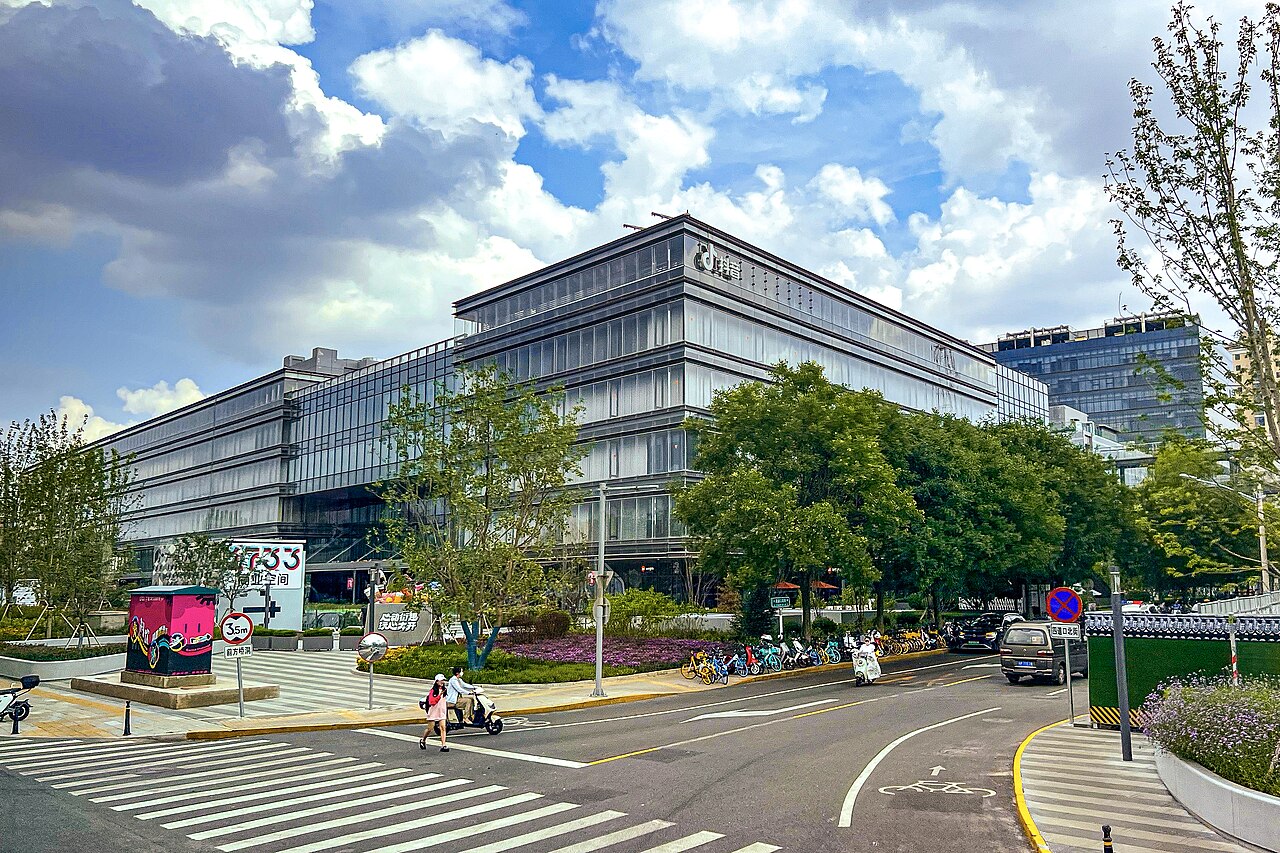
Image context: the cover uses a real 2024 photograph of ByteDance's 1733 Commercial Space in Beijing from Wikimedia Commons. It fits this article because the argument is about ByteDance turning multimodal understanding into company-level product infrastructure, not about illustrating an abstract benchmark race.[5]
What the June 2025 release actually claimed
The strongest public facts come from ByteDance's own launch note, and they need to be read with their built-in limits intact.
ByteDance wrote that Seed1.6-Embedding was built on Seed1.6-Flash, trained through a sequence that included text continuation, multimodal continuation, and then supervised fine-tuning on dozens of retrieval tasks plus Volcengine business scenarios.[1] The company also wrote that the model ranked first on CMTEB for pure text retrieval with a score of 75.62, and first on MMEB_v2 for multimodal retrieval, including an image score of 77.78.[1] On video, ByteDance claimed a lead of 20.1 points over the second-place model.[1]
But the same page also narrows the reading. The benchmark language is bounded to results "until June 28," which means the launch note itself treats these standings as a dated snapshot rather than a timeless ranking.[1] That matters. In AI-China coverage, benchmark claims should be treated as directional unless the evaluation boundary is explicit. Here, ByteDance did provide that boundary, so the responsible reading is straightforward: the release signaled strong internal confidence and a sharp June 2025 showing, but not a permanent, context-free lead.
The more revealing details are operational rather than celebratory. ByteDance simultaneously announced the model on Volcengine, where the documentation exposes it as doubao-embedding-vision-250615 and frames it as a production service for image-text embedding rather than as a research artifact.[2] Once a multimodal embedding model is sold through the cloud control plane, the commercial question shifts from "Is this number slightly higher?" to "What system is this model meant to sit inside?"
Why this looks like retrieval middleware, not just a benchmark entry
The answer is that Seed's broader product and research direction had already been moving away from single-modality understanding before the embedding package appeared.
ByteDance's Seed multimodal overview describes the team's focus in terms that go well beyond captioning or image tagging: the list includes multimodal RAG, visual chain-of-thought, and agent work.[3] The page also presents Seed1.5-VL as strong in visual reasoning, document understanding, chart interpretation, grounding, counting, video understanding, and GUI-agent tasks.[3] That matters because it shows Seed's multimodal program was already being aimed at workflows in which perception needs to be routable, composable, and operationalized.
Seen against that backdrop, Seed1.6-Embedding looks like the retrieval-side connector for a broader multimodal stack. If your upstream systems already read screens, documents, charts, and video, then a text-only embedding layer becomes a bottleneck. A unified embedding layer is what lets those upstream systems feed search, memory, recommendation, and retrieval-augmented agents without dropping everything back into a text-only schema.
ByteDance's Doubao-1.5-pro materials point in the same direction from an earlier stage. In January 2025, the company highlighted multimodal gains in visual understanding, visual reasoning, OCR-like document parsing, fine-grained information extraction, and instruction following.[4] Seed1.6-Embedding extends that trajectory into the retrieval substrate. The point is not merely that ByteDance has another multimodal model. The point is that the company is moving multimodality downward into infrastructure.
That is why the controllable vector size matters. Offering 2048 and 1024 dimensions is a practical concession to real deployment tradeoffs.[1][2] Higher dimensions can preserve retrieval quality in harder settings, while lower dimensions reduce storage, bandwidth, and index cost. A company building only for benchmark screenshots would not need to foreground that choice. A company building middleware would.
What this means for China's AI stack
The larger significance is competitive and architectural at once.
Chinese model vendors spent 2024 and 2025 proving they could ship strong foundation models, video generators, and agent demos. The next bottleneck is less glamorous: how to make heterogeneous inputs searchable and reusable across enterprise systems. Seed1.6-Embedding suggests ByteDance wants to own part of that layer. Instead of asking customers to stitch together one text embedder, one vision model, and one separate video-retrieval path, ByteDance is offering a consolidated retrieval primitive under the Doubao and Volcengine surface.[1][2]
That makes the release important even if one ignores the leaderboard rhetoric. A multimodal retrieval layer can sit under document archives, commerce catalogs, content moderation review, media asset search, assistant memory, and agent toolchains. In other words, it sits where usage can compound.
There is still a boundary to the claim. The public materials do not disclose enough to prove how Seed1.6-Embedding behaves across every enterprise domain, every latency target, or every indexing regime.[1][2] Nor do the benchmark snapshots alone tell us how robust the model remains under noisy OCR, niche industrial imagery, or long-tail video corpora. Those are real unknowns.
Even so, the June 2025 release made one strategic move unmistakable. ByteDance was no longer treating multimodal understanding as only a model-demo layer. It was pushing that capability into retrieval middleware that could become part of the operating fabric of its cloud AI stack.
Sources
- ByteDance Seed, "Seed-1.6-Embedding: A multimodal embedding model built on Seed1.6-Flash."
- Volcengine documentation, "Image-text embedding (Doubao series models)."
- ByteDance Seed, "Multimodal" research direction overview.
- ByteDance Seed, "Doubao-1.5-pro" product page.
- Wikimedia Commons, "ByteDance 1733 Commercial Space (2024)."