A useful way to read Chinese agricultural AI in 2026 is to stop counting chatbots. The sharper signal is a new sequence forming behind them: agricultural knowledge enters a model; sensors and remote sensing describe a particular field; crop and weather models calculate what may happen next; an agent compares interventions; equipment carries out a bounded action; and the next observation tests whether the advice worked.
That is the field loop. It is more demanding than answering an agronomy exam because each handoff can fail. A model may know the textbook symptoms of water stress but misalign a satellite pixel with a parcel. A simulator may predict an irrigation benefit using the wrong soil record. An agent may propose a sound treatment at the wrong growth stage. A machine may execute the right prescription at the wrong rate. Fluency cannot repair any of those errors after the fact.
Three developments make this loop the field signal to watch. China now has open agricultural language models and a benchmark that expose the knowledge layer; research systems are making calculations and intermediate artifacts inspectable; and university teams are explicitly connecting large models to crop simulators, remote sensing, and field equipment. Policy is moving in the same direction—from encouraging foundation models to asking for narrow applications that can be checked on site.[1][7]
The change is real. The proof remains uneven.
The answer layer is becoming infrastructure
China's October 2024 National Smart Agriculture Action Plan did not describe one all-purpose farm model. It called for an open platform and model library spanning crop growth, animal behavior, production decisions, linked control of facility environments, breeding, feed formulation, and farm management. The timetable matters: the platform and initial library were meant to be substantially in place by the end of 2026, with more than 20 foundation-model algorithms or general software and SaaS tools promoted by the end of 2028.[1]
Sinong 1.0 shows what the first layer of that infrastructure looks like. The Nanjing Agricultural University and Nanjing University of Science and Technology team released 8-billion- and 32-billion-parameter versions and describes a training corpus of more than 4 billion tokens assembled from 8,863 books, 243,897 papers, and 196,748 policy, standards, patent, and related documents. Its repository also carries the most important warning in the project: outputs may still be inaccurate or fabricated and should not be adopted blindly.[2]
That warning defines the baseline. An agricultural language model can compress a large shelf of knowledge, translate a question into domain vocabulary, retrieve a policy, or provide a natural-language entrance to specialist software. It does not acquire the local weather, soil, cultivar, management history, equipment state, or causal model needed to prescribe an intervention merely by absorbing more text.
AgriEval makes the boundary measurable. Released in July 2025, the Chinese benchmark contains 14,697 multiple-choice questions and 2,167 open-ended questions across six broad agricultural categories and 29 subcategories. Its authors evaluated 51 commercial and open models and reported that most did not reach 60 percent accuracy. They also found an average 6.95-point accuracy drop when answer options were shuffled, a useful warning that apparent agricultural knowledge can partly reflect test-taking shortcuts.[3]
But AgriEval's strength is also its limit. Its material comes from university examinations and assignments; multiple-choice items are scored by answer accuracy and open responses by ROUGE-L overlap with references. That is a defensible test of agricultural knowledge under a named setup. It is not evidence that a model can diagnose one farm, choose a safe action, or improve an outcome. The benchmark tells us whether the answer layer has gaps. It does not close the loop.
The calculation layer is becoming inspectable
The February 2026 AgriWorld preprint points to a different evaluation object. Instead of asking an LLM to reason over agriculture as text, the Sun Yat-sen University team puts an agent inside a Python environment with tools for parcel queries, remote-sensing time series, soil and terrain data, weather, crop simulation, and yield, stress, or disease-risk prediction. The agent writes code, observes the result, and revises its approach. Intermediate outputs retain metadata such as units, coordinate systems, resolution, and provenance.[4]
This design recognizes an unglamorous truth: agricultural reasoning breaks on joins. A field boundary and a sensor footprint may use different coordinate systems. A rainfall total may cover the wrong window. A management log may record kilograms while a tool expects grams. An image may be mostly cloud. In AgriWorld, those are not details for a polished answer to conceal; they are conditions a checker can reject.
Its reported benchmark result should stay inside its evaluation envelope. The paper fine-tunes Qwen3 models at 8B and 32B with LoRA and gives the reflective agent up to 20 steps in a controlled tool environment. In the authors' ablation table, the full system reaches 57.6 percent accuracy, compared with 21.9 percent for their text-only Kimi/GPT baseline and 48.2 percent for one-shot direct tool use.[4] Those numbers support the value of grounding and error correction within that constructed setup. They do not establish field reliability, cross-season robustness, or a yield gain.
Still, the unit of evidence has improved. A final answer can be lucky. An execution trace can show which parcel was selected, which weather window was used, which simulator ran, what units moved through it, and where a correction occurred. For farm AI, that trace is closer to a lab notebook than a chat transcript—and much more useful when something goes wrong.
Agents are being given models, sensors, and hands
The next signal is architectural convergence. On May 16, 2026, Nanjing Agricultural University presented its Shennong Huizhong agent series as a stack combining a domain language model, datasets, a knowledge graph, crop-growth models, remote-sensing models, multi-agent scheduling, and field-equipment output. Its published division of labor is revealing: the large model handles language and intent, while smaller quantitative models handle calculation and dynamic prediction. The university says the system can route work through crop simulation and field equipment and has been demonstrated in Jiangsu, Henan, Shandong, Jiangxi, and Shanghai.[5]
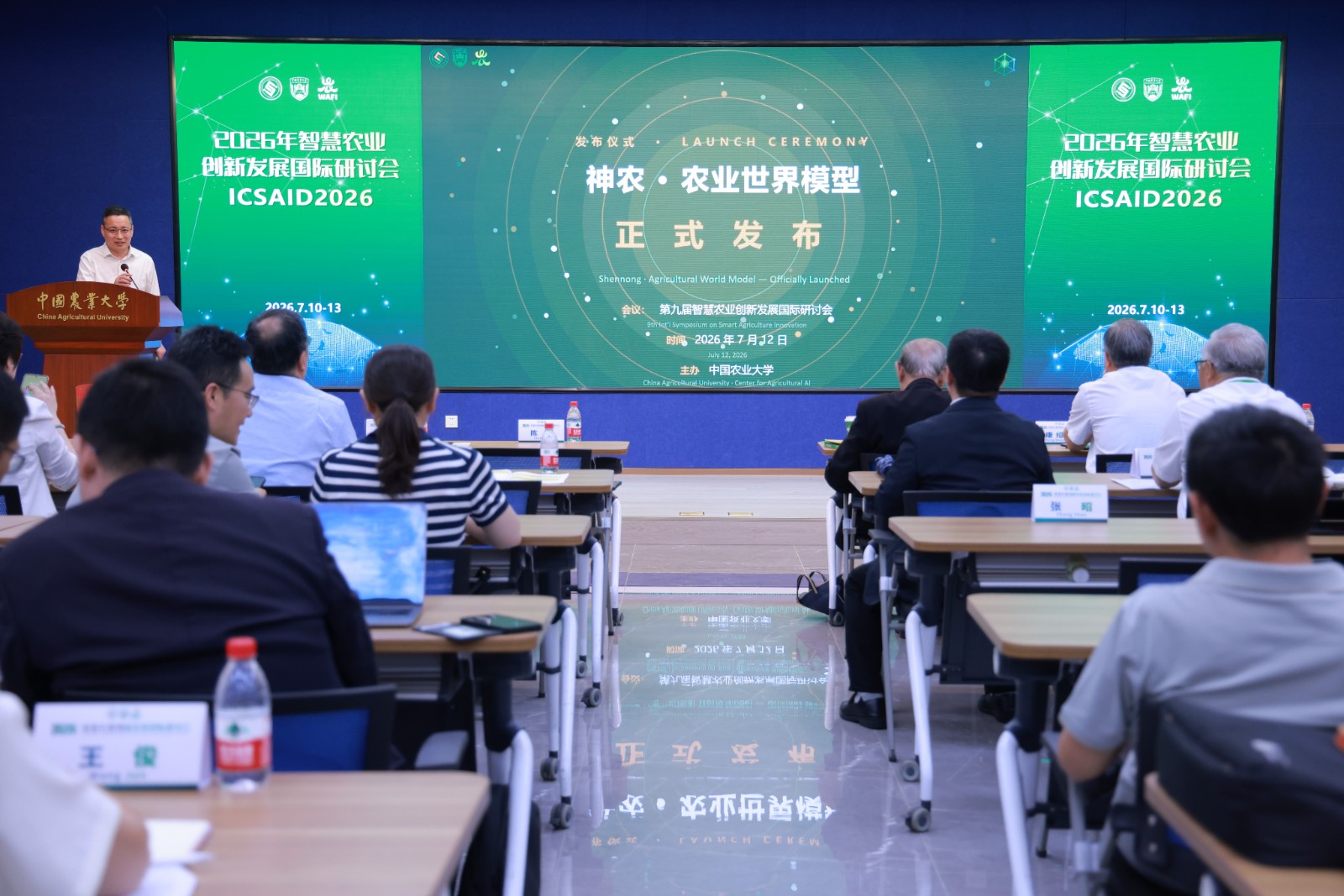
On July 11 and 12, China Agricultural University pushed the same pattern from two directions. Shennong 4.0 expanded the perception and interface layer with APIs, MCP services, dialect speech, genomics functions, and a university-reported disease-recognition range of 1,016 categories. The separately announced Shennong Agricultural World Model 1.0 targets the intervention layer: given crop state and weather, it is intended to simulate how water, fertilizer, ventilation, lighting, or other actions change future state, yield, quality, and risk.[6]
The university reports validation on tomatoes, lettuce, and cucumbers in controlled facilities and drought-management work across 38 counties in Jilin. It also says code, an evaluation benchmark, and a data contract were opened.[6] Those are promising claims, but the launch article does not give the error distributions, comparator models, field and season splits, intervention logs, or links from each headline result to a reproducible artifact. Until those details are easy to inspect, the figures should be read as a map of the team's claimed validation boundary, not as a general score for Chinese farming.
Put the projects together and the pattern is clearer than any one launch. The large model is becoming an interface and planner rather than pretending to be the crop model, GIS engine, and machine controller at once. Specialist components keep their own data and physics. Tools expose intermediate work. Equipment is treated as part of the system. This is a more credible architecture than a single agronomy chatbot because it gives each failure somewhere visible to occur.
Field proof needs a different scorecard
China's Ministry of Agriculture and Rural Affairs made an understated but consequential move in April 2026 when it solicited “AI + agriculture” cases. The notice favored small, deep, replicable applications; required reported benefits to be accurate rather than invented; asked provincial authorities to conduct field verification; and said the ministry could randomly inspect selected cases. Its categories ranged from breeding and vaccine research to pest prediction, precision livestock farming, logistics, traceability, and production-to-market matching.[7]
That process hints at the right scorecard. A field-loop system should first name its boundary: crop, region, farm type, season, sensor coverage, permitted interventions, and the human who can override it. It should then preserve the chain from raw observation to recommendation to machine command. Most importantly, it should compare outcomes against a credible baseline—standard practice, a randomized strip, a matched field, or a prior season adjusted for weather—rather than substituting user counts or model accuracy for agronomic effect.
Safety and economics belong in the same record. How often did the system abstain? How many recommendations did an agronomist change? Did a variable-rate prescription save water only because it reduced yield? What happened when a sensor dropped out or a cultivar moved outside the training distribution? How much labor, connectivity, and calibration did the loop require? A pilot becomes transferable only when another operator can see both the gain and the operating contract.
By the end of 2026, the most informative Chinese agricultural-AI release will not necessarily have the largest model or the broadest list of crops. It will pair a versioned model and data contract with intervention-level field logs, explicit baselines, failure and override rates, and results repeated across more than one season or region. The answer box was the easy part. The real product begins when an answer touches a field—and the field gets to answer back.
Sources
- Ministry of Agriculture and Rural Affairs of China, “全国智慧农业行动计划(2024—2028年)” (issued October 23, 2024; national platform, model-library, application, and adoption targets).
- Nanjing Agricultural University and Nanjing University of Science and Technology, “司农大语言模型” repository (accessed August 4, 2026; corpus description, open 8B/32B releases, RAG design, and model warning).
- Lian Yan et al., “AgriEval: A Comprehensive Chinese Agricultural Benchmark for Large Language Models,” arXiv:2507.21773 (July 29, 2025; dataset, evaluation setup, results, and positional-bias test).
- Zhixing Zhang et al., “AgriWorld: A World–Tools–Protocol Framework for Verifiable Agricultural Reasoning with Code-Executing LLM Agents,” arXiv:2602.15325 (February 17, 2026; tool environment, executable checks, benchmark setup, and ablations).
- Nanjing Agricultural University College of Agriculture, “南京农业大学‘神农慧种’系列智能体正式发布” (May 18, 2026; agent architecture, model roles, equipment handoff, and reported demonstrations).
- China Agricultural University, “中国农大发布两项农业AI重大成果:神农大模型4.0与神农·农业世界模型1.0同期发布” (July 14, 2026; official launch, claimed validation boundary, open-artifact statement, and source photograph).
- Ministry of Agriculture and Rural Affairs of China, “关于征集‘人工智能+农业’典型应用场景的通知” (April 20, 2026; eligible scenarios, evidence requirements, and field-verification process).