In October 2024, Shanghai Astronomical Observatory announced that an international team led by Jian Ge had found five planets smaller than Earth in previously released Kepler observations. Each completed an orbit in less than a day. The team’s new contribution was a search method called GPFC, combining graphics-processor computation with a neural network.[1]
There is something pleasingly concrete about this example of Chinese AI research. A telescope measures light; years later, a different way of examining its measurements reveals another world. The question is how that second look becomes a credible discovery.
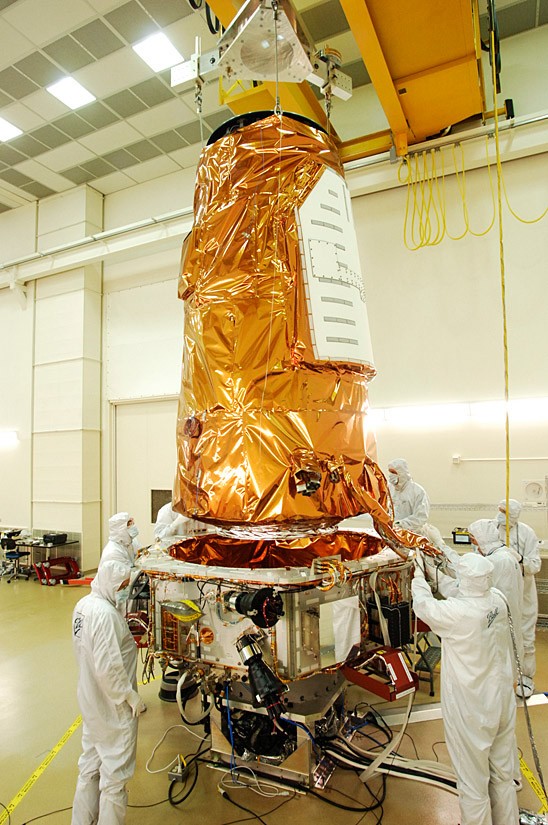
The archival photograph above returns the story to its physical beginning: Kepler’s photometer being lowered onto the spacecraft in a clean room.[5] The later software depends on that earlier instrument, and on people preserving what it recorded.
A mission leaves more than a catalogue
Kepler’s primary observing campaign ran from May 2009 to May 2013. Its archive at the Space Telescope Science Institute preserves several distinct products: light curves, which record brightness over time; images of the pixels surrounding individual targets; and images of the wider field. The MAST service provides individual searches, programmatic access, and bulk downloads.[4]
That distinction between a catalogue and an archive matters. A catalogue records conclusions reached so far. Preserved measurements permit another researcher to ask a different question. Keeping the pixels alongside the brightness records also gives a suspicious signal somewhere to be checked: what else was inside the telescope’s view?
The discovery study used Kepler Data Release 25 and selected targets through the existing Kepler Objects of Interest catalogue. Its search covered periods from 0.2 to 1 day, with previously identified transits removed before looking for additional signals.[3] This was a deliberately bounded investigation of very short orbits.
Give a faint rhythm somewhere to accumulate
A transiting planet briefly reduces the light received from its star. GPFC looks for that repeating dip by phase folding: assigning observations to corresponding positions within a trial orbital cycle, then combining them. At the right period, successive dips reinforce one another. An inaccurate period can blur a shallow signal.[2]
Imagine listening for a quiet tap beneath a crowd’s conversation. Knowing when the tap should recur lets you combine evidence from many repetitions. In the telescope’s data, however, the rhythm is initially unknown. The search must try many possible timings.
The January 2024 methods paper describes using an Nvidia GeForce RTX 3090 Ti to fold each light curve at 100,000 trial periods. A convolutional neural network then scores the folded records for transit-like patterns.[2] The two components have different jobs: the GPU makes a dense search practical, while the trained network evaluates what each alignment reveals.
That division helps explain the result more clearly than a general claim that AI is better at astronomy. The useful invention changes which signals can receive a careful computational look.
Teach the search what rarity could look like
Real examples posed a training problem. Shanghai Astronomical Observatory’s account explains that known transit signals were too scarce for the team’s purposes. The researchers therefore generated synthetic examples informed by transit physics, using real Kepler light-curve data to construct a training set of two million curves.[1]
Synthetic training data play a different role from observational evidence. They let researchers supply examples of patterns that nature has revealed only sparingly. They cannot establish that a particular planet exists. That requires returning to the actual measurements.
This distinction is also a limit on the method. If a training recipe describes a narrow family of signals, a successful search within that family leaves other kinds of signal an open question. My reading is that the physics used to build the examples deserves as much attention as the network architecture: it helps define what the search is prepared to notice.
A promising score starts another investigation
The discovery paper describes ten vetting tests. These included examining neighbouring stars, searching for secondary eclipses that might indicate an eclipsing stellar pair, and checking whether a detected period could be confused with a related repetition of an already known signal. A GPU implementation of Box-fitting Least Squares also recovered all five candidates at the same periods.[3]
That last check is especially instructive. The conventional method could see the signals when applied with the search precision used for verification. The achievement involved how thoroughly the observations were searched, as well as how the network recognized patterns.
One reported result, Kepler-879c, had an estimated radius about 0.4 times Earth’s and an orbital period of roughly 15.5 hours.[3] Those measurements convey the unusual scale of the discovery without turning a historical result into a claim about today’s smallest known planet.
For China’s scientific AI, the case suggests a practical opportunity in shared archives. A research team can contribute a new search method to observations collected elsewhere, while preserving the chain back to the instrument and its data. MAST’s continued provision of both measurements and documentation makes that kind of return visit possible.[4]
The next useful question is how much territory a search has actually covered. Wider period ranges, different stars, and less familiar signals would each test a different part of the method. GPFC’s five reported discoveries make a persuasive case for looking again. The remaining archive is an invitation to keep asking what the search was equipped to find.
Sources
- Shanghai Astronomical Observatory, “Using artificial intelligence to discover exceptionally small planets close to Sun-like stars,” October 14, 2024; Chinese-language institutional account of the team, training data, and discoveries.
- Kaitlyn Wang et al., “The GPU Phase Folding and Deep Learning Method for Detecting Exoplanet Transits,” MNRAS, 2024; author manuscript, version 2, January 21, 2024, especially sections 2.3–2.7.
- Kaitlyn Wang et al., “Discovery of small ultra-short-period planets orbiting Kepler KG dwarfs with GPU phase folding and deep learning,” MNRAS, 2024; author manuscript, version 3, September 14, 2024, especially dataset selection and candidate validation.
- Space Telescope Science Institute, MAST Kepler mission archive; observing dates, preserved data products, documentation, and access tools, accessed October 13, 2026.
- NASA Science, “Kepler Photometer Being Lowered onto Spacecraft”; archival clean-room photograph credited to Ball Aerospace, page dated December 18, 2009.