AI-chip portability begins in a surprisingly small place. Before a model can span clouds, clusters, or accelerator brands, its matrix multiplications, normalizations, activations, attention kernels, and hundreds of less celebrated tensor operations must all produce acceptable answers on the machine underneath.
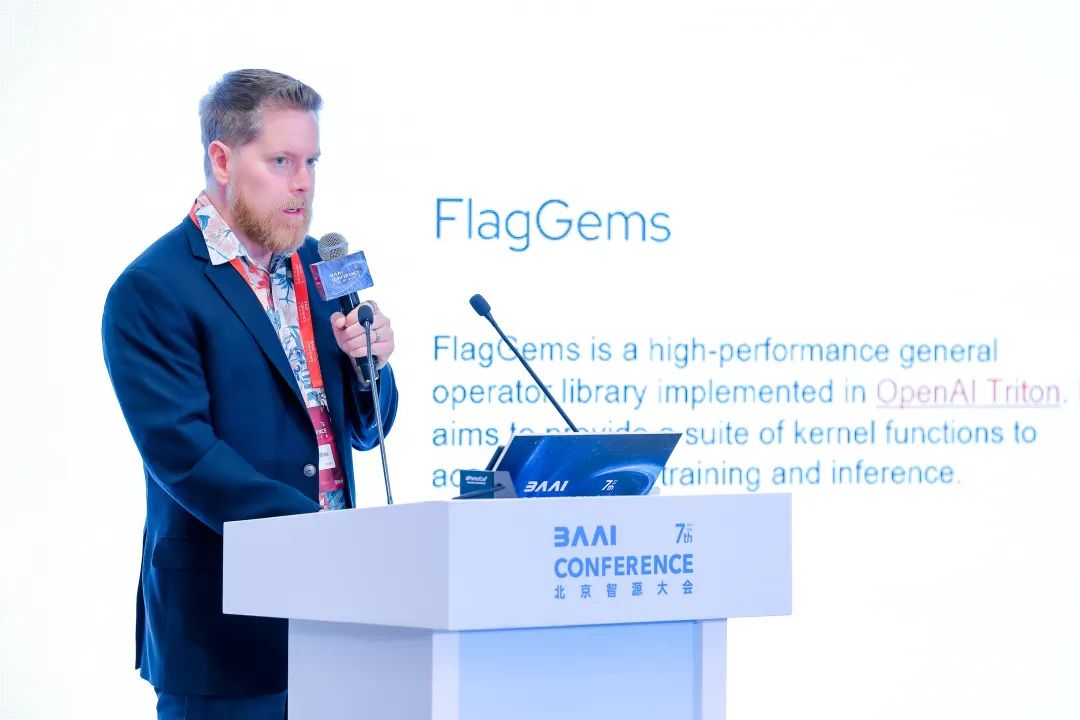
FlagGems is China’s clearest attempt to make that layer shareable. The FlagOS community’s open-source library sits between familiar PyTorch calls and a varied set of accelerator backends, replacing supported ATen operations with kernels written in Triton. Its promise is attractive: keep the model code recognizable, move the hardware-specific work below it, and stop rebuilding the same operator from scratch inside every vendor stack.[1]
The important change in 2026 is not that this promise has suddenly been completed. It is that the project is exposing more of the work required to test it. FlagGems 5.3.0, released on June 24, added a tuning interface for selected matrix-multiplication operators, published more benchmark data, and continued integrating backend code.[2] Read beside its requirements, test tables, and deployment notes, the release turns “run anywhere” from a slogan into a series of inspectable contracts—and shows exactly where those contracts can still break.
The shared layer sits below the model, not below the hardware
PyTorch models usually express work through operations such as matrix multiplication, softmax, or layer normalization. FlagGems registers alternative implementations in PyTorch’s dispatch system, so an application can invoke the same high-level API while the library selects an implementation for the detected backend. The project works in eager mode without requiring torch.compile; pointwise code generation and hand-tuned kernels fill out different parts of the operator catalog.[1][6]
That placement matters. A model vendor does not need to fork the whole application merely to exchange one supported implementation for another. A kernel contributor can work against a common operator meaning, while a chip team can focus on its compiler and backend. In June 2025, when FlagGems joined the PyTorch Ecosystem, the PyTorch Foundation’s project page described more than 180 PyTorch-compatible operators and more than ten hardware platforms.[6] By the March 2026 release notes for 5.0.1-rc0, the project listed 255 official and 152 experimental operators.[2]
Those counts measure catalog breadth, not equivalent support. The current repository says more than ten backends are integrated, while the stable requirements table names nine vendor families and marks AIPU and Huawei Ascend as only partially supported.[1][3] That difference is not a gotcha; it is a reminder that “backend present,” “operator implemented,” “dtype supported,” “numerically correct,” and “fast for this workload” are five different statements.
The dependency chain also remains hardware-specific. On a non-Nvidia platform, FlagGems requires compatible PyTorch and Triton builds supplied by the vendor or assembled through the FlagTree compiler project. The documentation explicitly notes that FlagTree supplies Triton, not a matching PyTorch build, and that some platforms need additional patches or setup.[3] A common kernel language reduces fragmentation above the compiler. It does not abolish the compiler, runtime, driver, or device semantics below it.
The test table is more important than the speedup headline
BAAI’s 2025 launch account said FlagGems averaged a 30% performance gain over PyTorch’s ATen CUDA operators and had been validated on Qwen and DeepSeek.[7] That is a useful project claim, but it is not a portable forecast. A kernel result depends on the accelerator, compiler version, tensor shape, dtype, memory layout, warm-up, reference implementation, and whether the measurement covers one operation or the whole model.
FlagGems’ own public results now make that boundary unusually visible. The documentation separates platform tabs and records accuracy, performance, passes, failures, skips, missing implementations, dtypes, compiler, and timestamp at operator level.[5] On the published Ascend run, for example, the table contains all four outcomes—passed, failed, skipped, and not found—rather than compressing them into one triumphant average. Other tabs use different compiler backends and test dates.[5]
This is the right unit of evidence. A faster operator that fails a numerical tolerance is not an acceleration. An accurate kernel that covers none of a model’s hot path will barely move end-to-end latency. A strong result at one fixed shape may disappear when batch size or sequence length changes. Version 5.3’s FlagTune work for selected matrix multiplications acknowledges that last problem: useful performance often comes from searching and caching configurations for the shapes a deployment actually serves.[2][4]
The operator list adds a second boundary. Entries carry maturity labels such as Stable, Beta, and Alpha, and include both standard ATen operations and fused or framework-specific kernels.[5] Teams therefore need a workload trace, not just a catalog total. The relevant question is which operations this model invokes, on these shapes and dtypes, at this concurrency—and which implementation handled each call.
“Enable” is a deployment action, not a magic switch
The basic interface looks almost frictionless: import the package and enable it globally, or use a scoped context manager. The operational controls reveal why the scoped route is often safer. Users can include or exclude named operators, record which FlagGems functions ran, inspect the selected vendor, and force a backend through the GEMS_VENDOR environment variable. The guide warns that forcing the wrong vendor can produce runtime errors.[4]
That control is not merely for debugging a young project. Selective activation creates a rollback boundary. If one operator is slower or numerically suspect on a target stack, an engineer can leave the rest of the library active while returning that operation to its reference path. The usage log then becomes evidence of what was actually replaced, rather than what the installation was theoretically capable of replacing.[4]
Process topology introduces another trap. In distributed vLLM inference, activating FlagGems only in the launch process is insufficient because each worker must initialize the library; otherwise remote workers can silently continue on their default implementations. The project’s Megatron guidance is similarly candid: enabling the library too early can affect data loading, so it recommends scoping acceleration to forward and backward computation and treating broader activation as less tested.[4]
These details change how portability should be evaluated. A clean import on one development GPU proves packaging. It does not prove that every production worker loaded the same kernels, that fallbacks were visible, or that the target model retained accuracy after the substitution. A credible acceptance run needs per-worker activation logs, operator-level correctness against a reference, representative shape sweeps, warm and cold latency, throughput under concurrency, and an end-to-end quality check.
China’s accelerator story is becoming a software-coordination story
FlagGems does not make Chinese accelerators interchangeable. It does something narrower and potentially more durable: it gives accelerator vendors, framework engineers, and model deployers a shared place to argue about operator semantics and publish executable evidence. The project’s contributors already span BAAI and several chip, compiler, and infrastructure teams, while FlagOS places the library beside separate components for compilation, communication, training and inference, migration, and evaluation.[7]
That separation is honest architecture. Operators cannot solve collective communication, scheduling, memory capacity, network topology, model conversion, or supply availability. But when each new accelerator otherwise requires a private kernel shelf, even a partial common layer can lower duplicated engineering work and make missing support legible. The strategic asset is not a single benchmark win; it is a maintenance surface where coverage, regressions, and vendor-specific exceptions can be compared.
The next proof points should therefore look mundane. Watch whether the public platform tables gain fresher, reproducible results with fewer unexplained failures; whether Alpha and Beta operators mature under model-level tests; whether version matrices for PyTorch, Triton or FlagTree, drivers, and frameworks become easier to reproduce; and whether downstream runtimes can initialize and fall back without source patches. Evidence from production workloads across several backends would matter more than another aggregate speedup.[3][4][5]
FlagGems’ strongest contribution is to make “portability” falsifiable. The same PyTorch call can now enter a common dispatch layer, but every backend still has to earn equivalence operation by operation, dtype by dtype, shape by shape, and release by release. That is less magical than “write once, run anywhere.” It is also how a heterogeneous compute ecosystem becomes real.
Sources
- FlagOS contributors, “FlagGems” — official repository, architecture, features, backend scope, and Apache-2.0 license.
- FlagOS contributors, “FlagGems releases” — official version history, including the March 2026 operator counts and June 24, 2026 version 5.3.0 changes.
- FlagOS Community, “Requirements” — official supported-platform table and the PyTorch, Triton, FlagTree, and vendor-build dependency boundary.
- FlagOS Community, “Use FlagGems” — official controls for operator selection, logging, vendor detection, tuning, and distributed-framework integration.
- FlagOS Community, “Benchmark Results” — public operator-level accuracy and performance tables by platform, compiler, and timestamp.
- PyTorch Foundation, “FlagGems Joins the PyTorch Ecosystem: Triton-Powered Operator Library for Universal AI Acceleration” (June 25, 2025).
- Beijing Academy of Artificial Intelligence, “Cross-chip AI operator library FlagGems officially joins the PyTorch Foundation ecosystem” (June 28, 2025; Chinese first-hand account and source for the cover photograph).