As of 2026-04-28 UTC, the sharper ai-china read on Zhipu is no longer that it has one more agent demo on a phone screen. The stronger signal is that the company is trying to turn agent capability into a cross-device distribution layer.[1][2][3][4] Read together, Zhipu's late-2024 materials show the same logic moving across four surfaces: AutoGLM as a phone-use foundation, GLM-PC as a desktop-control experiment, Samsung as an AI-phone OEM channel, and Intel AI PC as a local-compute and coding-assistant channel.[1][2][3][4]
That matters because it changes how the company should be watched. A phone-only agent story can still be read as a product novelty. A cross-device distribution story is harder to dismiss. It suggests Zhipu wants the same core agent logic to travel through consumer phones, PCs, and partner hardware surfaces, instead of staying trapped inside one chat app or one benchmark narrative.[1][2][3][4]
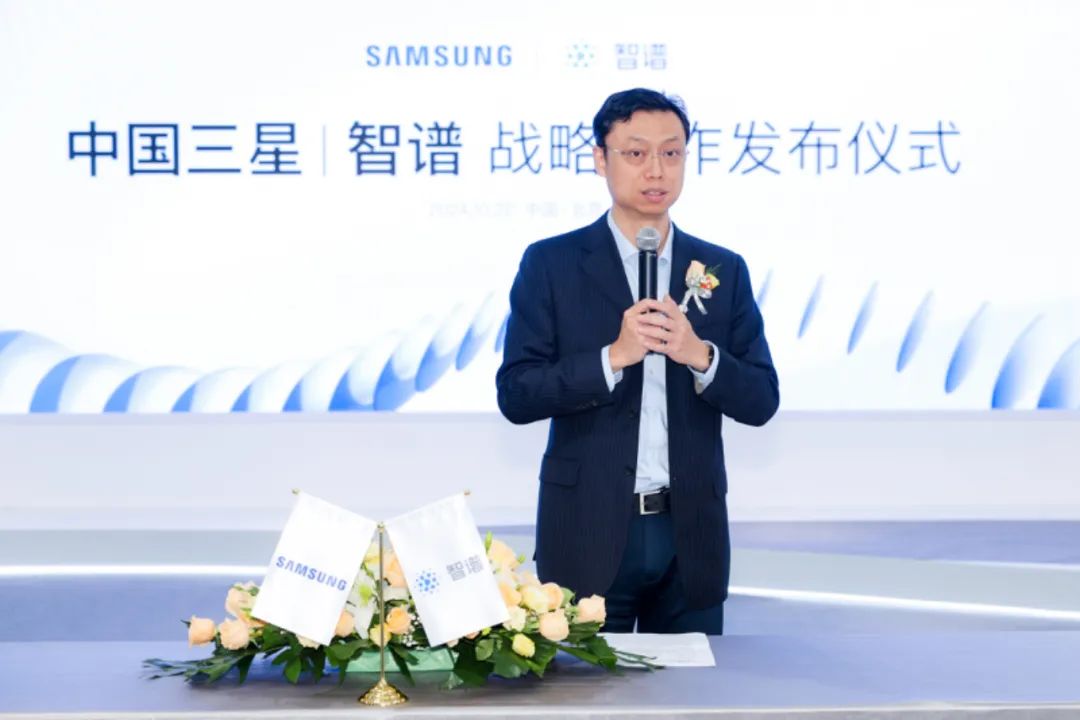
Image context: the cover uses a real photograph from Zhipu's October 27, 2024 Samsung strategic-cooperation event. It fits this article because the thesis is about where agent capability gets distributed. A partnership stage, rather than a synthetic UI graphic, shows that this is a channel story as much as a model story.[3]
AutoGLM was the first proof that Zhipu wanted action, not just conversation
The oldest layer in this stack is the phone.
Zhipu's AutoGLM research page says the company spent roughly 32 months pushing toward a system that could do more than chat: read screens, plan actions, and complete tasks inside real mobile apps.[4] The same page says that by October 25, 2024, Zhipu had released its first AutoGLM version that could reliably complete a full operation chain on a real phone, and it frames that milestone as the first stable Phone Use capability in the product line.[4]
That matters because the company is explicit about the intended workload. The page does not describe AutoGLM as a better mobile chatbot. It describes an agent that can enter food-delivery apps, process repetitive cloud-phone tasks, and automate sales, customer-service, or attendance-style actions that users would rather not click through themselves.[4] This is already an execution thesis.
Agent OpenDay widened the claim from phone use to cross-device control
The next step was not simply "more apps." It was more device surfaces.
At Agent OpenDay on November 28, 2024, Zhipu described several concrete expansions: AutoGLM could execute 50+ step long tasks, work across apps, and support shorthand instructions for repeated workflows.[1] More important for this article, the same event introduced GLM-PC as a PC-side autonomous agent experiment built on the multimodal CogAgent line.[1]
The public description is unusually specific. Zhipu says the first GLM-PC internal-test scenarios included meeting stand-ins, document downloading and sending, web search and summarization, remote phone-to-PC instruction handoff, and timed future execution while the computer is on.[1] It also says GLM-PC works from screen understanding and action execution rather than depending on HTML or pre-wired APIs.[1] That is the real cross-device signal. The company is no longer treating "agent" as a single app wrapper. It is trying to build one action grammar that can move from phone surfaces to desktop surfaces.
The boundary is visible too, and it is useful. Zhipu openly says current GLM-PC still requires very precise instructions and is not yet ready to replace office work broadly.[1] That makes the signal more credible, not less. The company is showing its intended direction without pretending the desktop problem is already solved.
Samsung turns the phone side into an OEM distribution channel
Phone use by itself is still a product feature. The Samsung partnership changes the commercial reading.
In Zhipu's October 28, 2024 announcement, China Samsung and Zhipu say they will co-create AI-phone products and intelligent services together.[3] Samsung's side of the statement is especially revealing: it describes AI phones as the result of hardware compute, advanced model algorithms, and user-facing AI scenarios operating together.[3] That is exactly the kind of language you use when AI stops being only an app feature and starts becoming part of a device category.
This matters because it gives Zhipu something more durable than raw download traffic. If the company can move from a standalone agent demo into an OEM phone channel, then its models and agent logic can ride on distribution that is already anchored in handset sales, system software, and hardware upgrade cycles.[3] My inference from the Samsung announcement is that Zhipu is trying to occupy the AI-phone intelligence layer without having to become a phone maker itself.
Intel AI PC extends the same logic into local compute and developer work
The Intel AI PC announcement on November 7, 2024 pushes the same pattern onto PCs.[2]
Zhipu says it worked with Intel on two concrete AI PC products: a local/offline-capable Qingyan client and a CodeGeeX intelligent programming assistant AIPC edition.[2] The Qingyan description is important because it emphasizes offline use, long-document analysis, and a local privacy mode, while still allowing cloud-connected features when needed.[2] In other words, Zhipu is not only putting a chat window on a laptop. It is positioning its assistant as a local-compute surface with selective cloud extension.
The CodeGeeX part matters for a different reason. Zhipu says the AIPC edition supports mainstream languages and IDEs including VS Code, IntelliJ IDEA, and PyCharm, and adds project-level explanation and project-map functions on top of code generation, completion, translation, and Q&A.[2] That turns the PC channel into more than a consumer AI story. It becomes a developer productivity distribution lane.
Taken together, the Intel material suggests that Zhipu wants agent capability to live not only in cloud APIs, but also in local hardware surfaces where privacy, offline responsiveness, and device-native workflows matter.[2]
The field signal is distribution through surfaces, not only through models
Put the four pieces together and the pattern becomes clearer.
AutoGLM shows the company building the underlying action logic on phones.[4] Agent OpenDay widens that action logic into PC control and remote handoff.[1] Samsung offers a route into AI-phone distribution.[3] Intel AI PC offers a route into local assistant and coding-assistant distribution on PCs.[2]
That is why this should be read as a field signal synthesis rather than as one more product recap. The interesting question is no longer only whether Zhipu can ship another strong foundation model. The stronger question is whether it can keep placing the same agentic core into multiple device categories before competitors lock down those surfaces with their own OS, assistant, or hardware partnerships.
The risks are real. Partner announcements do not guarantee durable usage.[2][3] Zhipu's own GLM-PC write-up says the desktop product is still early and instruction-sensitive.[1] AutoGLM's phone-use success still depends on interface stability, trust boundaries, and the amount of human takeover a workflow requires.[4] But those limits do not erase the signal. They define it.
The public record points in one direction: Zhipu is trying to become more than a model endpoint or a phone-agent novelty. It is trying to turn agent capability into a cross-device distribution layer spanning phone, PC, and partner hardware surfaces.[1][2][3][4]
Sources
- Zhipu AI, "Agent 新进展:跨 app、跨设备、更多玩法|智谱 Agent OpenDay" (November 28, 2024; 50+ step tasks, cross-app execution, GLM-PC scenarios, remote phone-to-PC handoff, timed execution, and the company's stated desktop boundary).
- Zhipu AI, "智谱与英特尔深化智能生态合作,落地端侧智谱清言和CodeGeeX智能编程助手" (November 7, 2024; local Qingyan on AI PCs, offline/privacy framing, CodeGeeX AIPC edition, supported IDEs, and Intel partner positioning).
- Zhipu AI, "智谱与中国三星宣布战略合作" (October 28, 2024; AI-phone co-creation framing, Samsung device-channel language, partner statements, and the event photograph used as this article's image).
- Zhipu AI, "AutoGLM开源:每台手机,都可以成为AI手机" (December 8, 2025; 32-month buildout, phone-use framing, 2024-10-25 stable real-phone milestone, cloud-phone/cloud-computer language, and 50+ high-frequency Chinese app demos).