As of 2026-04-28 UTC, the useful way to read Baidu's April 15, 2026 release of ERNIE-Image is not as one more sample-grid flex in the China image-model race. The stronger ai-china signal is packaging. Baidu has taken a visual-generation lane that could have stayed trapped inside closed flagship demos and pushed it outward as an open creator surface with public weights, public quick starts, and a clear workflow for posters, comics, multi-panel layouts, and other text-heavy image tasks.[1][2][3]
That distinction matters because the official materials are unusually practical. Baidu describes ERNIE-Image as an open text-to-image model built on a single-stream Diffusion Transformer with 8B parameters and paired with a lightweight Prompt Enhancer that expands short prompts into richer structured descriptions.[1][2][3] The companion ERNIE-Image-Turbo is framed even more operationally: the base model is positioned around 50 inference steps, while the turbo line is pushed down to 8 steps for faster generation.[2][3] This is already bigger than "here is our new image model." It is a release note about how Baidu wants developers to enter a visual lane.
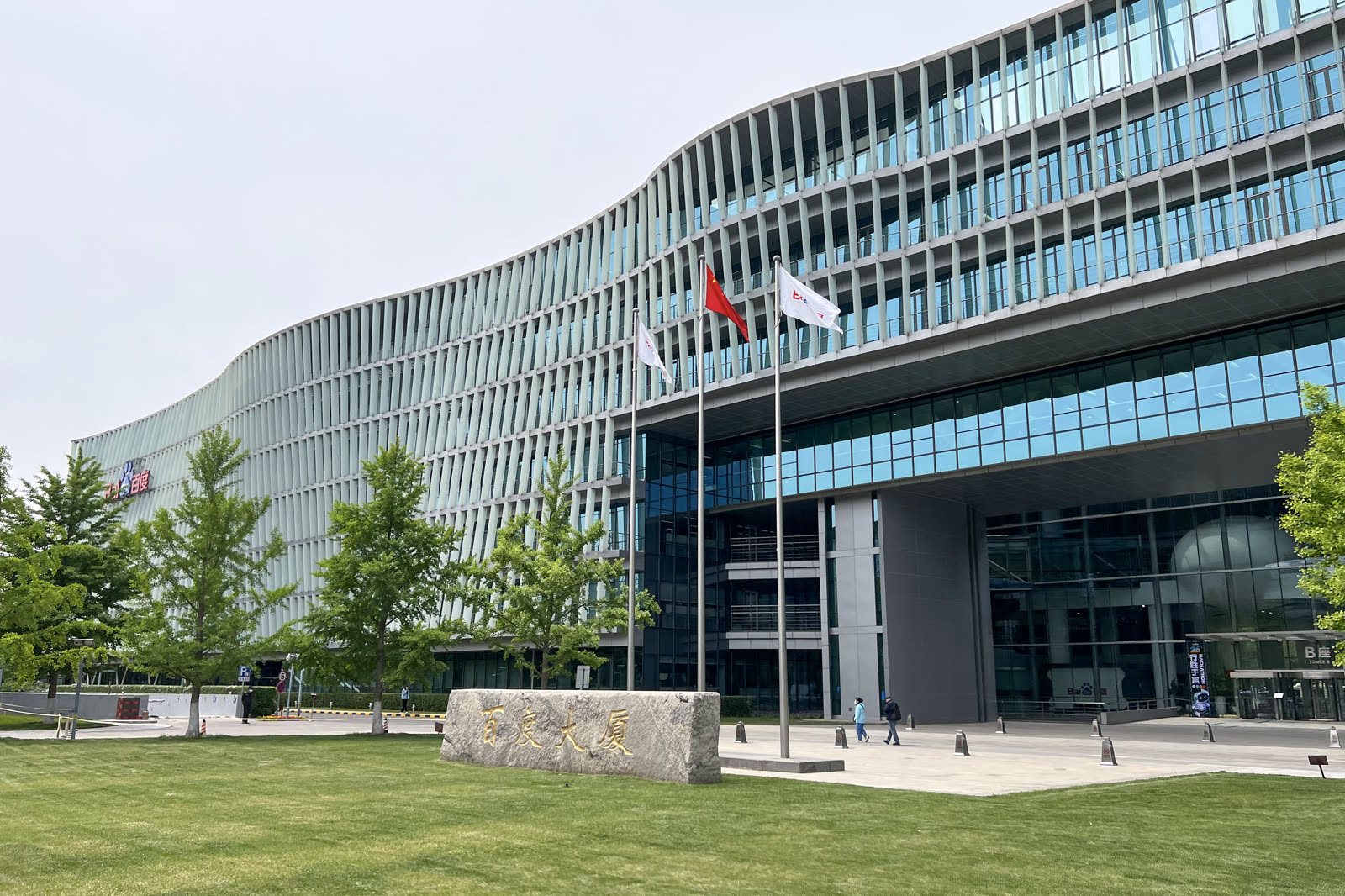
Image context: the cover uses a real Wikimedia Commons photograph of Baidu's Shangdi headquarters. It belongs here because the article is about a platform move, not a single pretty output. The building is a more honest visual anchor than a synthetic launch collage would be.[5]
The wedge is text rendering and structured layouts, not just generic aesthetics
The most revealing part of the launch is where Baidu says ERNIE-Image is strongest. Across the official repo and model card, the emphasis falls on text rendering, instruction following, and structured generation rather than on vague cinematic beauty alone.[2][3] Baidu is effectively telling users to think about visual tasks where fidelity means "did the model place the right words, objects, and layout in the right relationship?" instead of only "does the image look polished at a glance?"[2][3]
That is a strategically narrow but useful wedge. Posters, infographics, UI-like images, comics, and storyboards are the kinds of jobs where many image models still wobble: long text breaks, panel order gets sloppy, or multi-object instructions drift under style pressure. ERNIE-Image's launch language says Baidu knows this and wants to compete there on purpose.[1][2][3] In the China AI stack, that is a better entry point than trying to win a generic "best image model" argument every week.
The bilingual benchmark tables reinforce the same reading. In the official GENEval table, ERNIE-Image (w/o PE) posts an overall 0.8856, ahead of Qwen-Image at 0.8683, while still trailing Qwen on the counting subscore.[2][3] In OneIG-EN and OneIG-ZH, ERNIE-Image stays close to the top tier, especially on text and reasoning-heavy rows, but it is not a universal sweep.[2][3] And in LongTextBench, the best ERNIE-Image configuration reaches 0.9733 average, which is strong enough to matter while still sitting behind Seedream 4.5 at 0.9882.[2][3] The important implication is not that Baidu has crushed every rival across every image benchmark. The implication is narrower and more defensible: the model looks especially well aimed at text-rich, layout-sensitive work.
Open packaging matters more than launch theater
The second reason this release matters is deployability. The official Hugging Face card says ERNIE-Image can run on consumer GPUs with 24G VRAM.[3] The repo and model card both publish concrete entry paths through Diffusers and SGLang, with explicit example parameters instead of a hand-wavy "coming soon" promise.[2][3] That lowers the barrier from "interesting Baidu research artifact" to "something an individual developer or small team can actually test, route, and adapt."
This is where the release becomes an ai-china story rather than just an imaging story. China AI companies increasingly have to decide which capabilities stay premium and hosted, and which ones get pushed outward to build developer habit. ERNIE-Image makes a clear choice. Baidu did not only publish a press note; it published open weights, a public repo, public benchmark tables, and public inference instructions.[1][2][3] My inference from those materials is that Baidu wants a wider visual-creation entry funnel below the top-layer ERNIE brand, especially in workflows where design, text, and structure matter more than one-off photoreal wow shots.
The surrounding ecosystem hints at the same direction. The official repo already points to ComfyUI support, AI-Toolkit fine-tuning, and Unsloth GGUF work as adjacent integration lanes.[2] That is not the behavior of a company treating the model as a sealed showcase. It is the behavior of a company that wants the model to circulate through tools, templates, and downstream adaptations.
This release makes more sense when placed under ERNIE 5.0
Baidu's broader ERNIE framing helps explain why the company would push an image lane outward this way. In its February 6, 2026 write-up on ERNIE 5.0, Baidu described a 2.4 trillion-parameter unified multimodal foundation model built to integrate text, image, video, and audio in one autoregressive framework with shared token-space modeling and elastic deployment shapes.[4] That is the company's high-level research story.
ERNIE-Image is not presented as "ERNIE 5.0, but smaller." The release still feels connected to the same strategic grammar. Baidu is moving from a grand multimodal thesis at the flagship level toward a narrower creator-facing lane that ordinary developers can actually download, run, and compare.[1][2][3][4] This is an inference from the source set, not a statement Baidu writes explicitly. But it fits the public evidence: unified multimodal ambition at the top, then a more inspectable open image surface below it.
That matters because flagship multimodal narratives often fail at the adoption layer. They can describe everything while giving builders nothing they can operationalize. ERNIE-Image pushes in the opposite direction. It turns one slice of Baidu's multimodal agenda into an object with weights, steps, prompt handling, hardware assumptions, and concrete output categories.[1][2][3]
The benchmark story is real, but the boundary matters
The right reading is still disciplined. Baidu's launch wording says ERNIE-Image achieves leading performance among open-weight models, and the official tables support a strong claim for competitiveness.[1][2][3] At the same time, the comparison surface is not uniform. Some rows use the Prompt Enhancer, others do not. Some benchmarks reward text fidelity more than compositional counting or style diversity. And the turbo model is explicitly trading longer-step fidelity for speed-oriented packaging.[2][3]
So the article's claim should stay narrow. ERNIE-Image is best read as a specialized open creator lane with strong evidence around text rendering, structured output, and practical deployment, not as a settled declaration that Baidu now owns the whole open image leaderboard.[2][3] That is a stronger argument anyway, because it matches the real shape of the evidence instead of pretending all benchmark columns mean the same thing.
What to watch next
First, watch whether Baidu keeps the open lane synchronized with the surrounding tool ecosystem.[2][3] If Diffusers, SGLang, ComfyUI, and fine-tuning paths remain current, the creator-surface thesis gets stronger.
Second, watch whether ERNIE-Image starts showing up in workloads where text inside images is the product rather than a nuisance: ad creatives, slides, interface mockups, educational diagrams with labels, comics, and commerce graphics.[1][2][3] That is where this release looks most differentiated.
Third, watch the distance between this open lane and Baidu's higher-level ERNIE platform story.[1][4] If Baidu keeps translating flagship multimodal research into smaller public creator tools, the company will look less like a closed model vendor and more like a stack with multiple entry levels. If the open lane stalls while the hosted layer races ahead, ERNIE-Image will read more like a showcase than a lasting surface.
Sources
- ERNIE Blog, "ERNIE-Image 文生图模型发布" (official April 15, 2026 release note).
- baidu/ERNIE-Image GitHub README (official repository; released versions, benchmark tables, Diffusers/SGLang deployment, and adjacent ecosystem links).
- baidu/ERNIE-Image Hugging Face model card (24G VRAM deployment note, recommended parameters, benchmark tables, and quick-start paths).
- ERNIE Blog, "文心 5.0 (ERNIE 5.0):2.4 万亿参数的原生全模态大模型" (official multimodal context and architectural framing, February 6, 2026).
- Wikimedia Commons, "File:Baidu headquarters at Shangdi (20220509112427).jpg" (cover image source page).