As of 2026-03-31 UTC, the strongest Tencent signal in AI-China is not one more universal chat-model headline. It is that Tencent is quietly carving out specialist workflow lanes where users already pay for accuracy, structure, and low-friction deployment: document intake and cross-language translation.[1][2][3][4]
That matters because these are not decorative edge cases. OCR sits at the front of claims processing, invoice ingestion, subtitle extraction, form handling, and document QA. Translation sits inside export operations, multilingual customer support, catalog localization, and internal cross-border coordination. A provider that can turn those tasks into named model surfaces has a better shot at durable enterprise demand than a provider that only asks buyers to admire one general assistant.[1][2][3]
Tencent's own materials now show that shape clearly. On the open side, HunyuanOCR is presented as a dedicated OCR expert VLM rather than a generic visual chatbot.[1] Hunyuan-MT is framed as a translation system with both a core model and an ensemble model, rather than as a loose capability folded into a bigger assistant.[2] On the cloud side, Tencent's API overview does something equally important: it breaks translation out into a separate interface family, complete with ChatTranslations and glossary-management endpoints, instead of hiding it behind one all-purpose chat call.[3] When placed next to Tencent's 2025 annual results, which say cloud demand for AI-related services is rising and that HY foundation models are being pushed through abundant internal use cases, the pattern becomes easier to read.[4]
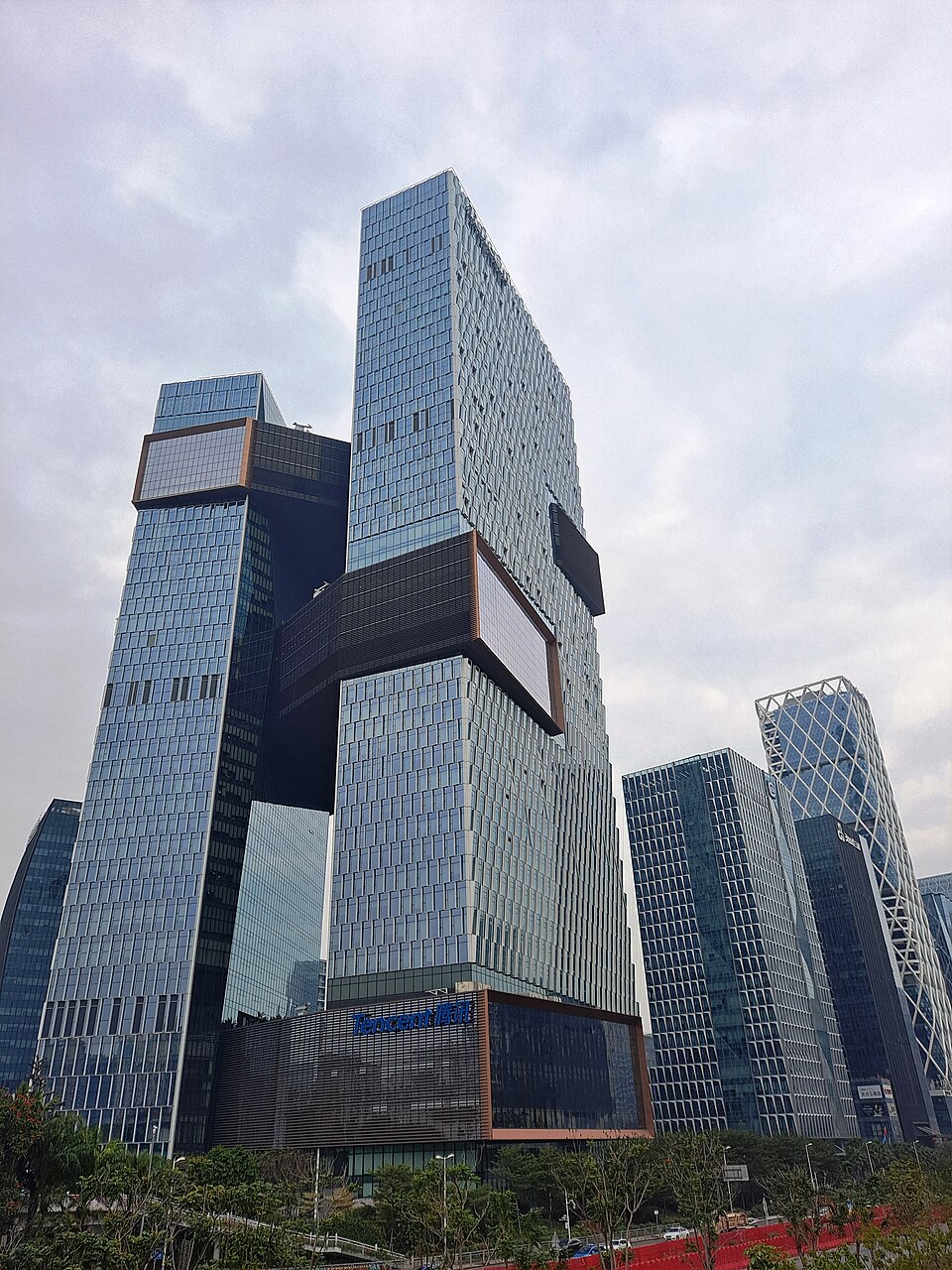
Image context: the cover uses a real Wikimedia Commons photograph of Tencent Seafront Towers in Shenzhen. That is the right visual here because the argument is about institutional delivery and workflow packaging inside a real company stack, not about a synthetic rendering of model internals.[5]
The OCR lane is valuable because it solves messy intake, not because it flatters a benchmark table
Tencent's HunyuanOCR README is explicit about where the model wants to win. It calls the system a 1B-parameter end-to-end OCR expert VLM, says it supports over 100 languages, and lists practical tasks such as complex multilingual document parsing, open-field information extraction, video subtitle extraction, and photo translation.[1] That is already more revealing than a generic "multimodal" label. It tells readers that Tencent is trying to own the ugly front end of information work: turning mixed, messy visual documents into normalized text and structure.[1]
The release notes make the operational boundary clearer. Tencent says the public model weights arrived on 2025-11-25, then notes a 2025-11-28 fix for vLLM inference bugs and hyperparameter issues, while also warning that Transformers still shows a performance gap relative to vLLM.[1] That kind of disclosure matters. It means Tencent is not just presenting OCR as a showcase demo. It is acknowledging the runtime path that production users will actually have to care about.
This is why HunyuanOCR should be read as a workflow wedge rather than as a side project. If a model can reliably parse multilingual forms, subtitles, images of text, and downstream document questions, it earns its place early in the enterprise pipeline.[1] Once it sits at the intake layer, it becomes harder to replace with a prettier general assistant that is less reliable on layout and extraction.
The translation lane shows Tencent wants repeatable language infrastructure, not only a chat feature
Hunyuan-MT points in the same direction. Tencent's README says the project includes Hunyuan-MT-7B and Hunyuan-MT-Chimera, with the latter combining multiple translation outputs into a refined result.[2] The model family is said to support mutual translation among 33 languages, including five ethnic minority languages in China, and Tencent claims first place in 30 of 31 language categories entered in WMT25.[2]
The detail that matters most is not the contest result by itself. It is the product framing around it. Tencent is not describing translation as a loose emergent capability of a bigger chat model. It is packaging translation as a dedicated system with its own prompt templates, its own ensemble layer, and its own language-coverage story.[2]
That packaging becomes more concrete in Tencent Cloud's API overview. Translation has its own interface block with ChatTranslations plus glossary CRUD endpoints such as ListGlossary, CreateGlossary, and UpdateGlossaryEntry, each published with a 20 requests-per-second frequency limit in the documentation updated on 2026-02-12.[3] Once a provider ships glossary management as part of the API surface, it is no longer selling "the model can probably translate." It is selling a translation workflow where terminology consistency is part of the contract.[3]
That is a much more monetizable position than general bilingual cleverness. Companies pay for terminology stability, predictable output form, and integration points that keep translation from drifting across teams and channels.
The cloud surface is the bridge between open specialist models and revenue-bearing work
The cloud packaging is what turns these specialist releases into a broader Tencent signal.
Tencent's API overview separates model functions into distinct operational families: standard chat, embeddings, image question answering, file workflows, image generation, and translation.[3] That tells enterprise buyers where Tencent thinks task boundaries deserve their own interface surfaces. Translation gets one of those named lanes. OCR, while exposed publicly through the open HunyuanOCR release rather than through the same API-overview block, is presented with equally strong operational cues around recommended runtime, hardware requirements, and deployment method.[1]
The annual results show why Tencent would care about this architecture. In the 2025 Annual and Fourth Quarter Results, Tencent says Business Services revenue rose by a high-teens rate for the year, reflecting stronger domestic and international cloud demand, including AI-related services.[4] The same release says Tencent Cloud achieved profit at scale as enterprise demand for AI workloads increased, and that Tencent's HY foundation models benefited from proprietary data and abundant use cases while becoming leaders in multimodal capabilities including 3D, text-to-image, and World model.[4]
My inference from these sources is straightforward: Tencent's open specialist models and cloud interface design are meant to feed each other. The open release establishes credibility and developer attention. The cloud surface turns that attention into routable production work. Document intake and translation are ideal places to run that play because buyers already understand the labor cost of getting them wrong.
Why this matters more than another general-model brag cycle
In AI-China, the easiest story to overproduce is the universal-model story: one more launch, one more benchmark graphic, one more claim to general intelligence. Tencent's more interesting move is quieter. It is pushing into narrow but expensive workflow bottlenecks where model quality can be measured by whether work gets processed cleanly.[1][2][3][4]
That is a stronger competitive lane for at least three reasons.
First, specialist workflows are easier to price because the buyer already has a budget line for them. Second, they are easier to evaluate because failure modes are concrete: misread fields, broken tables, wrong subtitles, inconsistent terminology. Third, they benefit from packaging features that general chat products often underplay, such as glossary control, runtime guidance, and repeatable prompt structure.[1][2][3]
This does not prove Tencent has already locked up these markets. A fair boundary remains: open-source release cadence and API packaging do not automatically equal broad paid adoption. But the direction is clear. Tencent is treating OCR and translation less like optional features and more like entry points into enterprise workflow control.
What to watch next
- Watch whether Tencent gives OCR a more explicit managed-cloud lane, not only an open release and demo path.[1][3]
- Watch whether translation APIs gain deeper governance features such as version pinning, audit visibility, or stronger enterprise terminology tooling.[3]
- Watch whether Tencent keeps tying AI-related cloud growth to these kinds of task-specific surfaces in future results, rather than talking only about frontier-model prestige.[4]
Bottom line
The cleanest way to read Tencent right now is not "another Chinese model vendor with many demos." It is a company trying to capture workflow bottlenecks with specialist model lanes.
HunyuanOCR is Tencent's bid for the document-intake layer.[1] Hunyuan-MT is its bid for cross-language normalization.[2] Tencent Cloud's API structure shows that at least part of this strategy is being turned into named, governable production surfaces rather than left as loose model capability.[3] That is the field signal worth taking seriously.
Sources
- Tencent-Hunyuan, "HunyuanOCR" GitHub README (1B OCR expert VLM, 100+ languages, task scope, runtime notes, and release timeline).
- Tencent-Hunyuan, "Hunyuan-MT" GitHub README (7B translation model, Chimera ensemble model, 33-language support, and WMT25 results).
- Tencent Cloud, "Tencent Hunyuan API Overview" (updated 2026-02-12; translation endpoints, glossary APIs, and frequency limits).
- Tencent Holdings, "Tencent Announces 2025 Annual and Fourth Quarter Results" (2026-03-18; AI-related cloud demand, Tencent Cloud profitability at scale, and HY foundation-model positioning).
- Wikimedia Commons, "File:Tencent Seafront Towers.jpg" (source page for the cover photograph).