As of 2026-04-19 UTC, one ai-china signal is becoming clearer: the interesting product competition is no longer only about whether one agent can finish a task alone.[1][2][3][4] The more durable move is to turn the agent into a shared workspace where teammates, sub-agents, files, credits, and permissions all meet.
That is a stronger reading of the current public surfaces than the simpler "smarter assistant" story. Manus is documenting collaboration, pooled credits, and connectors as first-class features.[1][2][3] Moonshot is explicitly selling Agent Swarm as a structure that can deploy up to 100 sub-agents in parallel.[4] 01.AI is describing enterprise multi-agent systems as a route from one worker with one tool to "one person, one team" and even an era of "silicon teams."[5]
This is a field signal, not a settled market verdict. Most of the evidence is product-authored, so it shows what companies want users to buy into more clearly than it proves long-term retention. Even with that boundary, the pattern is too consistent to ignore. My inference from [1] through [5] is that the competitive unit is shifting from the solitary prompt box toward the workspace contract around the model: who shares context, who pays, who can intervene, what external data stays attached, and how parallel work gets coordinated.
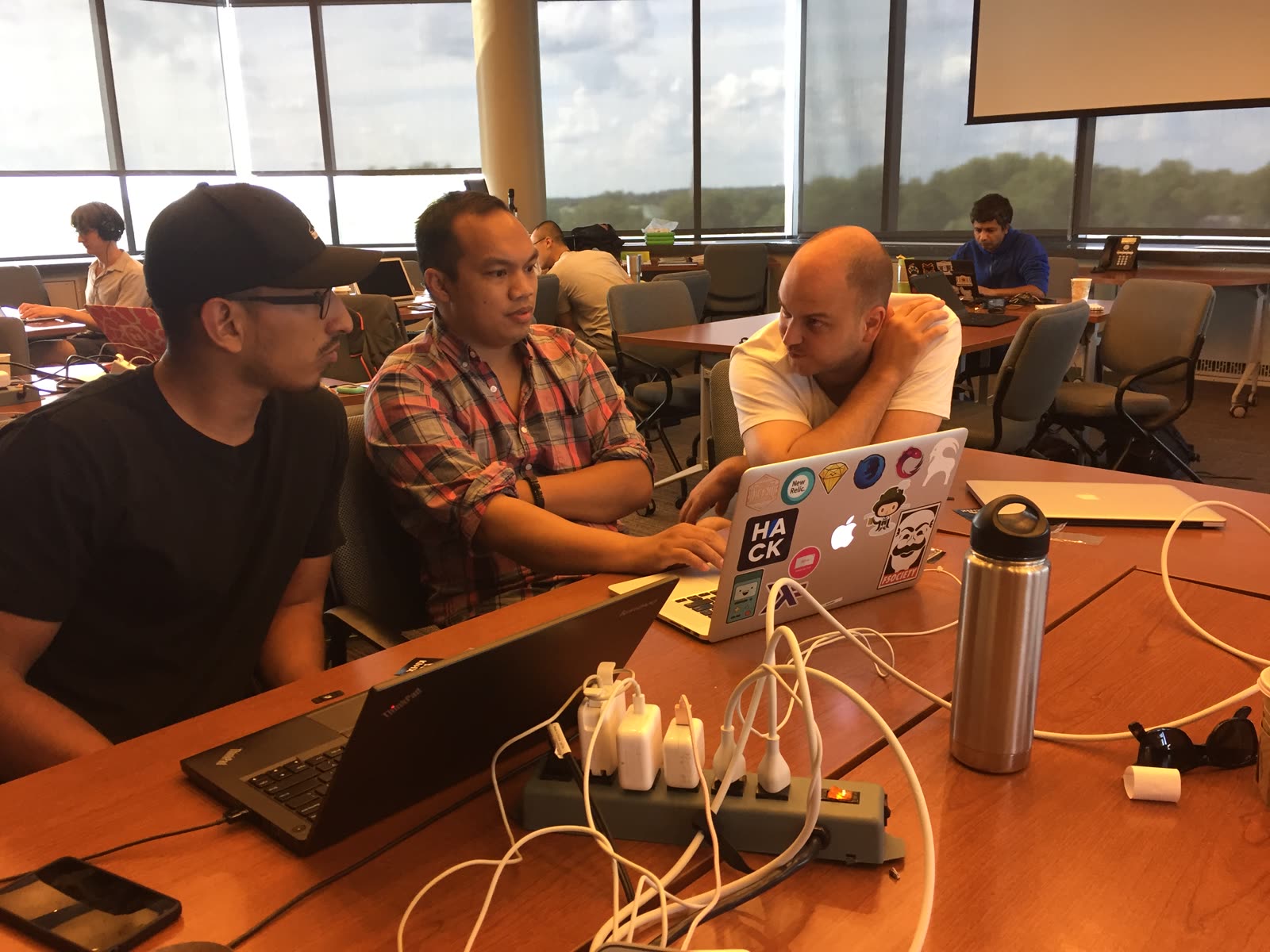
Image context: the cover uses a real 2017 hackathon photograph from Wikimedia Commons. It fits this piece because the article is not really about lone-chat intelligence. It is about AI products being packaged more like collaborative work surfaces, where multiple people and delegated roles gather around one evolving task.[6]
Manus makes the workspace contract explicit
Manus is unusually direct about this shift. Its Collab documentation does not describe collaboration as a lightweight comment layer added on top of an assistant.[1] It describes one shared workspace, one version, and one source of truth accessible via one link, with everyone seeing updates instantly and everyone able to prompt the system directly.[1]
The operational detail is the important part. Manus says only the task owner consumes credits in collaboration mode, while collaborators participate without using their own credits.[1] That means the product is already defining a cost owner, an access owner, and a shared history model. The same page says only the owner can invite collaborators and that all collaborators can see the complete task history.[1] This is a governance surface, not just a chat window with avatars.
The pricing docs reinforce that read. Manus says the Team Plan is built for collaborative access and higher usage limits, with a shared team credit pool, team collaboration, and admin controls.[2] Once credits are pooled and access is team-shaped, the unit being sold is no longer only individual reasoning power. It is a workspace budget with rules attached.
Connectors turn stored files into live context
The next step is what happens when the workspace stops being sealed off from the team's actual information.
Manus's Google Drive Connector page says the integration treats Drive as a personal database rather than a passive upload source.[3] The wording matters. Manus says Drive becomes a single source of truth that the system can draw from and contribute to in real time, and that users can schedule tasks that gather information, generate reports, and save them into a shared Drive folder for team review.[3]
This is a bigger product move than "we added another connector." Once files in a shared folder become live task context, the agent starts attaching itself to the team's working memory. The value no longer sits only in one answer. It sits in the fact that the same workspace can read prior documents, write new ones, organize folders, and keep output inside an existing repository of work.[3]
That changes switching cost. A better standalone model can always tempt users away from a weaker one. A workspace that already knows where the team's documents live, how reports are routed, and which folder is the reporting endpoint is harder to dislodge.
Kimi and 01.AI are pushing the same organizational metaphor
Moonshot and 01.AI show that this shift is not limited to collaboration tooling alone. The deeper change is conceptual: companies are increasingly describing agents as organizations, not only assistants.
Moonshot's Agent Swarm post is explicit on this point. It says, "The future isn't better single agents. It's agents that build organizations," then claims that Kimi K2.5 can deploy up to 100 sub-agents, execute over 1,500 tool calls, and deliver results 4.5x faster than sequential execution.[4] The post also says the system is strongest where work parallelizes: broad research, batch downloads, multi-file processing, multi-angle analysis, and long-form writing.[4]
That matters because the product metaphor is doing real work. Moonshot is not only saying the model is stronger. It is saying the model should be used as a managed team structure with delegation, reconciliation, and parallel specialization.[4]
01.AI's January enterprise multi-agent post arrives at a similar destination from the enterprise side. The company says its demos show multi-agent systems handling workflows that previously required at least a ten-person team, and it frames the next stage of enterprise agents as a move from "one person, one tool" to "one person, one team."[5] The same post argues that multi-agent systems represent a shift from individual task efficiency toward organizational intelligence, with planning, coordination, checking, and reusable capability modules.[5]
Put differently, Moonshot is using organization language for consumer and prosumer execution, while 01.AI is using it for enterprise restructuring. The surfaces differ, but the direction is similar: the agent is being sold as a workspace that can coordinate roles, not simply as a better paragraph generator.
Why this matters more than one more benchmark table
The practical consequence is that part of the AI-China moat is moving upward from the base model into the surrounding operating surface.
Four things become strategically important in that world.
First, context persistence. If the workspace already contains task history, collaborator prompts, shared files, and output destinations, that environment starts to matter as much as the model inside it.[1][3]
Second, governance. Owner-controlled invitations, shared credit pools, and explicit billing responsibility are not glamorous features, but they decide whether an AI workspace can survive contact with real teams.[1][2]
Third, parallel structure. Once vendors normalize sub-agent teams and division of labor, product competition shifts from raw output quality toward orchestration quality: when to split work, when to reconcile disagreement, and how much of that behavior can remain inspectable.[4][5]
Fourth, workflow stickiness. A solitary assistant can be swapped by changing a URL or SDK key. A shared workspace with collaborators, folder rules, reporting endpoints, and cost controls is slower to replace. My inference from [1] through [5] is that this is exactly why these companies keep publishing collaboration, connector, and multi-agent-organization language at the same time.
What to watch next
Three signals matter from here.
First, watch whether more ai-china vendors expose shared-budget and permission surfaces publicly instead of leaving them hidden inside enterprise sales decks.[1][2]
Second, watch whether connectors expand from storage into richer system-of-record integrations. The more a workspace can read and write directly into the team's existing data layer, the stronger its hold becomes.[3]
Third, watch whether multi-agent products publish more evidence about coordination quality, not only about parallelism volume. Spawning 100 sub-agents is interesting; showing how conflicts, auditability, and task ownership are managed is more important.[4][5]
The useful conclusion is narrower than "AI workspaces have already won" and stronger than "these are just smarter chatbots." The public AI-China market is increasingly teaching users to think in terms of shared agent workspaces: pooled context, bounded access, connected files, and organized delegation inside one task surface.[1][2][3][4][5]
Sources
- Manus Documentation, "Manus Collab" (shared workspace, one-link source of truth, owner-only credit consumption, invitation control, and full task history visibility).
- Manus Documentation, "Plans and Pricing" (shared team credit pool, team collaboration, and admin controls on Team plans).
- Manus Blog, "Google Drive Connector on Manus" (Drive as a personal database, single source of truth, shared-folder reporting, and live file context).
- Kimi, "Kimi Agent Swarm: 100 Sub-Agents at Scale" (organization metaphor, 100 sub-agents, 1,500+ tool calls, 4.5x faster execution, and parallel-work best practices).
- 零一万物 / Lingyiwanwu, "零一万物发布万智2.5企业级多智能体,开启2026'硅基团队'上岗元年" (enterprise multi-agent demos, "one person, one team," and organization-intelligence framing).
- Wikimedia Commons, "File:Men working on a computer.jpg" (source page for the 2017 collaboration photograph used as this article's cover image).