As of 2026-04-19 UTC, the useful way to read Baidu's Famou is not as one more Chinese company attaching the phrase "super agent" to a general-purpose chatbot.[1][2] The stronger signal is narrower and more industrial. Baidu is packaging an agent for problems where the search space is explicit, the objective can be scored, and the answer gets better only by running large amounts of structured iteration: offshore-wind cable routing, coordinated traffic signals, port scheduling, energy-demand prediction, and financial-risk feature mining.[1][2][3]
That distinction matters in ai-china. The sector already has enough demos where an assistant sounds capable for thirty seconds and then drifts into hand-wavy advice. Famou's public materials point somewhere else. Baidu describes a system that uses large-model reasoning to abstract a task, an evaluator to judge candidate solutions, expert intervention at key points, and distributed evolution to keep searching after the first decent answer appears.[1][2] Read that way, Famou is less a conversational product than a commercial attempt to put optimization search at the center of the agent story.
Public evidence is still mostly Baidu's own. That means the right reading is disciplined: treat the launch note, product page, and case pages as evidence of what Baidu is trying to commercialize and where it says the system already works, not as a neutral proof that every claim is settled.[1][2][3] Even with that boundary, the use-case choice is revealing.
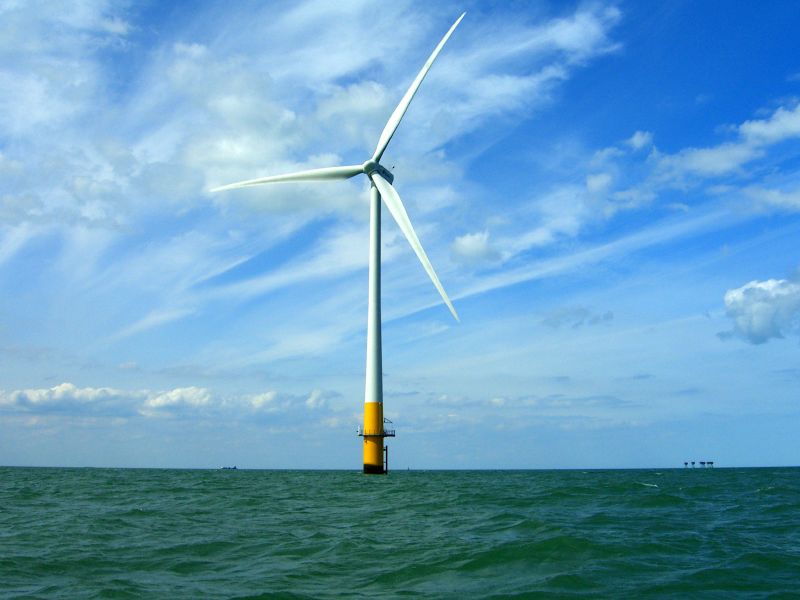
Image context: the cover uses a real 2006 photograph of a turbine at the Kentish Flats Offshore Wind Farm. It fits this piece because Famou's clearest industrial claim is not "better conversation." It is route finding inside a constrained physical environment, where every extra turn, crossing, and meter of cable has engineering consequences.[5]
The product only makes sense if the task can be scored
The Baidu launch note says Famou combines large-model reasoning, evolutionary computation, and a scalable distributed system so it can generate initial solution sets, keep iterating 7x24, and refresh the optimum as conditions change.[1] The product page makes the mechanics more concrete. It emphasizes intelligent modeling, expert intervention, self-driven evolution, full-process visibility, knowledge-base support, and distributed parallel execution through a Ray cluster.[2]
That bundle is the important part. Famou is not being sold like a normal office copilot that drafts text, calls tools, and leaves a human to decide whether the answer feels plausible. It is being sold for tasks where the agent can turn a messy industrial requirement into a search problem and then improve by repeatedly testing candidate strategies against an evaluator.[1][2] In other words, the value does not come from sounding smart. It comes from owning a loop where better and worse answers can be distinguished.
That is why Baidu keeps talking about "human defines the task, the agent keeps optimizing."[1] The phrase sounds promotional until it is placed next to the actual use cases. Once the target is a routing, scheduling, or feature-selection problem with hard constraints, the claim becomes easier to audit. Either the system finds a better feasible solution or it does not.
Offshore wind routing is the clearest window into what Famou is really for
Among the published cases, the offshore-wind one is the most revealing.[1][3] Baidu describes the problem as medium- and high-voltage cable-tray layout inside an offshore booster station: a dense three-dimensional environment where cables must pass through beams, columns, equipment, and compartments while obeying bend radius, elevation, clearance, fire-safety, corrosion, and maintenance constraints.[3]
This is a strong test case because it strips away the theater that clings to many agent launches. There is no need to pretend the system has a charming personality or encyclopedic world knowledge. The task is brutal, bounded, and expensive. Engineers traditionally model, check, and rework the layout by hand; when equipment or building models change, the route plan often has to be rebuilt from scratch.[3] Baidu says Famou keeps generating, testing, and improving heuristics until it can produce an industrial-grade routing solution automatically, shifting the engineer's job from manual model construction toward result review and engineering validation.[3]
The launch note adds the commercial edge. In Baidu's telling, the China Energy Engineering Group Guangdong Electric Power Design Institute used Famou in offshore-wind design and found shorter cable paths than manual design, with project delivery taking a multiple less time than before.[1] Because that number comes from the vendor, it should be treated as directional. Even so, the case matters because it shows the kind of surface where agent claims become concrete. A shorter safe path in a crowded three-dimensional station is not a vibes-based answer. It changes material usage, construction difficulty, and rework risk.
This is a different AI-China lane than chat-first assistants
The deeper reason this use case matters is that it suggests another commercialization lane for Chinese AI companies. Much of the cycle has centered on model launches, consumer assistants, search interfaces, and enterprise chat shells. Famou points toward a workload where the model is only one layer inside a larger optimization stack.[1][2]
That matters economically. In its May 21, 2025 first-quarter results, Baidu said AI Cloud revenue grew 42% year over year and that non-online-marketing revenue was up 40%, mainly driven by AI Cloud.[4] If that business is going to keep compounding, Baidu needs workloads that are harder to replace than a generic chat interface. Industrial optimization is one plausible answer. These problems are domain-heavy, tied to customer data and engineering rules, and they reappear whenever layouts, traffic flows, risk patterns, or operating constraints shift.
Famou's own product shape reflects that logic. The product page offers basic, professional, and enterprise editions, including private deployment and deeper co-creation for organizations that need integration rather than a public demo.[2] That is a cloud-and-services posture, not a mass-market app posture.
There is also a strategic implication for how to think about "agents." Famou suggests that some of the strongest agent businesses may emerge where the system owns the search space instead of trying to simulate a universally competent worker. When the task has an evaluator, a feasibility boundary, and a real cost for suboptimal answers, search can compound. When the task is open-ended conversation, marketing usually grows faster than reliability.
What to watch next
Three things will decide whether Famou is more than a strong demo category.
First, watch for more cases where Baidu publishes enough detail to show that the objective, constraints, and measurable gains are real outside a one-line anecdote.[1][2][3] The offshore-wind routing case is promising because it exposes a hard physical planning problem, but the public evidence is still thin.
Second, watch whether third parties start validating the product's role in industrial workflows rather than repeating Baidu's framing. At the moment, the story is still vendor-shaped.[1][2][3]
Third, watch whether this lane stays attached to AI Cloud growth and enterprise deployment rather than collapsing back into a broad "agent" narrative.[2][4] If Baidu keeps selling optimization loops into engineering, logistics, and risk systems, Famou will look like an important ai-china signal. If it drifts into generic assistant marketing, the sharper thesis weakens.
Famou matters because it gives the China agent race a more grounded template. The interesting claim is not that Baidu built a chatbot with a bigger title. It is that Baidu is trying to commercialize a system that searches bounded industrial spaces until a better answer emerges.[1][2][3][4]
Sources
- Baidu AI Cloud, "百度伐谋正式发布!'自我演化'超级智能体,为产业难题寻找'全局最优解'" (November 18, 2025; official launch note describing Famou's architecture, search loop, and early industry cases).
- Baidu AI Cloud, "百度伐谋 算法自进化智能体" product page (feature set, Ray-based distributed parallelism, deployment editions, and listed scenario coverage).
- Baidu AI Cloud, "海上升压站中高压桥架布置" customer case page (the offshore booster-station cable-routing problem, constraint set, and claimed design-cycle effects).
- Baidu, "Baidu Announces First Quarter 2025 Results" (May 21, 2025; AI Cloud revenue growth and company-level AI-first context).
- Wikimedia Commons, "File:Off-shore Wind Farm Turbine.jpg" (2006 Phil Hollman photograph of a Vestas turbine at the Kentish Flats Offshore Wind Farm; source page for the cover image used in this article).