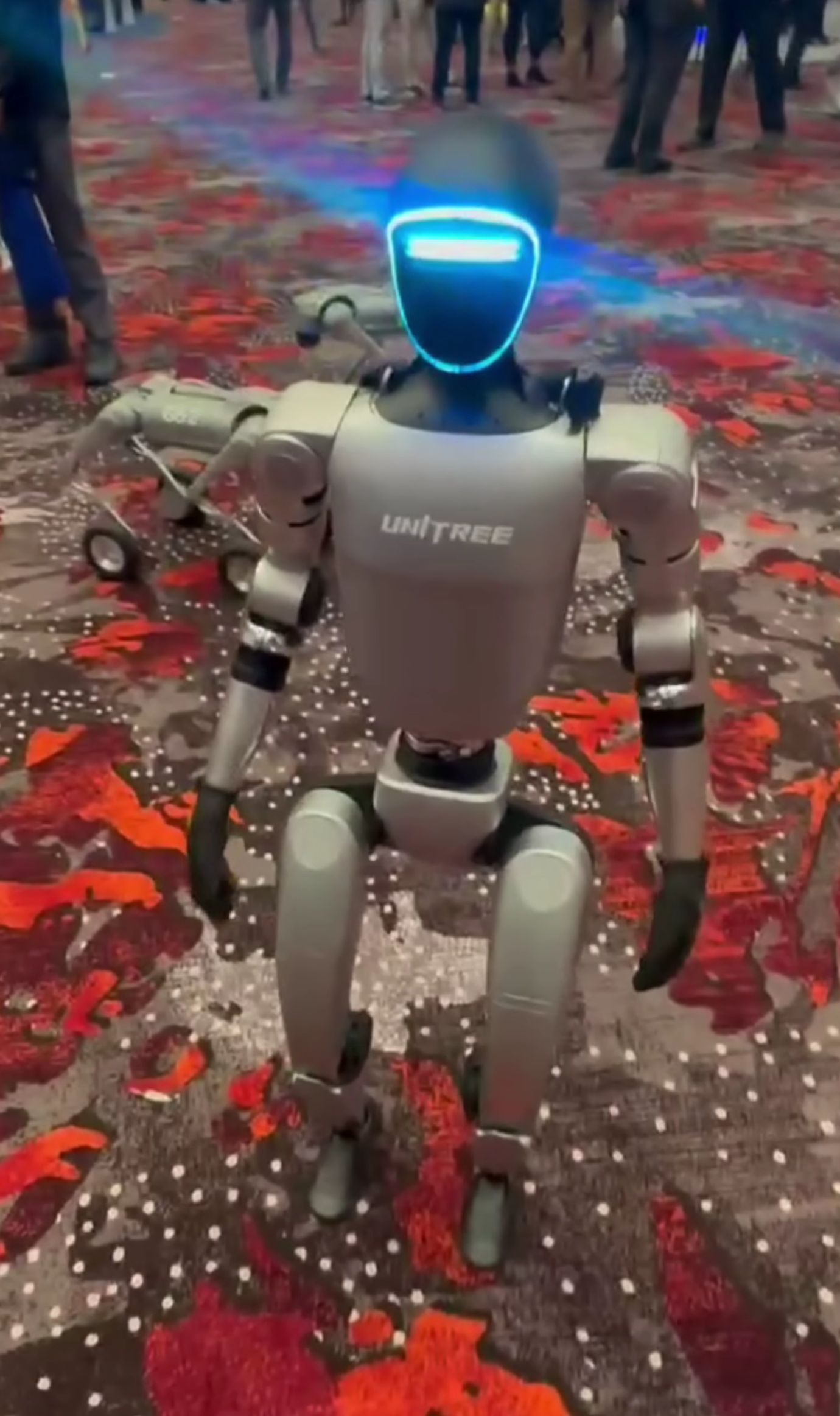
As of 2026-04-20 UTC, Unitree's most interesting AI-China signal is not that a Chinese robotics company can sell attention-grabbing humanoids at consumer-electronics prices. That part is already visible on the product page: G1 is presented as a "Humanoid agent AI avatar" with pricing from $13.5K, 23 to 43 joint motors depending on configuration, depth camera plus 3D LiDAR, a four-microphone array, speaker, Wi-Fi 6, Bluetooth 5.2, optional NVIDIA Jetson Orin on G1 EDU, and explicit secondary-development support.[4] The stronger signal is that Unitree is trying to wrap those machines in an open embodied-learning stack rather than leave them as impressive moving hardware.[1][2][3][4]
The public materials now point in one direction. Unitree's open-source page lists UnifoLM-VLA-0 as a Vision-Language-Action model for humanoid manipulation, describes manipulation datasets for G1 dexterous-hand, G1 gripper, and Z1 dual-arm scenarios, and links a LeRobot-based imitation-learning framework adapted to Unitree hardware.[1] The same page also describes UnifoLM-WBT-Dataset as an open-scene humanoid whole-body teleoperation real-machine dataset launched on March 5, 2026 with high-frequency rolling updates.[1] Read together, these are not isolated GitHub trophies. They are the parts of a loop: sell robots, collect demonstrations, convert data into trainable formats, fine-tune action policies, deploy back to real robots, and repeat.[1][2]
Image context: the cover avoids a rendered product shot. A photographed G1 is the right anchor because the article's claim depends on embodiment. Vision-language-action models do not become meaningful until camera frames, joint states, action chunks, latency, hands, batteries, and safety boundaries all meet in physical space.[4][6]
The product page already points past locomotion
G1's page is more revealing than a normal spec sheet because it does not stop at robot motion. It markets the robot as an agentic humanoid, says imitation and reinforcement learning are driving the technology forward, and names UnifoLM as a "Unified Robot Large Model" under the line "Robot world model, let's create it together."[4] That language matters. It shows Unitree trying to move the buying conversation from "how agile is this robot?" toward "what learning loop can this robot join?"
The hardware still constrains everything. A robot that weighs about 35 kg, runs around 2 hours on a quick-release 9000 mAh battery, and carries depth camera plus 3D LiDAR is not a cloud chatbot with legs.[4] It is a physical platform with power, sensing, torque, compute, and safety limits. Unitree's own caution that the humanoid industry remains in an early exploration stage is useful because it keeps the claim bounded.[4] The signal is not that G1 is suddenly a general household worker. The signal is that Unitree is exposing enough hardware, secondary-development surface, and training infrastructure for researchers and builders to treat the robot as a data-producing endpoint.
That is a different posture from pure hardware spectacle. The page's optional dexterous-hand degrees of freedom, Jetson Orin module, and secondary-development lane matter because VLA research needs precisely those bridges: controllable embodiment, perception, action interfaces, and a path for real-world testing.[4]
UnifoLM-VLA makes action the missing layer
The UnifoLM-VLA repository gives the strategy its clearest engineering shape. It defines UnifoLM-VLA-0 as a Vision-Language-Action model in the UnifoLM family, intended for general-purpose humanoid manipulation. The README says the model evolves from vision-language understanding toward an "embodied brain" through continued pre-training on robot manipulation data, then highlights stronger spatial perception, geometric understanding, and action generalization.[2]
The implementation details are as important as the slogan. The repo says code, model weights, training, inference, and checkpoints were released on January 29, 2026.[2] It lists CUDA 12.4 as the strongly recommended runtime, provides data-conversion paths from LeRobot format to HDF5 and RLDS, exposes model-server deployment code, and separates server-side action inference from a robot client that collects real observations.[2] That is the workmanlike part of the signal. Unitree is not only claiming that VLA models are the future. It is publishing the glue needed to move from collected demonstrations into a policy that can run against a real robot client.[2]
The project page supplies the benchmark and real-robot framing. On LIBERO, UnifoLM-VLA-0 is listed at 98.7 average across Spatial, Object, Goal, and Long suites, and the page says Unitree built a G1 real-robot dataset covering 12 categories of complex manipulation tasks.[3] Those numbers should be read with the usual benchmark caution; simulated task success and demo-page videos are not the same as unsupervised deployment in messy rooms. Even so, the structure of the disclosure matters. Unitree is placing benchmark claims, dataset structure, model weights, training scripts, and robot inference into the same public surface.[2][3]
Open datasets turn hardware volume into model leverage
The deeper AI-China implication is about data. Humanoid robotics has a brutal data problem: internet-scale video can teach appearance and language, but it does not automatically provide aligned joint trajectories, gripper states, force constraints, recovery behavior, or safe whole-body motion on a particular platform. OpenVLA's 2024 paper made the broader field legible by treating robot manipulation as a vision-language-action problem, not just a VLM problem that describes scenes.[5] Unitree's variant is narrower and commercially sharper: start from machines the company can manufacture, instrument, and sell, then make those machines the source of action data.[1][2][4]
That is why the open-source page's dataset list matters. G1 dexterous-hand, G1 gripper, Z1 dual-arm, and whole-body teleoperation datasets create a bridge between product hardware and model training.[1] The LeRobot-based project matters for the same reason: it adapts a known open training framework to Unitree's G1, Z1, and Dex3 hardware, giving teams a path from data collection to algorithm work, training, and real-machine deployment tests.[1]
If this loop works, Unitree's moat is not only actuator cost, agility videos, or a striking price point. It becomes a feedback system. More robots in labs create more demonstrations. More demonstrations improve policies. Better policies make the hardware more useful. More useful hardware attracts more developers and buyers. That loop is still early, fragile, and task-bounded, but it is a more serious AI story than viral locomotion clips alone.[1][2][3][4]
What to watch next
The next proof is not another backflip video. It is whether Unitree keeps turning physical usage into reusable learning infrastructure. Three signals matter most.
First, watch whether the UnifoLM-WBT-Dataset keeps receiving the rolling updates promised on Unitree's open-source page.[1] A static launch dataset would be useful; a living dataset tied to real robot operation would be more strategically important.
Second, watch whether UnifoLM-VLA's real-robot tasks widen beyond controlled manipulation categories into longer sequences with recovery, interruption handling, and cross-room context.[2][3] The moment a single checkpoint can stay reliable across task chains, the argument moves from demo competence toward operating-system value.
Third, watch whether G1 EDU and related developer configurations become the normal robotics-research baseline in China and abroad. The price point, Jetson option, depth sensing, LiDAR, microphone array, dexterous-hand option, and secondary-development support already make the platform legible to labs.[4] The missing question is whether enough builders standardize on it for Unitree's data and model layer to compound.
For now, the most defensible reading is narrow but important: Unitree is trying to convert a hardware lead into an embodied AI flywheel. In AI-China terms, that matters because it shifts the comparison away from chatbot leaderboards and toward a harder stack: physical products, open datasets, imitation-learning tools, VLA models, simulation and deployment code, and real machines that can keep generating the next training traces.[1][2][3][4][5]
Sources
- Unitree Robotics, "Official Open Source" - UnifoLM-VLA-0, manipulation datasets, Unitree imitation-learning/LeRobot framework, and UnifoLM-WBT-Dataset notes.
- Unitree Robotics, "unitreerobotics/unifolm-vla" GitHub repository - model description, January 29, 2026 release note, installation, data conversion, training, and real-world inference workflow.
- Unitree/Unigen, "UnifoLM-VLA-0: Vision-Language-Action Foundation Model" - LIBERO table and G1 real-robot experiment summary.
- Unitree Robotics, "Unitree G1" - product positioning, price, sensors, degrees of freedom, compute, battery, and developer-support specifications.
- Moo Jin Kim et al., "OpenVLA: An Open-Source Vision-Language-Action Model." arXiv, 2024 - broader VLA context for robotic manipulation.
- Wikimedia Commons, "Unitree G1.jpg" - source page for the real 2024 Unitree G1 expo photograph used as the article image.