As of 2026-04-05 UTC, the cleanest way to read SenseTime is no longer as a company trying to win one more large-model headline. The stronger public signal sits lower in the stack. SenseTime keeps publishing evidence that its durable product is a translation layer: SenseCore absorbs heterogeneous domestic compute and partner chips, SenseNova pushes model capability outward into cloud, on-premises, and edge packages, and the Hong Kong Cantonese rollouts show how that infrastructure can be localized into regional deployment surfaces.[1][2][3][4]
That matters because SenseTime does not have the simplest position in China's model race. It is not the clearest open-weight lab, not the most obvious consumer assistant, and not the easiest API brand to summarize in one line. My inference from the company's 2025 results, product releases, and deployment announcements is that it is solving a different problem. It wants to make an AI stack that stays usable when compute is heterogeneous, deployment has to move across cloud and edge, and customers care about local language, local regulation, or on-premises control as much as they care about benchmark theater.[1][2][3][4]
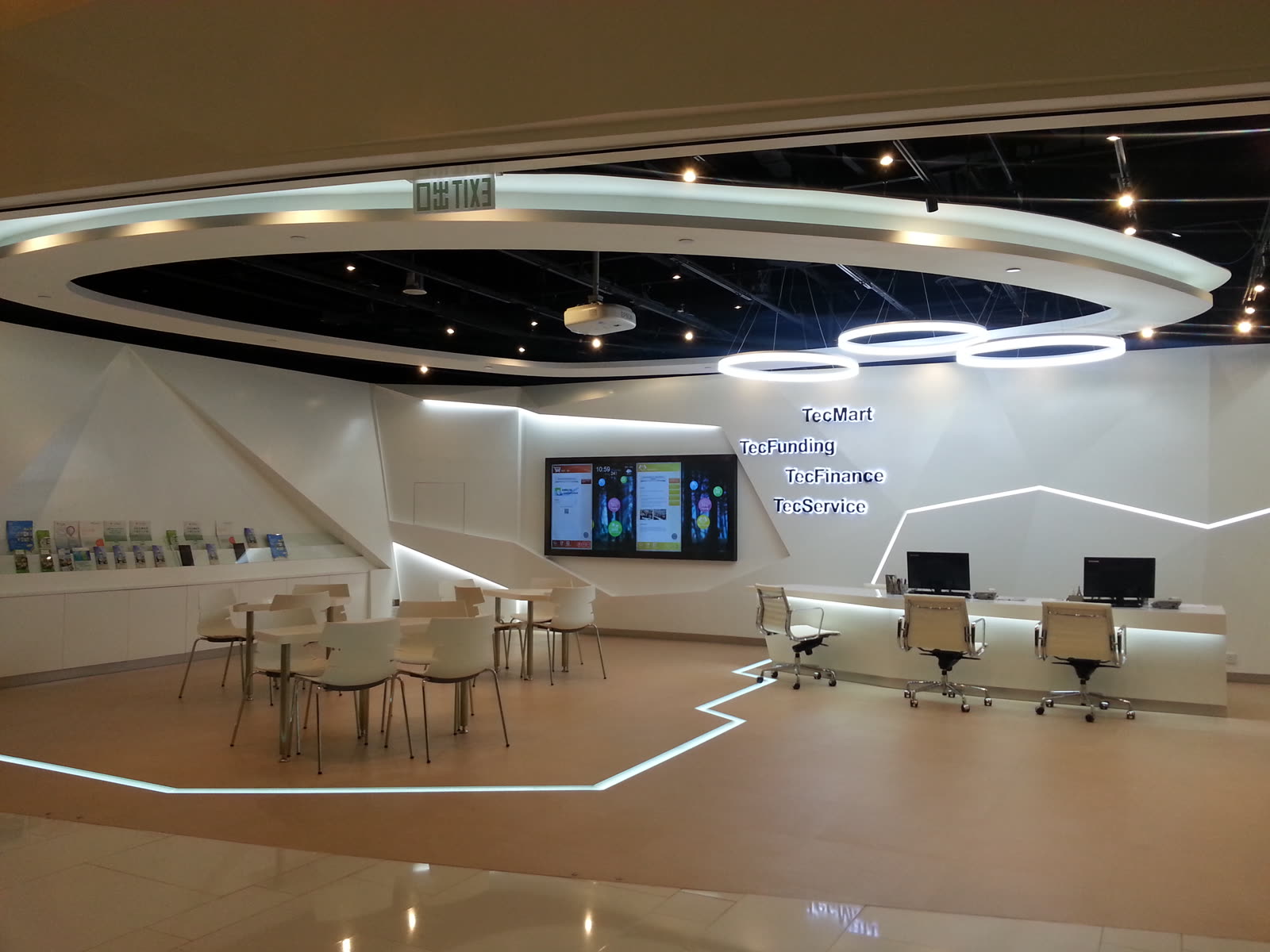
Image context: the cover uses a real Wikimedia Commons photograph of TecONE at Hong Kong Science Park. It works here because the article is about how a central model-and-infrastructure system narrows into a specific regional deployment surface, with local compute, local language, and local enterprise requirements all in view.[5]
1. The company is telling a chain story, not a single-model story
SenseTime's March 25, 2026 annual-results release is revealing because it does not present growth as model acclaim alone. The release says 2025 revenue passed RMB 5 billion, second-half EBITDA turned positive, and the company plans to launch a new foundational model based on its second-generation NEO architecture in Q2 2026.[1] Those are the headline items. The more interesting lines sit underneath them. SenseCore is described as a "key chain master" inside the domestic technology ecosystem, with partnerships spanning more than a dozen chip makers including Huawei Ascend, Hygon, and Cambricon, and total operational computing scale reaching 40,400 PFLOPS (FP16).[1]
That phrasing matters. A company that still wanted to be read mainly as a model vendor would center its case on benchmark deltas or one superstar endpoint. SenseTime's own release instead frames infrastructure coordination as part of the business model.[1] The stack is not being sold as compute on one side and models on another. It is being sold as a linked production system where model iteration, inference cost, and hardware sourcing can reinforce each other.
2. SenseCore's job is to normalize heterogeneous domestic compute
The November 19, 2025 SenseCore announcement makes this point more explicit. In the Frost & Sullivan and LeadLeo framing carried on SenseTime's site, SenseCore is presented as an AI-native cloud built from the ground up for AI workloads, not a retrofitted general cloud.[2] The concrete claims are the key part. SenseTime says SenseCore realized large-scale mixed training on a cluster of 5,000 domestic GPUs, reached up to 80% computing-power utilization, and achieved efficiency equal to 95% of homogeneous training.[2] The same announcement says the platform completed full adaptation with the Ascend 384 super node and established strategic cooperation with Cambricon.[2]
The significance is narrower than "SenseTime solved domestic AI infrastructure." It did not. The significance is that the company is making a public case for translation rather than purity. If the supply side were simple, homogeneous, and abundant, this layer would be less valuable. But when the practical compute surface includes multiple domestic chip families, multiple performance profiles, and non-trivial portability work, the platform that can smooth those boundaries becomes strategically important.[1][2]
This is where SenseTime begins to look less like a direct analogue of a model-first API lab and more like an operator of stack friction. The hard problem is not only training a strong model. It is keeping model development, inference, and deployment legible across compute that does not come from one perfectly standardized lane.
3. SenseNova 5.0 pushed that infrastructure outward into a cloud-to-edge matrix
The April 24, 2024 SenseNova 5.0 launch shows how SenseTime wanted to cash out that infrastructure advantage at the product layer. The company described SenseNova 5.0 as part of an industry-leading "Cloud-to-Edge" full-stack large-model matrix, then immediately paired the flagship model with an edge-side product matrix for terminal devices and an enterprise integrated large-model edge device for sectors such as finance, coding, healthcare, and government services.[3]
That packaging tells you what the company thinks the bottleneck is. SenseTime did not stop at saying that SenseNova 5.0 had stronger reasoning, coding, or multimodal capability.[3] It also emphasized edge inference speed, image-generation speed on device-class hardware, and dedicated enterprise devices meant to lower inference cost and deployment friction in regulated sectors.[3]
This matters for a supply-chain read because "cloud-to-edge" is not only a marketing phrase. It is a statement about how model value is expected to travel. A stack built on heterogeneous centralized compute becomes more defensible if the same company can shape where that capability lands next: cloud service, local device, enterprise appliance, or sector-specific package.[2][3] In other words, SenseTime is not only trying to own the model. It is trying to own the path the model takes into operational environments.
4. Hong Kong localization is the proof that the stack can narrow, not just scale
The November 22, 2024 HKSTP announcement is the most useful downstream proof point. SenseTime says it deployed the SenseNova Cantonese Large Model on HKSTP's high-performance computing service platform, calling it a milestone for local computing-center deployment and explicitly tying it to Hong Kong enterprises' needs.[4] The announcement also says data can be processed in the local cloud for compliance with corporate and regional data-processing regulations, while on-premises deployment remains available for both the Cantonese model and its RAG knowledge base.[4]
This is exactly the kind of evidence that makes a stack article stronger than a model article. A strong benchmark or demo can show that a model exists. It says much less about whether the model can be narrowed into a specific language register, a specific regulatory geography, and a specific enterprise deployment option. The Cantonese case does all three at once.[4]
It also clarifies why the earlier "cloud-to-edge" framing matters. SenseTime is not only building outward from one central cloud. It is showing that the stack can contract into locally bounded surfaces when language, regulation, or customer trust require it. That is a different competitive skill from merely raising the ceiling on a general model.
5. What this changes about how SenseTime should be watched
The resulting picture is more coherent than the older question "Can SenseTime win the general China model race?" SenseTime's public materials suggest that the better question is whether it can keep tightening a loop:
- secure or adapt heterogeneous domestic compute,
- turn that compute into a usable AI-native cloud,
- productize the model family across cloud, edge, and enterprise form factors,
- localize deployment into sector or regional surfaces where trust and compliance matter.[1][2][3][4]
That loop is more defensible than a one-quarter benchmark spike because every step can reinforce the others. Better infrastructure adaptation lowers the cost and friction of model iteration. A broader model matrix creates more places to monetize the infrastructure. Localized deployments make the stack harder to substitute with a generic public endpoint.
The boundary is clear too. Public evidence still does not prove that SenseTime has turned this architecture into the kind of default developer surface that Alibaba or ByteDance can sometimes claim. The company is stronger, in public, at showing integrated stack logic than mass-market habit.[1][2][3][4] That distinction matters. A chain is not the same thing as dominance.
But as a stack and supply-chain update, the article's strongest claim is narrower and sturdier than that. SenseTime looks most coherent when read as a company trying to translate constrained and heterogeneous compute into deployable AI surfaces. The model matters. The translation layer matters more.
Sources
- SenseTime, "SenseTime Group Reports Record High Revenue of Over RMB 5 billion in 2025; Second Half EBITDA Turns Positive" (March 25, 2026; 2025 revenue, NEO roadmap, SenseCore partnerships with domestic chip makers, and 40,400 PFLOPS operating scale).
- SenseTime, "Market Share No. 1! SenseTime SenseCore Ranks First Among China's AI Native Cloud Vendors" (November 19, 2025; AI-native cloud framing, 5,000 domestic GPUs, Ascend 384 adaptation, and Cambricon cooperation).
- SenseTime, "SenseTime launches SenseNova 5.0 with comprehensive updates and the industry-leading 'Cloud-to-Edge' full-stack large model product matrix" (April 24, 2024; cloud-to-edge matrix, edge-side products, and enterprise integrated large-model devices).
- SenseTime, "SenseTime Leads the Way in Deploying its Cantonese Large Model via HKSTP's High-Performance Computing Service" (November 22, 2024; local-cloud processing, on-premises deployment, and Hong Kong enterprise positioning for the Cantonese model).
- Wikimedia Commons, "File:TecONE at Hong Kong Science Park.jpg" (source page for the article image).