
As of 2026-04-12 UTC, the most useful way to watch Baidu AI Cloud's 40-second video "Baidu Digital Humans Now Blend General And Domain-Specific Expertise", published on October 10, 2023, is to stop treating it as a realism demo.[1] The faces matter, the lip movement matters, and the polished render certainly matters. But the sentence that changes the whole clip is in the title itself: general and domain-specific expertise are being fused inside one digital-human surface.[1]
That is a much narrower and more interesting claim than "our avatars look real." In 2026, the afterlife of Baidu's own materials makes that reading stronger. At Baidu AI Day on August 5, 2025, the company said its first batch of AI digital employees combined large models, digital-human technology, and industry know-how so they could work as marketing managers, repayment assistants, auto sales staff, recruiters, and other vertical operators.[2] A June 23, 2025 Baidu AI Cloud note, citing IDC's 2024 China AI digital-human market-share report, described Xiling as a full-modal platform covering 2D真人, 3D超写实数字人, voice cloning, 98.5% lip-sync accuracy, and deployments across 20+ industries with public, private, and hybrid-cloud options.[3] Put beside the 2023 clip, those pages suggest that Baidu was not chasing avatar novelty first. It was building a human-shaped service channel.
The non-entertainment cases make the point even clearer. Baidu's AI sign-language host case says the first version launched on November 24, 2021, and that the system later served live news and Winter Olympics coverage for hearing-impaired users while also extending to museum-guide work such as "文夭夭".[4] A later Baidu AI Cloud essay from December 2, 2024 argues that large models changed the economics of digital humans by shrinking 3D production cost from the million-RMB level toward the ten-thousand-RMB range and shortening production cycles from months toward hours.[5] My inference from the video and these follow-on sources is that Baidu wants the viewer to understand a digital human as a deployable front end: it looks like a person, speaks like a person, but its real value is that it can carry scripted expertise, live interaction, and workflow logic into a vertical business or service scene.[1][2][3][4][5]
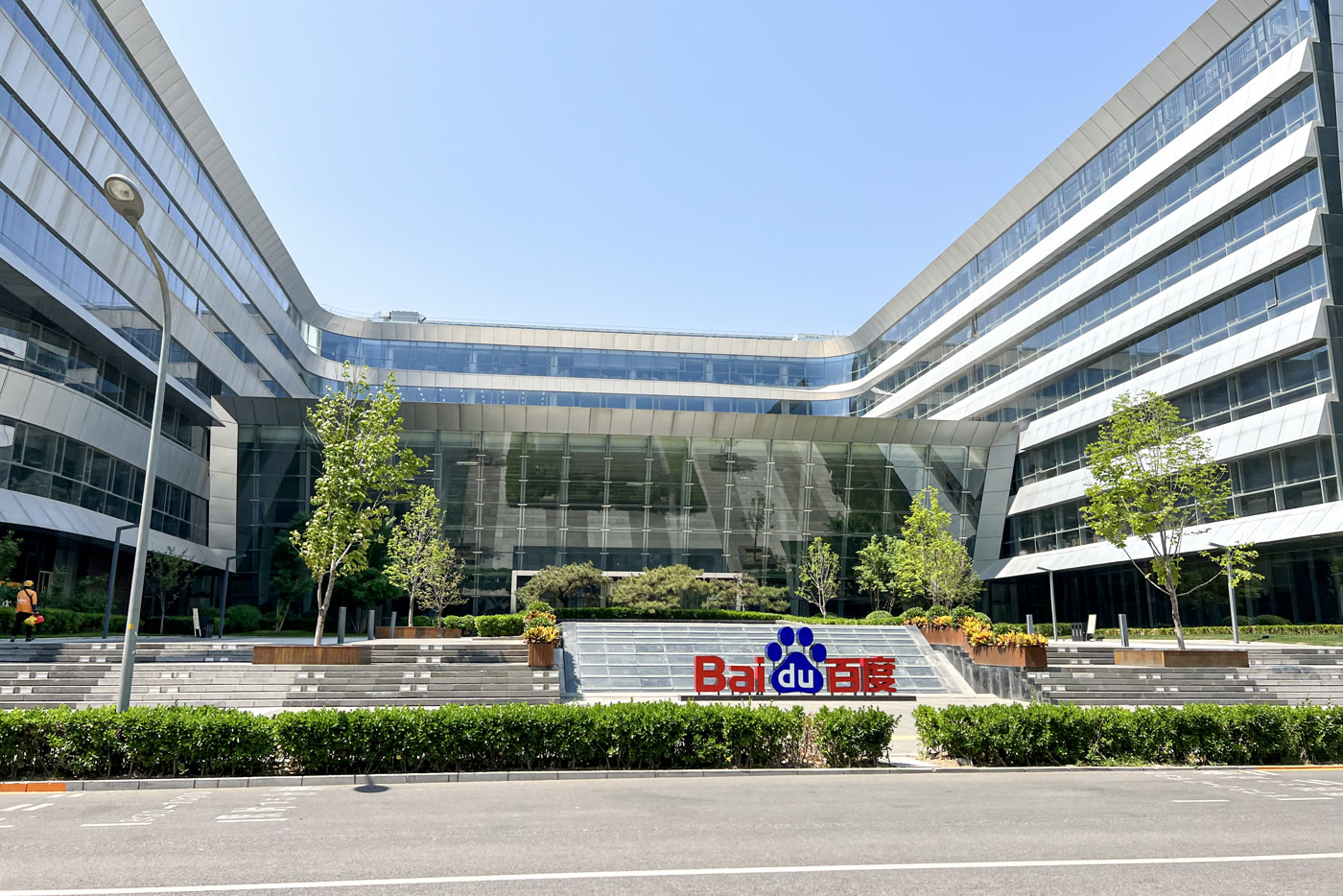
Image context: the cover uses a real Wikimedia Commons photograph of Baidu's ZPark Phase II campus in Beijing. That is the right visual here because the article is about a company-scale delivery strategy, not a fantasy avatar. The video's promise only matters if there is an institution behind it that can train, package, sell, and maintain these digital-human systems across multiple industries.[6]
Around 0:00 to 0:10, realism opens the door, but it is not the sale
The first seconds lean hard on face, voice, and surface polish.[1] That is not accidental. A digital human cannot become a service front if viewers reject it immediately as stiff or uncanny. Baidu's later market-share note makes this trust layer legible in operational terms: 4D scanning, 1200-dimensional facial restoration, film-grade rendering claims, high-fidelity voice cloning, and precise lip sync are presented as product fundamentals rather than decorative extras.[3]
But that is exactly why the video's most important argument is not realism alone. Realism is the entry ticket. It lowers resistance so the viewer can accept the next step, which is that this "person" can stand inside a business process. In AI-China terms, the avatar is not being sold as art. It is being sold as a usable interface that can inherit the authority, tone, and repetition demands of a company or institution.[1][3]
Around 0:10 to 0:22, the phrase "general and domain-specific expertise" turns an avatar into a worker
This is the hinge of the whole clip.[1] Once Baidu frames the digital human as a fusion of foundation-model breadth and vertical knowledge, the object stops being a mascot and starts looking like labor. The later AI digital employee launch makes that logic explicit. Baidu did not introduce one generic helper. It introduced role-shaped units with job descriptions: repayment assistant, recruiter, course consultant, auto sales, product manager, and marketing manager.[2]
That move matters because it answers a commercial question many digital-human demos avoid. Why should an enterprise buy a synthetic spokesperson instead of a chatbot, a call-center script, or a normal prerecorded video? Baidu's answer is that the digital human can sit where presentation, dialogue, and domain judgment overlap. It can explain, respond, escalate, persuade, and keep the interaction in a form people already recognize as service labor.[1][2]
Around 0:22 to 0:32, the e-commerce and culture examples reveal the route to market
The short video moves quickly across scenario hints rather than dwelling on a single benchmark.[1] That editing choice is revealing. Baidu is not trying to prove one task better than a rival model. It is trying to show that the same underlying stack can be skinned for commerce, cultural guidance, customer service, and public communication. The sign-language host case is especially important here because it widens the frame beyond obvious marketing scenes. Once the same family of tools can cover live news, sports interpretation, museum explanation, and accessibility services, the product stops looking like an ad-tech novelty and starts looking like a reusable interaction layer.[4]
This is where the article's main inference lives. Baidu seems to understand that digital humans succeed in China not when they imitate cinema, but when they attach themselves to existing service bottlenecks: staff shortage, repetitive explanation, 24/7 availability, multilingual or multimodal communication, and the need for one recognizable "face" across many channels.[2][3][4]
Around 0:32 to the end, production economics decide whether the digital human becomes infrastructure
The final seconds matter because a human-shaped interface is worthless if it remains too slow or expensive to deploy at scale.[1] Baidu's later materials keep returning to this exact point. The June 2025 Xiling note says 10 minutes can generate a 3D digital human, 2D clones have fallen to the hour level, scripts can become professional video in three steps, and the platform can be delivered through SaaS, components, or customized deployment across cloud environments.[3] The December 2024 essay describes the same direction in broader industry terms: large models are collapsing the cost and time barriers that once made digital humans feel like special-project toys.[5]
That is why this old short clip still matters in 2026. Its real subject is not avatar beauty. Its real subject is the conversion of avatar technology into an operational surface. Baidu is arguing that once the model has enough language ability, the voice layer has enough fidelity, and the production stack is cheap enough to repeat, the digital human can become a vertical service front: part spokesperson, part agent shell, part workflow endpoint. That is a meaningful AI-China story because it shows a different path from pure chatbot competition. Instead of asking one model to win everywhere, Baidu is trying to place human-shaped AI workers exactly where institutions already need repeatable presence.[1][2][3][4][5]
Sources
- Baidu Inc., "Baidu Digital Humans Now Blend General And Domain-Specific Expertise|Baidu AI Cloud," official YouTube video, published October 10, 2023.
- Baidu AI Cloud, "百度智能云AI‘打工人’天团上线,7款数字员工‘落地即上岗’" (August 6, 2025; AI Day launch of seven role-specific digital employees combining large models, digital-human tech, and industry know-how).
- Baidu AI Cloud, "市场份额第一!百度智能云曦灵实力领跑数字人行业" (June 23, 2025; IDC market-share note covering 2D/3D generation, 98.5% lip-sync accuracy, 20+ industries, and multiple deployment modes).
- Baidu AI Cloud, "AI手语主播" (official case page; the 2021 launch of Baidu's AI sign-language host, Winter Olympics coverage, accessibility service, and museum-guide extension).
- Baidu AI Cloud, "大模型重塑数字人产业新生态" (December 2, 2024; how large models compress digital-human production cost, shorten timelines, and expand interaction capability).
- Wikimedia Commons, "File:Baidu Technology Park at ZPark Phase II (20220502113650).jpg" (source page for the photograph used in this article).