
As of 2026-04-10 UTC, the useful way to watch BytePlus's 63-second video "SeedEdit 2.0 Pro" is to stop treating it as one more flashy image-model montage.[1] The clip does contain fantasy architecture, stylized portraits, and clean before-after reveals, but its editing grammar is much narrower than a general text-to-image ad. Nearly every shot is built around a bounded command: insert a house into the sky, add glasses and a hat, change a background, remove a foreground obstruction, alter a pose, rewrite product text, restyle an animal image, or turn a set of images into a more decorative collage.[1] The official description beneath the video says SeedEdit 2.0 Pro performs high-quality, precise image edits from text prompts and points viewers directly to a ModelArk documentation page rather than to a generic brand splash page.[1][2] That is the first clue about what the video is really selling.
The deeper clue comes from ByteDance's own research history. The original SeedEdit paper frames image editing as a balance problem between reconstruction and re-generation: preserve enough of the source image that identity and structure hold, but regenerate enough that the edit instruction actually lands.[4] The newer SeedEdit 3.0 launch note and technical report push the same line further, emphasizing better instruction following and stronger preservation of image content, including identity-like details on real image inputs.[3][5] Read against that background, the SeedEdit 2.0 Pro promo looks less like a general creativity pitch and more like a productization pitch. My inference from the video and the written sources is that ByteDance wants enterprise buyers to think of image editing as a menu of dependable operations rather than as an open-ended act of visual invention.[1][2][3][4][5]
That distinction matters in ai-china because Chinese model coverage often compresses visual systems into a familiar frontier race story: sharper outputs, more realism, more cinematic style, better benchmarks. This clip is doing something more commercially useful. It breaks image editing into discrete verbs that can be packaged inside workflow tools: preserve the person, change the apparel, rewrite the label, remove the object, keep the product shot, shift the style. In other words, the ad is not mainly about imagination. It is about control surfaces.[1][4][5]
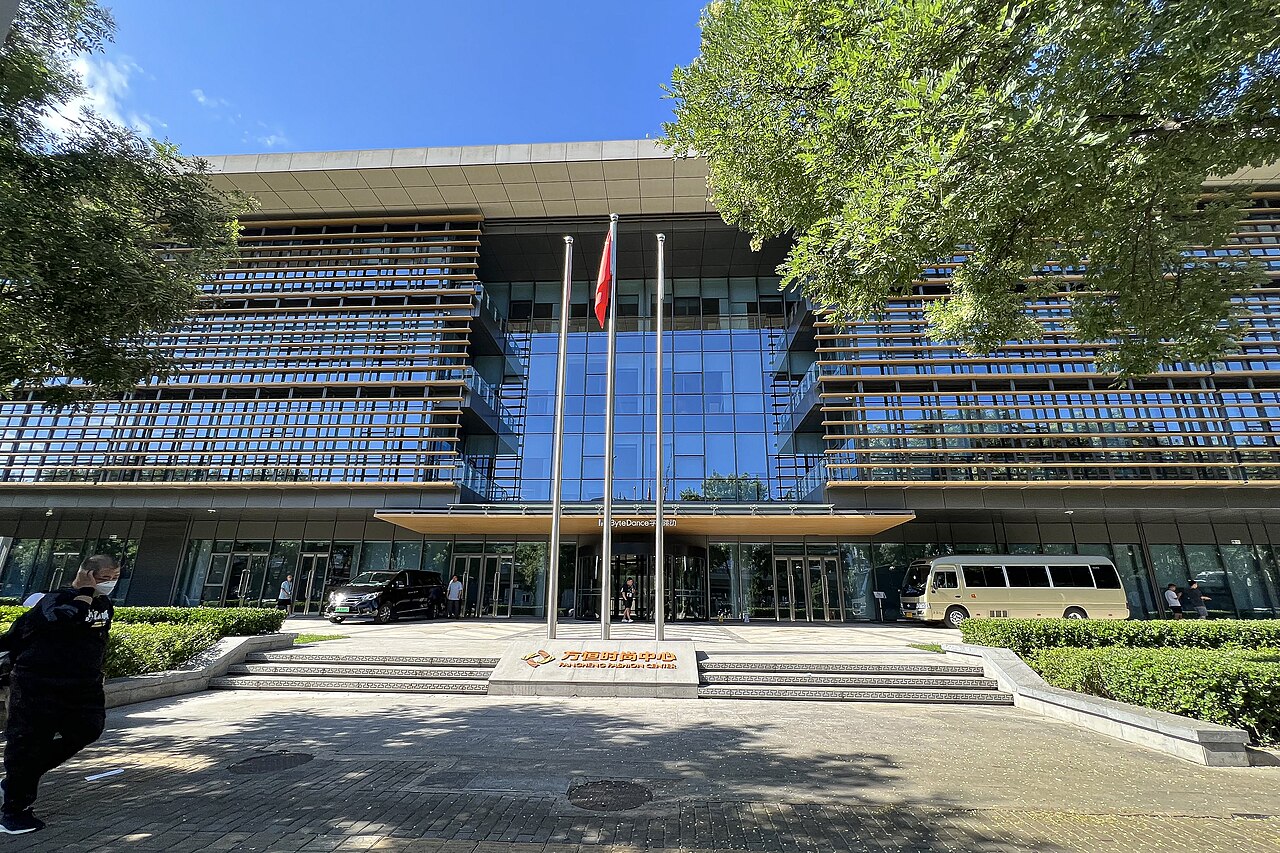
Image context: the cover uses a real Wikimedia Commons photograph of the Fangheng Fashion Center entrance in Beijing, a building marked for ByteDance offices. That is the right visual for this article because the promo is fundamentally about an entrance surface. The official video does not end on a benchmark table or an art reel. It ends by routing viewers toward a product entry point where the edit stack can be used, priced, and operationalized.[1][2][6]
In the first 15 seconds, the clip defines editing as controlled replacement rather than blank-sheet generation
The opening sequence is telling. After the SeedEdit title card, the video moves quickly through a city street scene and then a fantasy-style floating house composition.[1] What matters is not simply that the images look polished. It is that the transformations read like explicit commands applied to an existing frame, not like a free-form prompt wandering through possibility space. The viewer is being taught a behavioral contract: give the system a source image and a narrow instruction, and it should make a legible change without losing the frame's overall coherence.[1][4]
That matches the research framing closely. The 2024 SeedEdit paper does not describe image editing as a looser cousin of text-to-image generation; it describes it as a balancing act between keeping the source and regenerating enough for the requested change.[4] The promo compresses that whole technical problem into instantly readable edits. My inference is that BytePlus deliberately avoids showing a chaotic series of surreal prompts because surrealism is not the commercial proof it needs. The proof it needs is that viewers can glance at the before-after and immediately understand what operation was executed.
Around 15 to 35 seconds, character edits make identity preservation the real star
The strongest section is the portrait run. A stylized female character appears, then the video overlays a prompt cue about adding a hat and glasses, and moments later it shifts into a background-change example that pushes the same figure into a steampunk-style setting.[1] These are not random beauty shots. They are demonstrations of what enterprise users actually care about in image editing systems: can the subject remain recognizably the same while accessories, setting, and visual context change around that subject?
That is exactly where the written sources become useful. ByteDance's SeedEdit 3.0 launch note says the model improves both edit instruction following and preservation of image content such as ID-like details and fine structure, especially for real-world images.[3] The SeedEdit 3.0 paper makes the same claim more formally, stressing stronger preservation on real image inputs while improving instruction following.[5] So the portrait section of the video is doing heavier work than it first appears to do. It is not merely saying "we can stylize a pretty avatar." It is saying "we can hold the person stable while the editable slots around that person change." In product terms, that is a much more valuable promise.[1][3][5]
Around 35 to 50 seconds, removal, pose change, and text rewrite show why this is an operations demo
The middle-to-late stretch is where the video becomes unmistakably operational. One shot foregrounds removal by clearing a visual obstruction from a woman's portrait; another uses change pose on a male portrait; another rewrites the typography on a takeaway coffee cup; and another "mixture" example alters a product-like car image without abandoning the core shot.[1] This is the section that makes the whole promo snap into focus. BytePlus is not advertising a single monolithic creative model. It is advertising a set of named edit verbs that could easily become buttons, API modes, or workflow steps inside a commercial interface.
That is also why the ModelArk link in the official description matters.[1][2] The description does not simply say the model is beautiful or powerful. It sends viewers toward a product surface where the capability is meant to be consumed. In that context, the named operations in the video start to look like commercial packaging. Each one implies a user intention that can be turned into a reliable software affordance: clean up the image, change the styling, keep the identity, fix the layout text, adapt the same asset to another channel. The original SeedEdit paper's emphasis on stable editing over repeated revisions fits that reading well.[4] The commercial value lies in reducing editing to repeatable transforms, not in maximizing surprise.
The last 10 seconds make the sales motion explicit: restyle for breadth, then exit through the product door
The closing moments are brief but revealing. The video runs through a watercolor-style cat example and then a multi-panel collage of differently styled outputs before landing on a QR code and a website prompt that tells viewers to visit SeedEdit to learn more.[1] That ending is important because it clarifies the video's priority. If BytePlus only wanted a prestige reel, the clip could have ended on the most visually impressive frame. Instead it ends on an instruction to enter the product surface.
That move links the promo back to the larger ByteDance research arc. The SeedEdit papers are about making image editing more stable, more faithful to instructions, and better at preserving what should remain intact.[4][5] The video translates that research logic into product language: here are the edit operations, here is how cleanly they read, and here is where you go to use them.[1][2][3] In that sense, SeedEdit 2.0 Pro is worth embedding because it captures a specific AI-China pattern. The frontier story is still present, but the more important story is workflow packaging. ByteDance is taking a hard technical problem in image editing and turning it into a visibly legible enterprise surface built around control, preservation, and named operations rather than around pure generative spectacle.[1][2][3][4][5]
Sources
- BytePlus, "SeedEdit 2.0 Pro," official YouTube video, published June 6, 2025.
- BytePlus, "ModelArk" documentation page linked from the official SeedEdit 2.0 Pro video description.
- ByteDance Seed, "Image Editing" launch note for SeedEdit 3.0 - instruction following and image-content preservation framing.
- Peng Wang and colleagues, "SeedEdit: Align Image Re-Generation to Image Editing" (arXiv:2411.06686, November 2024).
- Peng Wang and colleagues, "SeedEdit 3.0: Fast and High-Quality Generative Image Editing" (arXiv:2506.05083, June 2025).
- Wikimedia Commons, "File:Fangheng Fashion Center with ByteDance markings (20220728154237).jpg" - source page for the photograph used as the article image.