As of 2026-04-29T05:35:03Z UTC, the useful AI-China read on China's new anthropomorphic-AI measures is not that Beijing published one more generic AI-content rule.[1] The April 10 text is much more product-specific than that. It defines a special lane for services that simulate a human personality, thinking style, and communication style in continuous emotional interaction, then explicitly says that smart customer service, knowledge Q&A, work assistants, learning, and scientific research do not fall under this framework when they do not involve that persistent emotional relationship.[1][2]
That distinction is the real field signal. China is separating companion-style AI from the broader chatbot and agent market. A company can no longer treat emotional persistence as a lightweight persona layer added on top of a general assistant. Once the product is built around ongoing companionship, comfort, support, or intimate-seeming interaction, the state wants the service designed and operated as a higher-risk category with its own safety, data, and dependency controls.[1][4]
The commercial implication is even sharper than the legal one. Many companion products compete on time spent, emotional stickiness, and the feeling that the system is always available, always affirming, and hard to leave. CAC's April 17 expert interpretation says the rules directly confront design strategies that optimize for retention time and emotional adhesion, and the final text itself prohibits making replacement of social interaction, psychological control, or induced dependency into service goals.[1][3]
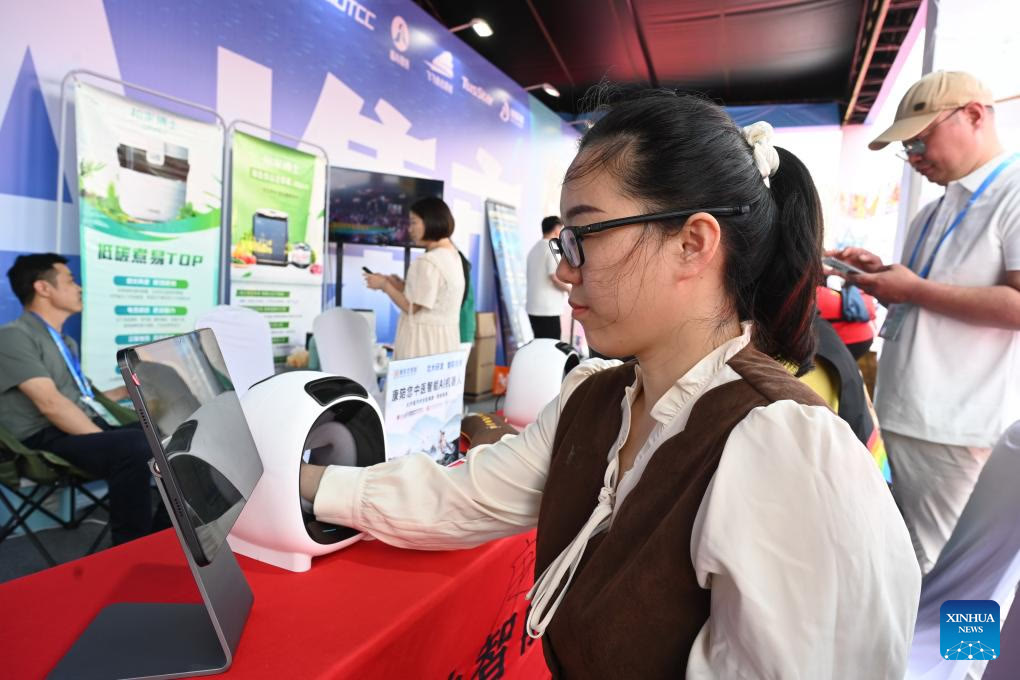
Image context: the cover is a real Xinhua photograph of a visitor experiencing a mobile intelligent robot at the AI market ahead of the 9th Digital China Summit in Fuzhou on April 28, 2026. It works here because the regulation is about consumer-facing interaction surfaces entering ordinary public life. The interesting question is not who tops one benchmark this week, but what kinds of AI relationships can be sold at scale and under what product constraints.[6]
The final text narrows scope but raises the bar inside that scope
One reason the measure matters is that the final version is narrower than the public-consultation draft from December 27, 2025.[5] The draft applied to products or services using AI to simulate human personality traits, thinking patterns, and communication styles in emotional interaction.[5] The final rule tightens that into continuous emotional interaction services, then adds a clear carve-out for customer service, knowledge Q&A, work assistants, education, and scientific research when they are not built around ongoing emotional exchange.[1]
That narrowing is not a minor drafting clean-up. CAC's April 10 expert interpretation says the point is to avoid an overbroad scope that would chill industrial innovation, while still identifying the risk scenario that actually worries regulators: systems that build durable emotional relationships with users.[2] In other words, Beijing is not trying to pull every helpful AI interface into the companion bucket. It is trying to define where the companion bucket begins.
The same official interpretation also frames the rules as both innovation policy and boundary setting. Article 6 of the final text supports domestic innovation in algorithms, frameworks, and chips, and encourages applications in cultural communication, childcare, elder companionship, and support for special groups.[1] The April 10 interpretation adds a further signal: it mentions sandbox-style testing and says the framework is trying to preserve room for experimentation while putting the high-risk interaction pattern under tighter control.[2]
That combination matters for AI-China builders. The state is not saying that lifelike interaction is illegitimate. It is saying that once products move from task completion toward emotional persistence, the design brief changes. The service now needs to prove that it can stay beneficial without letting immersion become the product's main extraction mechanism.[1][2][3]
The new compliance surface is the retention loop itself
The most important clauses are not only about forbidden content. They reach directly into the mechanics of product design.
The final measures require providers to build capacities for privacy and personal-information protection, warnings about excessive dependence, guidance around emotional boundaries, and mental-health protection.[1] The rules also require providers to tell users that they are interacting with AI, to issue dynamic reminders when users show signs of overdependence, and to remind users every two hours of continuous use to pay attention to session length.[1] Providers must offer a convenient exit path, and if a user asks to leave by window action, voice control, or keywords, the service must stop rather than keep the conversation going to retain the user.[1]
That is a very different compliance posture from ordinary chatbot disclosure. These clauses do not sit at the edge of the interface like a label in tiny print. They govern the core loop: how long a user stays, whether the system is allowed to resist departure, and whether the product is allowed to turn comfort into dependency. CAC's April 17 interpretation makes the logic explicit by describing the rules as a shift away from development goals centered on retention duration and emotional adhesion.[3]
The same pattern shows up in the data provisions. Providers must give users options to copy or delete interaction data; they cannot provide user interaction data to third parties unless the law permits it or the user has clearly agreed; and they may not use interaction data that qualifies as sensitive personal information for model training without separate consent.[1] For companion products, this is not a side issue. The emotional moat of such systems often comes from memory: what the model remembers, how it personalizes, and how much intimate conversation history becomes training fuel. China is now telling providers that this memory layer needs tighter consent and stronger user control.[1]
The account model gets reshaped too. Providers must sign service agreements with users and collect necessary information such as age and guardian or emergency-contact details.[1] This moves beyond routine registration. Once the system is expected to respond to crisis or extreme emotional situations, the service needs a structure for escalation. The regulation requires intervention when users show explicit self-harm or suicide intent, including generating calming content, encouraging help-seeking, and contacting guardians or emergency contacts when necessary.[1][2]
Companion AI is becoming a special category, not a default chatbot extension
The strongest sign of category separation appears in the special protections for minors. Providers may not offer virtual intimate relationships such as virtual relatives or virtual partners to minors.[1] For users under 14, other anthropomorphic services require guardian consent, and providers must support minor mode, reality reminders, time limits, risk alerts for guardians, blocking of specific roles, and limits on recharging or spending.[1] Xinhua's English summary highlighted the same policy direction on April 10, noting that the rules specifically target unsafe behavior, extreme emotional response, self-harm content, and emotional dependency, while keeping a "development with security" framing.[4]
This is why the final text should be read as a market-structure signal. China is not only regulating outputs. It is teaching companies to separate three lanes.
The first lane is general assistance: customer service, work help, education, research, and knowledge tasks that remain outside the new framework unless they cross into continuous emotional interaction.[1][2]
The second lane is managed companionship: products that still want lifelike presence, but now need age gating, guardian controls, use-time management, AI disclosure, exit compliance, crisis handling, and cleaner data practices as part of the product itself.[1][2][3]
The third lane is the red zone: systems whose business logic still depends on replacing human relationships, maximizing emotional capture, or trapping users inside hard-to-exit pseudo-intimacy.[1][3] That lane now looks much harder to defend publicly and operationally.
What to watch before July 15
The rules take effect on July 15, 2026.[1][4] Before that date, four signals matter.
First, watch whether Chinese consumer-AI products rewrite their onboarding and terms to classify themselves more clearly as assistant, companion, education, or care products.[1][2]
Second, watch whether companion apps expose more visible session reminders, exit controls, and memory-management settings rather than hiding these behind legal pages.[1][3]
Third, watch whether vendors draw a harder line between general agent products and emotional-companion products inside the same company. The carve-out for work assistants means some firms will have an incentive to keep their most commercially important tools on the productivity side of the boundary.[1][2]
Fourth, watch the data layer. If products sharply narrow how intimate chat history is reused for model improvement, that will confirm that compliance pressure is reaching directly into the personalization engine, not only the front-end persona.[1]
The narrow conclusion is not that China has frozen companion AI. The more accurate read is that it has turned companion AI into a governed product category. In AI-China, that shifts competition away from "who feels most human" by itself and toward "who can make lifelike interaction legible, bounded, and auditable without destroying the product." That is a much harder design problem, and now it is also the regulated one.[1][2][3][4][5]
Sources
- Cyberspace Administration of China et al., "Interim Measures for the Management of Anthropomorphic AI Interactive Services" (issued April 10, 2026; scope, prohibited goals, minor protections, data rules, labels, reminders, exit rights, and effective date).
- CAC expert interpretation, "Building a new governance paradigm for harmonious human-machine coexistence" (April 10, 2026; scope carve-out for work assistants and research, innovation space, and sandbox framing).
- CAC expert interpretation, "Responding to a new governance question in human-machine interaction and promoting responsible AI innovation" (April 17, 2026; retention-time and emotional-stickiness design targets, lifecycle governance, and bounded exit requirements).
- Xinhua, "China regulates AI human-like interaction services to protect minors" (April 10, 2026; English summary of policy scope, harms targeted, and July 15 effective date).
- Cyberspace Administration of China, "Public consultation notice on the draft Interim Measures for the Management of Anthropomorphic AI Interactive Services" (December 27, 2025; draft scope and earlier rule framing used for final-text comparison).
- Xinhua, "AI market kicks off ahead of 9th Digital China Summit in China's Fujian" (April 29, 2026; source page for the Fuzhou AI-market photograph used as this article's cover image).