An industry has crossed a threshold when it needs more than founders, researchers, and product names. It needs job definitions. On July 1, 2026, China's Ministry of Human Resources and Social Security opened consultation on a group of proposed additions to the national occupational classification. Two choices reveal where the country's AI economy expects work to accumulate: embodied-intelligence robot application technician would become a standalone occupation, while AI agent developer would become a new work type beneath an existing occupation.[1][2]
The distinction is more useful than another estimate of how many jobs AI will create or erase. It separates two deployment problems at different levels of specificity. The proposed agent-developer label signals a software application specialty, but the schedule supplies no separate task list. The robot role is defined concretely: an application technician makes a physical system function in a particular warehouse, factory, shop, or care setting through data collection, model adaptation, on-site integration, testing, monitoring, and maintenance.[1] Neither role is simply “AI researcher, but junior.” Both sit between a model release and reliable work.
As of August 6, 2026, the status boundary matters. The July consultation closed on July 17, but the official sources cited here do not show a later final notice incorporating these titles into the national classification. This brief therefore treats them as proposed classifications, not completed standards or guaranteed policy benefits. Naming a role does not prove that employers need it at scale, that training is good, or that the job pays well. It does show which missing capabilities the state and industry want to make legible.
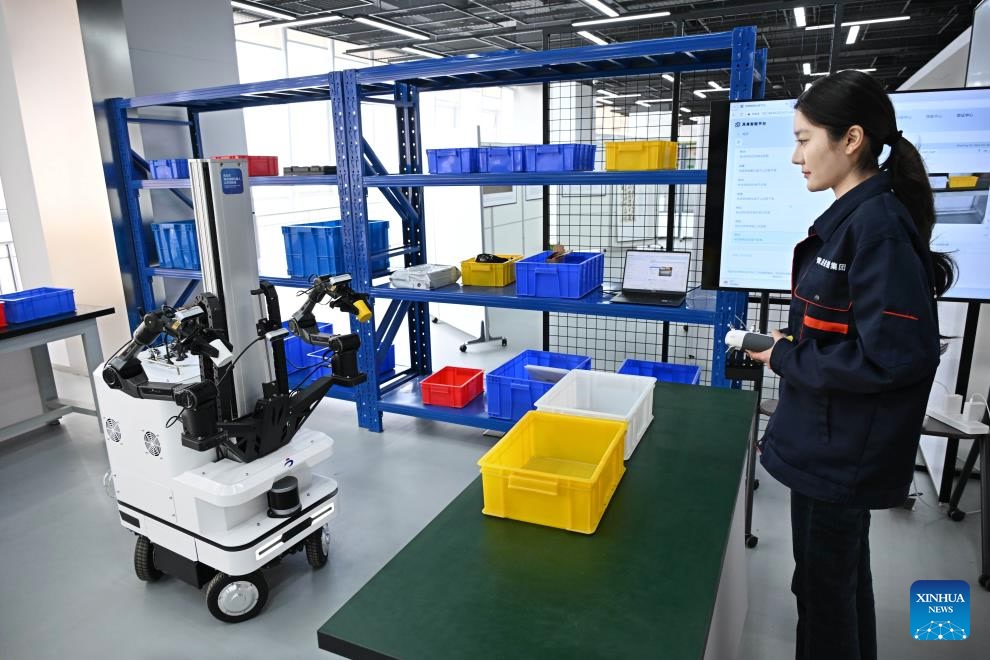
Image context: the cover is a real photograph of a trainer supervising a humanoid robot in a warehouse scenario at a Qingdao public training center. It shows the situated work behind embodied-AI deployment: a person, a machine, a task environment, and an observable result.[7]
The hierarchy is the signal
China's occupational system distinguishes an occupation from a narrower work type nested inside one. That makes the placement of AI agent developer consequential. In 2024, the ministry added “generative artificial-intelligence system application worker” to the national list.[5] The 2026 proposal does not discard that application category or elevate every agent builder into a new profession. It defines agent development as a more specific branch within it.[1]
That nesting describes a market moving from general access to specialization. The 2024 category could cover people applying generative systems across many tasks. At most, the proposed work type signals a narrower specialty within that application layer. It would be premature to turn the label into an official list of model, tool, knowledge, workflow, or control duties: the proposal does not give agent developer a separate task list, and it does not settle what counts as an agent. A later standard could define those boundaries.
The embodied-robot role is structurally different. It is proposed as its own digital occupation, with code 4-04-05-16, rather than a subtype of the existing generative-AI application role. Reporting on the consultation describes work already being performed at Leju Robotics in Shenzhen: collecting multimodal interaction data and deploying and debugging robot software and hardware on site. The official schedule extends the role across collection design, data handling, model fine-tuning and adaptation, installation and calibration, safety and task validation, performance monitoring, fault diagnosis, maintenance, and technical documentation.[1][2]
This is not semantic housekeeping. It draws a boundary between inventing a robot, manufacturing one, operating an older fixed industrial robot, and adapting an embodied system whose perception and behavior may keep changing after it reaches a real environment. The application technician owns the last-mile interface between model, body, site, and task. That is where a polished demonstration meets uneven floors, unfamiliar packaging, bad lighting, network loss, safety zones, and the customer's actual process.
The job description mirrors the deployment bottleneck
The proposed role makes more sense beside China's 2026 embodied-intelligence field program. In June, the Ministry of Industry and Information Technology and the State-owned Assets Supervision and Administration Commission told participating provinces and central enterprises to build real-world training spaces, form application consortia, develop reusable task-skill packages, verify performance, and move successful systems into routine deployment. The program aims to identify more than 100 high-value scenarios and support deployment capacity at the 10,000-unit scale by the end of 2026.[3]
The notice is unusually concrete about the work between lab and site. It calls for full-body trajectories, force-position curves, action sequences, environmental semantics, abnormal-condition data, model compression, edge deployment, collision detection, emergency braking, and validation of success rate, efficiency, reliability, safety, and economics. It also asks for operating guidance covering environment adaptation, deployment verification, routine maintenance, responsibility, and emergency response.[3]
Those tasks do not belong to a single frontier-model team. They require people who can move among teleoperation, data quality, model behavior, robot hardware, site operations, and safety evidence. The occupation proposal is therefore a lagging indicator and a policy instrument at once. It recognizes work that training centers and integrators already do, then offers a route for turning that work into a portable skill vocabulary.
Industry has begun filling the gap before a national standard exists. Workers' Daily reported that Leju Robotics and the education and examination center under the industry ministry published a three-level capability standard in April, with role duties and training hours by level.[2] That is evidence of demand for structure, not yet evidence that one company's framework should become the national template. The hard question is whether a future standard can travel across robot bodies, control stacks, and industries without becoming either vendor-specific or so generic that it measures little.
A job code can move training before it moves wages
Occupational classification matters through a chain: a title can lead to a national standard; the standard can define skill levels and assessment; schools and training providers can design courses around it; employers can use it in hiring and promotion; and public systems can count the work more consistently. The ministry's July 3 summary says the proposed occupations would enter the official classification after consultation and that national standards would then guide vocational education, skills training, and talent assessment.[8]
Parts of that pipeline are already moving. China's Ministry of Education added more programs to its 2026 vocational-education catalog, including embodied-intelligence computing and humanoid-robot engineering at the vocational-bachelor level, as well as agent-communication technology at the higher-vocational level. The ministry positioned these additions as a response to changing occupational and industrial demand.[4]
Shanghai's 2026 digital-technology engineer review offers a useful adjacent lane. It includes embodied intelligence within the robotics field for professionals working on robot datasets, models, agents, related hardware and software, training, testing, and standards.[6] That engineer track and the proposed application-technician occupation need not compete. Together they suggest a ladder from research and system design to field integration and continuing operation. The labor market becomes easier to navigate if each rung has a distinct evidence standard.
The danger is credential theater. A fast-moving field can outrun a fixed syllabus; a course can teach one vendor's interface and call it a profession; an assessment can reward vocabulary without testing whether a candidate can diagnose drift, document a safety boundary, or recover a failed deployment. A useful national standard would therefore test artifacts and outcomes: an agent evaluation packet, a permission design, a robot data record, a deployment checklist, a validated task, a maintenance log, and a documented escalation path.
The market claim still has to be earned
The strongest reading of the proposal is not “AI has created two jobs.” It is that China's AI policy is beginning to classify the human complements required after models and robot bodies exist. That is a more modest claim, and a more testable one.
Four signals would show that the taxonomy has acquired market force:
- Final definitions: a formal notice preserves clear boundaries among AI engineering, agent application, robot training, system integration, operations, and maintenance.
- Assessable standards: competency levels require live troubleshooting, safety and privacy controls, evaluation evidence, and human-handoff design—not only course attendance or a written test.
- Portable training: schools, employers, and independent evaluators recognize comparable skills across vendors and industries, with apprenticeships or field hours tied to real systems.
- Employer adoption: job postings, pay bands, promotion ladders, service contracts, or procurement requirements begin using the classifications and rewarding verified capability.
The falsifier is equally clear. If employers continue hiring under unrelated titles, credentials remain vendor-bound, and trainees cannot convert certificates into better work or pay, the new labels will function mainly as policy vocabulary. If they do travel, the classification will have done something more consequential than predict the future of labor. It will have made the deployment layer visible enough to train, test, hire, and hold accountable.
Sources
- Ministry of Human Resources and Social Security of the People's Republic of China, “关于对拟发布船舶岸基管理工程技术人员等职业信息进行公示的公告” (July 1, 2026; official consultation notice and attached proposed occupation and work-type definitions).
- Workers' Daily via Xinhua, “12个新职业集中发布:产业‘风向标’如何指引人才供给新方向?” (July 22, 2026; field duties, industry capability standard, and training implications).
- Ministry of Industry and Information Technology and State-owned Assets Supervision and Administration Commission, “关于联合开展2026年度人形机器人与具身智能实景实训专项行动的通知” (June 8, 2026; official field-training, validation, safety, and deployment program).
- Ministry of Education of the People's Republic of China, “教育部职业教育与成人教育司负责人就2026年《职业教育专业目录》专业增补答记者问” (July 16, 2026; vocational-program additions and their occupational rationale).
- Ministry of Human Resources and Social Security of the People's Republic of China, “人力资源社会保障部、国家市场监督管理总局、国家统计局联合发布生物工程技术人员等19个新职业” (July 31, 2024; official addition of the generative-AI system application occupation and classification process).
- Shanghai Municipal Human Resources and Social Security Bureau, “关于开展2026年度机器人、智能制造、物联网、工业互联网、增材制造方向工程师职称评审工作的通知” (May 11, 2026; embodied-intelligence scope in the digital-technology engineer track).
- Xinhua, “Trainers of embodied AI emerge as new profession in Qingdao, China's Shandong” (April 23, 2026; photographic record of trainers working across warehouse, manufacturing, service, and data-processing scenarios).
- Ministry of Human Resources and Social Security of the People's Republic of China, “12个新职业向社会公示” (July 3, 2026; official summary of the consultation, classification path, and planned national standards).