As of 2026-04-14 UTC, the cleanest way to read Baidu's current AI position is to stop looking only for the next model headline. Baidu's own documentation now keeps pointing to a thicker product shape on Qianfan: the platform is framed as a large-model service and agent-development surface, the update log keeps shipping features above raw inference, and several separate docs now describe how agents, tools, parsing, and callable assistants fit into one lane.[1][2]
That shift matters because it changes where Baidu is trying to hold the customer. A model can be swapped more easily than a work surface that already bundles API keys, parsing, tool access, report generation, and application-level endpoints. My inference from the public docs is that Baidu no longer wants Qianfan read mainly as a model catalog. It wants Qianfan read as the managed place where enterprise agent work is prepared, equipped, executed, and billed.[1][2][3][5][6][7]
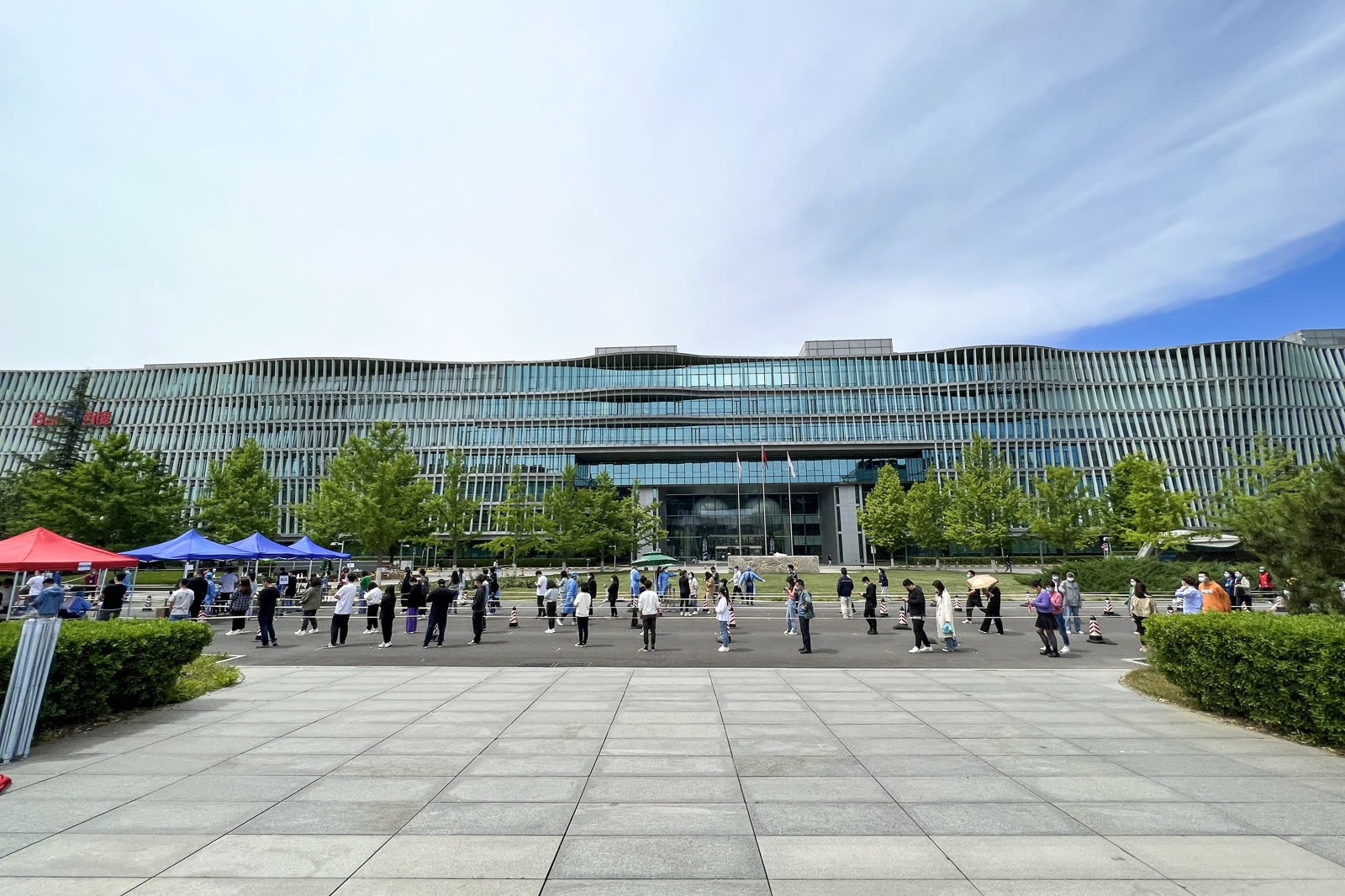
Image context: the cover uses a real Wikimedia Commons photograph of Baidu's Shangdi headquarters in Beijing. That is the right visual here because the article is about Baidu's company-level effort to package agent work into a controlled product lane, not about a free-floating benchmark or a generic chatbot screenshot.[8]
The recent signals are landing above the model layer
The 2026 update log is revealing because its most important entries are not only new weights.[2] On 2026-02-13, Baidu said the OpenClaw experience page had gone live, supporting one-click configuration of Qianfan models and official Skills for first deployment.[2] On 2026-03-13, Baidu said the AI Assistant was upgraded to an intelligent dispatch mode with general and image question-answering, and it also highlighted a Baidu Search MCP tool tuned for real-time retrieval under the MCP protocol.[2] On 2026-01-23, the Deep Research surface gained report-draft export plus a choice between performance-first and quality-first generation modes.[2] On 2026-02-05, Deep Research was commercialized at RMB 2.5 per call, with a free usage allotment for each account.[2]
Taken together, those entries describe a company adding control points around the model layer rather than merely adding more model names. The commercial object is becoming clearer: model access sits inside a broader lane that includes shell distribution, specialized tools, parsing, and premium report generation.[2]
That distinction is important for ai-china because it moves Baidu's strategy into a category where switching costs usually deepen. Once an enterprise workflow is organized around one provider's parsing pipeline, first-party tools, assistant endpoint, and report surface, the competitive question is no longer just whose base model scored higher last week.
OpenClaw is revealing because Baidu hosts the shell on Baidu rails
The OpenClaw deployment docs make that product direction unusually concrete.[3] Even though the page is written as a Feishu-bot tutorial, the strategically important part happens before Feishu enters the story. Baidu tells users to go to the Qianfan OpenClaw console, click quick deployment, choose a model, configure or create an API Key, and install agent Skills directly inside that flow.[3] The same doc says Qianfan currently provides 7 skills that can be selected during deployment.[3]
That is not the posture of a provider treating agent shells as something that lives entirely outside its own platform boundary. Baidu is willing to let users work through an open shell, but it wants that shell provisioned from the Qianfan console and paired with Baidu-managed credentials and skills.[3] The lock-in point is subtle. It is not "you may only use our native chat interface." It is "you may use the shell, but the shell becomes more convenient once it is attached to our keys, our skills, and our deployment surface."
The update log reinforces that reading. Baidu explicitly described OpenClaw's quick experience as supporting one-click configuration of Qianfan models and official Skills, and tied that to an onboarding incentive for new users.[2] That language is pure distribution strategy. Baidu is not only selling a model endpoint. It is trying to make first contact with agentic coding happen on its own control plane.
First-party tools are where Baidu is trying to make the lane sticky
A separate Baidu doc exists just to explain how to call official tools in OpenClaw.[4] That is a product signal by itself. It implies Baidu expects the shell to sit on top of a first-party tool hub rather than to operate only as a thin wrapper over generic external APIs.[4]
The official-tools catalog shows what Baidu wants that tool layer to look like in practice.[5] The tools are not vague "capabilities." They are priced work products. On the Baidu Wenku / Netdisk side, the catalog lists Baidu Netdisk AI Video Notes at RMB 0.0012 per second, Baidu Wenku Smart PPT Outline at RMB 0.1 per call, Baidu Wenku Smart PPT at RMB 3 per call, Baidu Wenku AI Long-form Outline at RMB 0.1 per call, Baidu Wenku AI Long-form at RMB 2.5 per call, and an agent version of Smart PPT at RMB 2.5 per call.[5]
That pricing page is one of the clearest clues in the dossier. It shows Baidu trying to turn document work, report generation, and content assembly into metered components inside the same Qianfan lane.[5] In other words, Baidu is not only offering intelligence. It is offering finished office-style outputs as callable services. Once that happens, the strategic unit shifts from "which model should I query?" to "which provider already owns my report, slide, note, and long-form generation path?"
The update log fills in the same picture from another angle. In late January and February, Baidu was separately promoting AI paper, AI search, MCP search, and instruction-to-PPT flows, often in language that emphasized direct console access, export, and production utility rather than research novelty.[2] The company is steadily surrounding the core model with practical surfaces people can bill against.
The substrate below the shell is also being productized
The strongest managed-platform stories are not built from shells and tools alone. They also need a data-preparation layer beneath them. Baidu's Knowledge Base Advanced Parsing page is important for that reason.[6]
The page says advanced parsing adds deep document parsing for charts and formulas, multimodal parsing through VLM image understanding and ASR audio parsing, plus knowledge enhancement and knowledge-graph construction.[6] It also makes the commercialization boundary explicit: the service is billed per successful standard page, priced at RMB 0.4 per standard page, and the fee applies to files newly imported or re-parsed after 2026-03-19.[6]
That is not just a back-office detail. It means Baidu has productized the retrieval substrate under agent applications.[6] Parsing is no longer an invisible preprocessing step that customers must design entirely for themselves. It becomes a paid, standardized layer inside the same platform that also offers assistant endpoints and official tools. That raises the chance that Qianfan can hold the workflow even when the chosen model shifts over time.
AI Assistant and Deep Research turn the lane into an application surface
The AI Assistant Conversation API makes the top layer more explicit still.[7] Baidu exposes a dedicated endpoint at https://qianfan.baidubce.com/v2/agent/ai_assistant/run, says it is used to converse with the AI Assistant agent, and documents three modes: intelligent dispatch, general QA, and image QA.[7] The doc also makes the access boundary clear: the API is called with API Key authentication.[7]
That matters because it turns assistant behavior into a programmable surface rather than a console-only demo.[7] If a company can call Baidu's assistant layer directly, while also using Baidu's parsing, official tools, and OpenClaw deployment lane, then Qianfan starts to look less like a loose bundle of services and more like a vertical application stack.
Deep Research sits one rung higher in the same ladder. Baidu's January updates added draft export, source-to-body traceability in the report draft, and a split between performance-first and quality-first modes, with the faster mode capping search depth and the deeper mode spending more time on multi-round generation.[2] Then Baidu commercialized the feature in February.[2] That is a strong signal because research reporting is a higher-value task than generic chat. Baidu is using it to show that Qianfan can monetize not just tokens, but finished analytical work.
What this changes about Baidu's AI-China position
Public docs do not prove that Baidu has already won durable enterprise usage. They cannot tell us how deep real customer adoption runs, how often the first-party tools outperform specialist vendors, or how much of the workflow still gets rebuilt in customer middleware. Those are real boundaries.
Even so, the documentation does support one narrower conclusion. Baidu's stronger 2026Q2 move is to assemble a managed agent lane on Qianfan.[1][2][3][4][5][6][7] The lane has a recognizable shape:
- platform framing and update cadence at the top,[1][2]
- OpenClaw deployment with model, API-key, and skills provisioning,[2][3]
- first-party tools for search, research, notes, slides, and long-form outputs,[4][5]
- advanced parsing and knowledge processing beneath those tools,[6]
- and callable assistant/report surfaces at the application layer.[2][7]
That stack does not eliminate model competition. It does something commercially more interesting. It moves Baidu's center of gravity from isolated model access toward the managed workflow around that access. In ai-china, that is often the more durable place to watch.
Sources
- Baidu Cloud Docs, "平台简介" for 百度千帆·大模型服务及Agent开发平台 (platform framing for Qianfan as a large-model service and agent-development platform).
- Baidu Cloud Docs, "更新动态" for 百度千帆·大模型服务及Agent开发平台 (2026 update log covering OpenClaw quick experience, Deep Research, AI Assistant, MCP search, and related application-layer changes).
- Baidu Cloud Docs, "千帆 OpenClaw 接入飞书机器人教程" (quick deployment flow for OpenClaw on Qianfan with model selection, API Key configuration, and skill installation).
- Baidu Cloud Docs, "如何在OpenClaw调用官方工具" (official documentation showing OpenClaw as a shell for Qianfan's first-party tools).
- Baidu Cloud Docs, "官方工具" (official tool catalog and pricing for Baidu Wenku, Baidu Netdisk, and related callable outputs).
- Baidu Cloud Docs, "知识库高级解析" (advanced parsing features including chart/formula parsing, VLM image understanding, ASR audio parsing, and knowledge-graph construction, plus pricing).
- Baidu Cloud Docs, "AI助手对话" (AI Assistant API endpoint, API-key authentication, and intelligent-dispatch/general/image-QA modes).
- Wikimedia Commons, "File:Baidu headquarters at Shangdi (20220509111950).jpg" (source page for the real headquarters photograph used as the cover image).