As of 2026-05-12 UTC, the most useful way to read Baidu's May 9, 2026 release of ERNIE 5.1 is to start one layer above the benchmark table. The official post does repeat the now-familiar efficiency line: ERNIE 5.1 inherits the ERNIE 5.0 pre-training foundation, compresses total parameters to roughly one-third, active parameters to roughly one-half, and claims flagship-grade performance at only about 6% of the pre-training cost of comparable models.[1] But the bigger shift is where Baidu chooses to spend that efficiency in public. The same note moves immediately into Arena Search, agent evaluation tasks, AIME26 with tool use, and hands-on access through ERNIE Bot and an AI Studio playground.[1]
That packaging matters because it changes the meaning of 5.1 relative to the earlier April 30 preview note. The preview was still centered on LMArena Text and category tables, with the compression claim attached as the deeper technical hook.[2] The official release turns the same compressed lane into a more specific company story: Baidu wants 5.1 to be understood as a model that belongs on top of search, agent workflows, and developer-facing product surfaces, not only inside a leaderboard screenshot.[1][2]
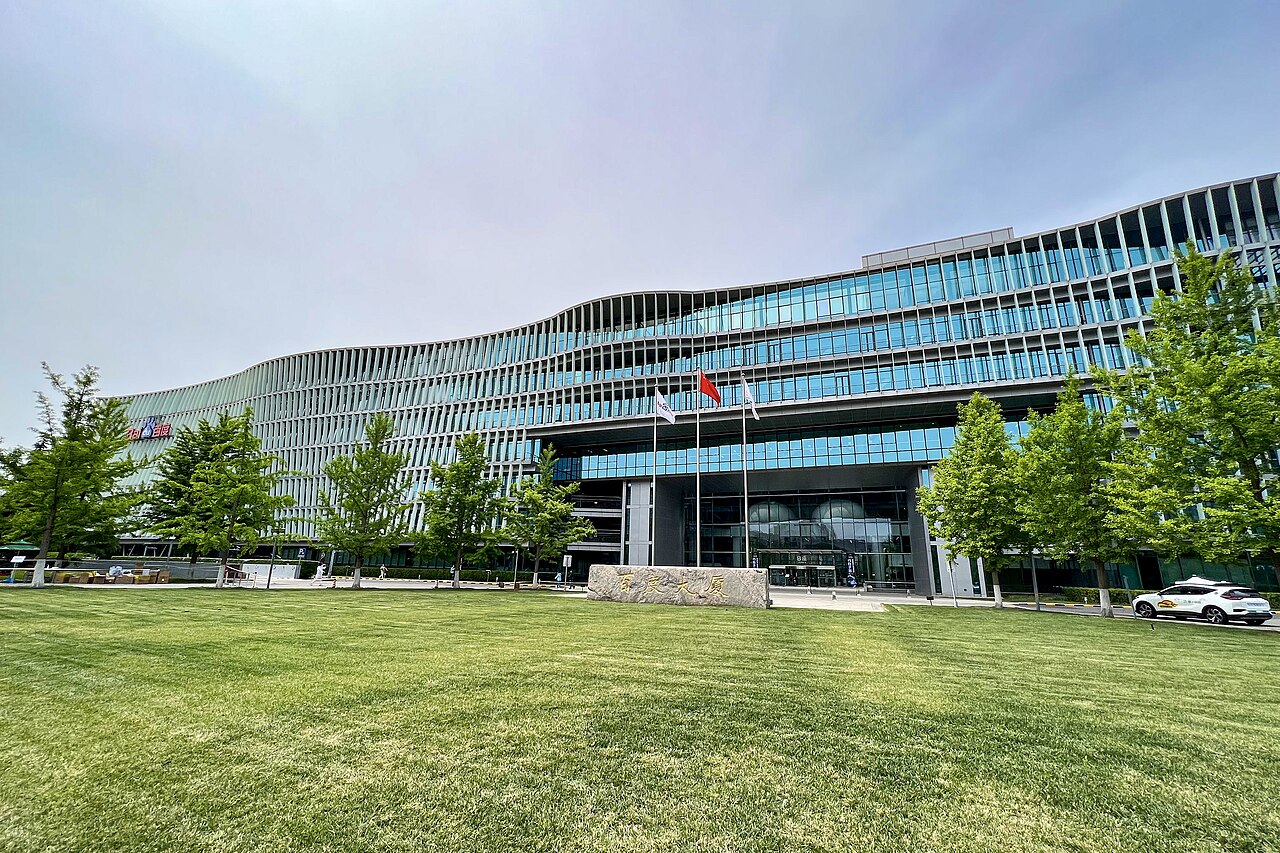
Image context: the cover uses a real Wikimedia Commons photograph of Baidu's Shangdi headquarters in Beijing. That visual register matters here because the article is about an institutional packaging choice. The real signal is a company taking one operating point from a giant model family and making it legible across public chat, playground, and enterprise entry surfaces.[6]
The official release changes the center of gravity from text rank to search-and-agent fit
The April 30 preview note was narrow and revealing. It said ERNIE-5.1-Preview ranked No. 1 among Chinese models and No. 13 globally on LMArena Text, then listed category placements in math, legal and government, business and financial operations, and software and IT services.[2] That framing told readers to see 5.1 as a cheaper text-first lane extracted from the much larger ERNIE 5.0 base.
The May 9 release keeps the same compression arithmetic, but it changes the lead signal.[1] Baidu now says ERNIE 5.1 scored 1223, ranking No. 4 globally and No. 1 among Chinese models on Arena Search.[1] It then foregrounds τ³-bench and SpreadsheetBench-Verified for agent performance, GPQA and MMLU-Pro for world knowledge, and AIME26 with tool use for reasoning.[1] Even before one debates the quality of each benchmark, the company's editorial choice is clear. Baidu no longer wants 5.1 to be read mainly as a general text-preference result. It wants the model tied to the kinds of tasks that sit closer to Baidu's own product surfaces: search, tool use, and task execution.[1][2]
That shift is not arbitrary. At Baidu World 2025, the company had already described ERNIE 5.0 as a natively omni-modal base tied to a broader application push, while also saying 70% of top-one Baidu Search results were already being presented in rich-media form and that the company's AI search APIs were being used by 625 partners.[4] In the same event materials, Baidu also stressed GenFlow 3.0 as a general agent and framed AI agents themselves as the most significant applications.[4] Read against that backdrop, the new ERNIE 5.1 release is less a stand-alone model announcement than a sharper alignment move: the smaller lane is now being positioned where Baidu already has distribution and product ambition.
The 5.0 technical architecture explains why Baidu can make this move
The technical bridge still matters. The ERNIE 5.0 Technical Report describes a unified autoregressive multimodal model trained across text, image, video, and audio with modality-agnostic expert routing inside an ultra-sparse MoE architecture.[3] More important for this release, the report says ERNIE 5.0 adopts an elastic training paradigm so that a single pre-training run can produce a family of sub-models with different depths, expert capacities, and routing sparsity, allowing tradeoffs among performance, model size, and inference latency.[3]
That makes the 5.1 compression story easier to interpret. The official May 9 note does not read like Baidu starting over with a separate small model line. It reads like Baidu extracting one commercially useful operating point from the broader 5.0 system and then deciding what that operating point should be famous for.[1][3] In April, the public answer was text ranking and cost shape.[2] In May, the public answer becomes search-and-agent competence with enough reasoning strength to keep the flagship aura intact.[1]
This is the part that distinguishes the current post from the earlier preview story. The preview proved that Baidu could point to a cheaper lane.[2] The official release tells us what the company thinks that lane is for. It is for search-heavy interaction, tool-using agent tasks, and broad public exposure without carrying the full conceptual weight of the giant 5.0 model in every user-facing context.[1][3]
The public surface is the point: ERNIE Bot, AI Studio, and an Agent-first platform frame
The official release closes with public availability language that matters more than it first appears. Baidu tells readers to use ernie.baidu.com to talk to the latest ERNIE 5.1 model and says Baidu AI Studio has already launched an ERNIE 5.1 Playground for hands-on experimentation.[1] The company's own AI platform homepage reinforces the same message in product terms: a homepage banner says "ERNIE 5.1 officially released! Search capability tops domestically, pre-training cost only 6% of the industry", while the same page describes Qianfan as an Agent-centered one-stop enterprise large-model service platform.[5]
Those details matter because they show a three-surface alignment. First, there is the direct public chat surface. Second, there is the builder or playground surface. Third, there is the enterprise platform surface that Baidu itself defines through an agent lens.[1][5] A lot of model launches never get past the first surface. Baidu is trying to move 5.1 across all three at once.
This is why the best ai-china reading is narrower than "Baidu released a better model." The stronger reading is that Baidu is trying to give the market a smaller public contract above the giant 5.0 base. Instead of asking developers and users to reason from omni-modal scale downward every time, it is asking them to start from a more digestible promise: this is the ERNIE lane for search, agents, and usable public entry.[1][3][5]
What still needs proof
The release is strong on directional signaling, but the production contract is not yet fully exposed in the materials cited here. Baidu's May 9 post highlights benchmark outcomes, but one of its strongest writing comparisons is explicitly an internal evaluation against Gemini 3.1 Pro.[1] The post also does not publish a full deployment note with latency envelopes, Qianfan pricing, or a detailed serving boundary for ERNIE 5.1 itself.[1][5]
So the clean conclusion is disciplined. Baidu has clearly changed the public meaning of 5.1 between April 30, 2026 and May 9, 2026.[1][2] It is no longer presenting the model mainly as a compact text-lane curiosity. It is presenting it as the public search-and-agent surface that makes the broader ERNIE 5.0 architecture easier to distribute. What remains to be proven is how completely that surface will be documented and productized for developers and enterprise buyers over the next release cycle.[1][3][5]
Sources
- ERNIE Blog, "ERNIE 5.1 Officially Released! Topping Multiple Leaderboards — A Model That Writes Better and Understands You More" (May 9, 2026; official release note covering parameter compression, Arena Search, agent benchmarks, reasoning claims, ERNIE Bot access, and the AI Studio playground).
- ERNIE Blog, "ERNIE-5.1-Preview Tops LMArena Text Leaderboard as No.1 Chinese Model!" (April 30, 2026; preview note covering the earlier text-first framing, category ranks, compression, and post-training language).
- Haifeng Wang and colleagues, "ERNIE 5.0 Technical Report" (arXiv:2602.04705; unified multimodal foundation, modality-agnostic expert routing, and the elastic-training family-of-submodels framework that makes a 5.1-style extraction legible).
- Baidu, "Baidu Unveils ERNIE 5.0 and a Series of AI Applications at Baidu World 2025, Ramps Up Global Push" (November 13, 2025; official event release covering ERNIE 5.0, AI search transformation, partner API usage, Qianfan access, and GenFlow's agent positioning).
- Baidu AI Open Platform homepage (accessed in May 2026; homepage banner for ERNIE 5.1 and product framing that describes Qianfan as an Agent-centered enterprise large-model platform).
- Wikimedia Commons, "File:Baidu headquarters at Shangdi (20220509112439).jpg" (source page for the real headquarters photograph used as the article image).