
As of 2026-05-12 UTC, the useful way to watch BytePlus's 74-second launch clip "Introducing Dreamina Seedance 2.0" is to stop treating it as one more AI-video beauty reel.[1] The video's own description is unusually explicit. It says Dreamina Seedance 2.0 is live through BytePlus ModelArk API, can create videos from text, images, audio, and clips, and is built around consistent characters, controlled motion, complex prompts, and multi-shot scenes inside a single workflow.[1] The official product page sharpens the same point from another direction: Seedance 2.0 is a professional multimodal video model built around multimodal references, video editing, and extension, with an emphasis on precise generation and reusable iteration rather than on one-shot spectacle.[2]
That framing matters in ai-china because a large share of commercial video-model marketing still invites the wrong reading. It encourages viewers to judge the system as if one breathtaking clip were the whole product. Seedance 2.0 keeps interrupting that habit. The video repeatedly cuts away from outputs into product-language cards such as "Physical Integrity," "Unified Multimodal workflow," "Create Once, Adapt Everywhere," and "Advanced intent Understanding and Reasoning."[1] Those are not decorative slogans. They are labels for control problems. BytePlus is telling the viewer that the value sits in how references enter the system, how shots can be extended or adapted, how motion obeys the scene, and how prompts survive contact with a longer workflow.
The supporting materials make that interpretation more defensible. BytePlus's marketplace listing emphasizes audio-visual alignment, cinematic narrative quality, and 5-10 second outputs designed for high-concurrency API usage, while the April 2026 technical paper presents Seedance 2.0 as a multi-modal audio-video joint generation system targeting 4 to 15 second video at 480p and 720p resolution.[3][5] Even the surrounding BytePlus explainers treat Seedance less as a novelty toy than as something that can serve film production, marketing, e-commerce, training, and developer/API integration contexts.[4] My inference from the video plus these written sources is that BytePlus is not mainly pitching a model with nicer clips. It is pitching a reference-control room where many kinds of assets can be routed through one repeatable production surface.[1][2][3][4][5]
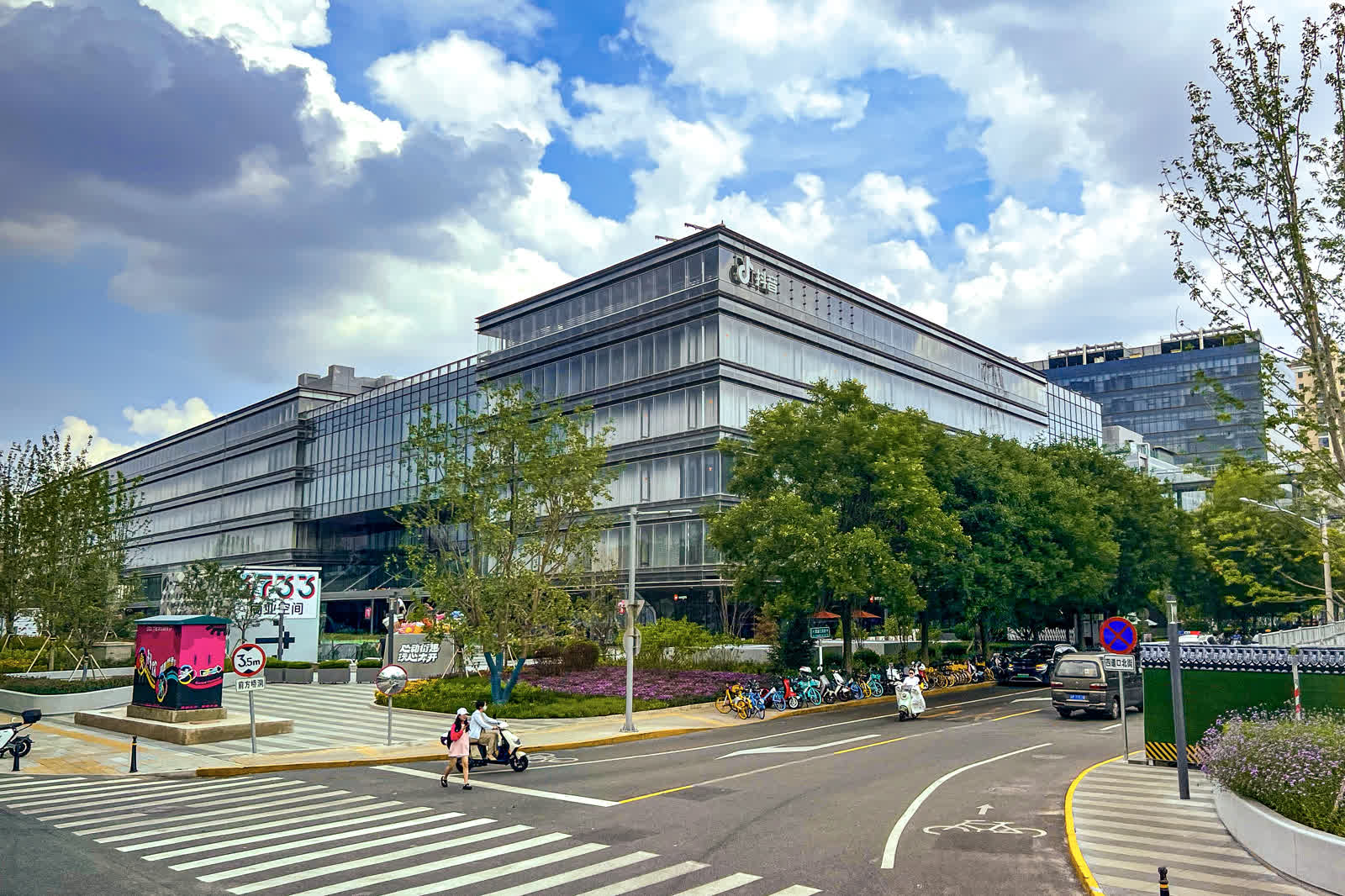
Image context: the cover uses a real Wikimedia Commons photograph of ByteDance's 1733 Commercial Space office complex in Beijing. That is the right visual here because the launch clip is about a company workflow, not a free-floating lab demo. The video's strongest claim is organizational: references, edits, extension, and audio-video synchronization now belong to a named surface that can be sold, documented, and reused.[6]
In the opening fight sequence, the model is being tested on obedience before it is judged on beauty
The video opens in a warehouse-like space with a woman walking forward while fighters rush into frame, followed by kicks, flips, close-range impacts, and fast camera movement.[1] That choice is revealing. BytePlus could have opened on a dreamy landscape or a slow cinematic portrait, where almost any frontier model can hide behind atmosphere. Instead it starts with bodily interaction and motion logic, then cuts to the "Physical Integrity" card.[1] The point is not that martial-arts imagery is inherently impressive. The point is that it is unforgiving. If body position, limb continuity, contact timing, or camera-space coherence break down, the failure is immediately obvious.
That is why the opening belongs to the article's main argument. Seedance 2.0 wants to be read as a controlled production system, so the first proof has to show that motion can stay legible under pressure.[1] The later written materials reinforce that emphasis in product terms rather than in cinematic language alone: BytePlus highlights synchronized audio-video behavior, usable output quality, and scalable API delivery, while the paper frames the system as a large-scale multimodal generation architecture rather than a one-off artistic trick.[3][5] In other words, the opening fight is doing systems work. It is showing that the model's first promise is not prettiness. It is obedience.
Around the middle, the "Unified Multimodal workflow" card reveals the real product boundary
The most important moment in the clip is not one of the flashy outputs. It is the card that lays out a collage of audio, video, and images under the phrase "Unified Multimodal workflow."[1] At that moment the whole launch becomes easier to read. Dreamina Seedance 2.0 is not being pitched as a text-to-video box with a few optional extras attached later. It is being pitched as a workflow where different reference types can enter at the start.
That reading aligns almost word-for-word with the video's own description, which says users can create from text, images, audio, and clips in one workflow.[1] The product page uses slightly different language but points in the same direction by stressing multimodal references and editing and extension capabilities.[2] The paper pushes one level deeper by describing a unified audio-video joint generation architecture designed for "world complexity," which is essentially a research way of saying that real creative tasks do not arrive as single clean prompts.[5]
This is where Seedance 2.0 distinguishes itself from simpler generator demos. A blank canvas is only one mode of commercial work. Agencies, game teams, brand studios, and internal communication teams often begin with existing stills, style references, stock clips, voice material, or partially finished assets.[4] By foregrounding multimodal intake, BytePlus is telling potential buyers that the model belongs inside that messier reality.
"Create Once, Adapt Everywhere" turns generation into asset extension
The next decisive move comes when the video cuts from stylized character work into the "Create Once, Adapt Everywhere" card and then shows city imagery, interface-like editing panels, and a prompt that asks the system to generate the in-between video from existing footage.[1] This is the point where Dreamina Seedance 2.0 stops looking like a model that merely produces clips and starts looking like a system for adapting clips.
That matters because extension and adaptation are where enterprise video economics actually change. The product page explicitly says Seedance 2.0 supports video editing and extension.[2] The use-case explainer broadens that commercial frame by placing Seedance inside marketing, e-commerce, training, and API-integration settings, all of which depend heavily on reusing and reworking existing assets instead of generating every output from zero.[4] The official marketplace listing also reinforces the same logic by presenting configurable output, high-concurrency API use, and short-form deliverables rather than only trophy samples.[3]
My inference is that BytePlus wants the viewer to internalize a workflow shift: the valuable object is no longer a single finished clip but a reference set that can be extended, infilled, reshot, reformatted, and re-synchronized without leaving the same system.[1][2][3][4] That is a much more durable commercial promise than "our videos look cinematic."
The closing prompt and hardware shots say the model is being sold as a prompt-digestion engine, not a magic wand
Late in the clip, the video flashes a long descriptive prompt block, then moves through clean hardware-style renders, a racing-mouse-like object with electric effects, and other deliberately varied visual contexts before returning to brand cards.[1] This section matters because it pushes the product away from the fantasy that a single short prompt can do all the work. BytePlus instead stages the opposite claim: the model should be able to hold up under denser instructions and varied scene demands.
That interpretation is grounded in the source trail. The YouTube description explicitly highlights complex prompts and multi-shot scenes.[1] The AWS Marketplace page describes audio-visual alignment, cinematic narrative quality, and configurable output parameters suited to API usage at scale.[3] The paper's title, "Advancing Video Generation for World Complexity," points to the same ambition in more formal language.[5] These are all different ways of saying that the commercial problem is not only generation quality. It is prompt digestion under real working conditions.
That is why the video's final effect is stronger than the usual launch montage. It does not simply say, "Here are some beautiful things we made." It says, "Here is a workflow that can ingest references, preserve continuity, adapt assets, synchronize sound, and survive denser instruction." In AI-China terms, that is the real signal. The competition is moving away from isolated wow clips and toward production surfaces where reliability, extension, and reuse matter as much as model aesthetics.[1][2][3][4][5]
Sources
- BytePlus, "Introducing Dreamina Seedance 2.0," official YouTube video, published April 14, 2026.
- BytePlus, "Dreamina Seedance 2.0 API Now Fully Available to Clients" (official product page describing multimodal references, video editing, extension, and reusable iteration).
- AWS Marketplace, "Dreamina Seedance 2.0" (BytePlus seller page highlighting audio-visual alignment, cinematic narrative quality, and 5-10 second high-concurrency API outputs).
- BytePlus, "Top 10 Seedance use cases across industries in 2025" (official explainer covering film, marketing, e-commerce, training, and developer/API integration contexts).
- Yingqing He and colleagues, "Seedance 2.0: Advancing Video Generation for World Complexity" (arXiv:2604.14148, April 2026).
- Wikimedia Commons, "File:ByteDance 1733 Commercial Space (20240731145554).jpg" (source page for the real ByteDance office photograph used as the article image).