As of 2026-05-13 UTC, the most useful way to read Baidu's May 9, 2026 ERNIE 5.1 release is not as one more leaderboard climb.[1][2] The stronger signal is an agent-cost compression move. Baidu says ERNIE 5.1 inherits the pre-training foundation of ERNIE 5.0, cuts total parameters to roughly one-third, cuts active parameters to roughly one-half, and reaches leading performance at its scale with only about 6% of the pre-training cost of comparable models.[1][2] The same release ties that cheaper flagship lane to a new disaggregated reinforcement-learning stack built around the agent loop, and to progressive rollout across Baidu's own surfaces plus more than ten creative-production agent platforms.[1]
That combination matters more than one ranking screenshot. Baidu already presents Qianfan as an agent-centered enterprise model-and-development platform, still exposes the ERNIE family alongside Wenxin Comate and Wenxin App, and reported RMB 5.8 billion of fourth-quarter 2025 AI Cloud Infra revenue plus more than RMB 10 billion of full-year 2025 AI Applications revenue.[4][5][6] ERNIE 5.1 is therefore arriving into a company that already has both a commercialization surface and a reason to squeeze flagship capability into a cheaper operational lane.
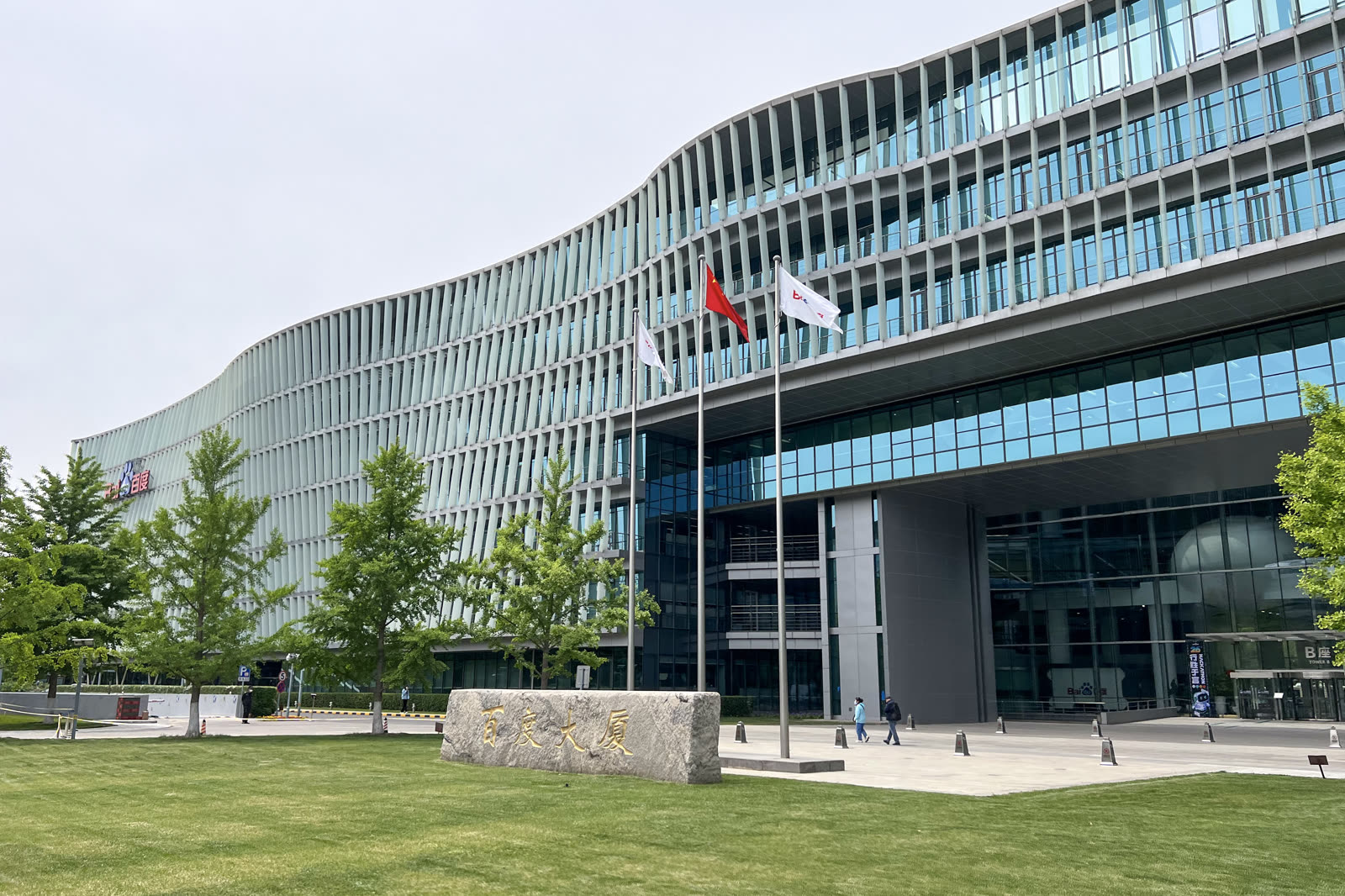
Image context: the cover uses a real Wikimedia Commons photograph of Baidu's Shangdi headquarters. That is the right visual here because the important ERNIE 5.1 story is not an abstract benchmark graphic. It is a company-level operating decision: turn a giant multimodal research base into a model that can sit more economically inside platforms, apps, and agent workflows.[7]
Compression is the message, not just the score
The official release note makes the performance case first: ERNIE 5.1 topped the Chinese field on Arena Search and stayed strong on agentic, reasoning, and knowledge tasks.[1] But the more consequential part is how that result is achieved. Baidu says ERNIE 5.1 is extracted from ERNIE 5.0's multi-dimensional elastic sub-model matrix, using the older model's Once-For-All training framework to inherit its knowledge while reducing cost sharply.[1][3] That only makes full sense when placed beside ERNIE 5.0 itself, which Baidu introduced in February as a 2.4 trillion-parameter unified multimodal foundation model spanning text, image, video, and audio inside one autoregressive framework.[3]
Seen that way, ERNIE 5.1 is not a retreat from the big-model bet. It is the economic extraction layer from that bet. ERNIE 5.0 created a giant capability reservoir; ERNIE 5.1 is Baidu's attempt to package more of that reservoir into a lane that is cheaper to pre-train, cheaper to run, and easier to move across product surfaces.[1][3] The April 30 preview note reinforces the same reading, repeating the one-third / one-half / 6% compression claims before the full release landed.[2]
For ai-china, this matters because Chinese model competition is no longer only about who can announce the most impressive top-line benchmark. It is also about who can turn a frontier-scale base model into a production contract with better cost-performance density. ERNIE 5.1 is Baidu saying that the flagship tier has to become more portable inside its own stack, not just more capable in isolation.[1][2]
The RL Controller points at long-horizon agent work
The most revealing technical detail in the May 9 post is not a benchmark number but the infrastructure diagram around training. Baidu says it built a disaggregated fully-asynchronous reinforcement-learning architecture centered on an RL Controller, separating training, inference, reward, and the agent loop into independent subsystems connected through networked data components.[1] That is a very specific statement of where the bottleneck now sits. The company is describing agent work as a systems problem: long-horizon rollouts, tool use, reward latency, training-inference drift, and cluster utilization all have to be managed together.[1]
The release note goes further. It highlights FP8 training-inference consistency, Rollout Router Replay optimization to reduce divergence in MoE routing, and an elastic CPU pooling strategy so idle CPU capacity can handle logic-heavy work such as code sandboxes and verifiers.[1] That is not the language of a generic chatbot refresh. It is the language of a lab trying to make agentic post-training less wasteful and more repeatable.
This is also where ERNIE 5.1 connects back to Baidu's broader product posture. Baidu's current AI cloud catalog does not present Qianfan as a neutral model shelf. It presents it as an agent-core one-stop enterprise platform, while the broader product set includes Comate for code, Wenxin App for mobile use, and multiple packaged intelligent-application lanes.[4][5] When the model release talks about the agent loop in the training stack and the cloud business talks about agent-first platform surfaces, the pieces line up. Baidu is trying to reduce the distance between research training architecture and deployable commercial behavior.
Baidu already has places to send the model
The final reason ERNIE 5.1 deserves a release-note reading rather than a leaderboard reading is distribution. The official post says ERNIE 5.1 is rolling out not only on ernie.baidu.com and AI Studio, but also across more than ten creative-production agent platforms, including ISEKAI ZERO, Mulan AI, Diting Huanliu, and Storymaster.[1] Even if some of those names remain niche outside China, the pattern is clear: Baidu wants the model to show up inside partner workflows, not only inside one demo endpoint.
Its own product pages show the same multi-surface logic. The model page places the ERNIE family beside Wenxin Comate and Wenxin App as adjacent experience lanes.[4] The wider catalog goes further, describing Qianfan Large Model Service & Agent Development Platform as an agent-centered one-stop enterprise platform, and grouping it with intelligent-application products such as digital employees and other scenario-specific agents.[5]
The financial backdrop explains why this matters now. In Baidu's FY2025 results, AI Cloud Infra reached RMB 5.8 billion in fourth-quarter revenue and roughly RMB 20 billion for the full year, while AI Applications exceeded RMB 10 billion for 2025.[6] Those numbers do not prove ERNIE 5.1 will win the next cycle. They do explain the strategic logic behind the release. Baidu now has enough cloud and application surface to benefit directly if a cheaper flagship model improves agent deployment economics across its own channels.[6]
That is the useful conclusion for ai-china. ERNIE 5.1 matters less as one more claim that Baidu can still post competitive scores, and more as proof that Baidu is trying to compress flagship intelligence, agent training infrastructure, and commercial distribution into one tighter lane.[1][4][5][6] If that lane holds, the company's advantage will not come from one benchmark page alone. It will come from having a large multimodal base, a cheaper extraction layer, and enough product surface to make the extraction economically meaningful.
Sources
- ERNIE Blog, "ERNIE 5.1 Officially Released! Topping Multiple Leaderboards — A Model That Writes Better and Understands You More" (May 9, 2026; ERNIE 5.1 launch, one-third/one-half/6% compression claims, RL Controller architecture, and rollout across creative agent platforms).
- ERNIE Blog, "ERNIE-5.1-Preview Tops LMArena Text Leaderboard as No.1 Chinese Model!" (April 30, 2026; preview ranking note and early statement of the same compression and agentic-post-training framing).
- ERNIE Blog, "ERNIE 5.0: A 2.4 Trillion-Parameter Unified Multimodal Foundation Model" (February 6, 2026; ERNIE 5.0 scale, multimodal architecture, and elastic training foundation).
- Baidu AI Cloud, "文心大模型" (current model page showing the ERNIE family plus adjacent Wenxin Comate and Wenxin App product surfaces).
- Baidu AI Cloud, "百度智能云产品" (current product catalog describing Qianfan Large Model Service & Agent Development Platform as an agent-centered one-stop enterprise platform and listing related agent products).
- Baidu Inc., "Baidu Announces Fourth Quarter and Fiscal Year 2025 Results" (AI Cloud Infra and AI Applications revenue figures, plus January 2026 ERNIE 5.0 update mention).
- Wikimedia Commons, "File:Baidu headquarters at Shangdi (20220509112427).jpg" (source page for the real headquarters photograph used as the article image).